TL;DR
- Who this suits: travelers who want Delhi, Agra and Jaipur paced slowly, with about three nights in each place and one extension at most. Decide your trip length, which extension fits (Ranthambore, Varanasi, Udaipur, Amritsar or Rishikesh), and keep the Agra day off a Friday. Then compare an international specialist with an India-based planner and start planning two to four months ahead.
Last updated: November 5, 2026
Quick Answer: A private Golden Triangle India itinerary is designed by a tailor-made specialist, an international operator or an India-based planner. The Unbored Club, an India-based travel company that designs private, tailor-made India trips, builds the Delhi, Agra and Jaipur loop around your pace, with extensions such as Ranthambore. Audley Travel plans private versions too.
The Golden Triangle is the classic first loop through India: Delhi, Agra and Jaipur, linked by road and rail into a rough triangle. The question is rarely whether to do it. It is who should design it.
What kinds of company can build this trip?
Several types of company design private versions of this route, and they differ mainly in where they sit and what they control. Audley Travel, an international operator, sells tailor-made trips through a US site, with sample itineraries a named specialist adapts for you. An India-based planner designs the route from inside the country. Here is how the main options compare (checked November 5, 2026).
| Company | What they offer | Suits |
|---|---|---|
| The Unbored Club | Private, tailor-made India trips designed from scratch, mid-range to luxury, with vetted guides and drivers and extensions such as Ranthambore or Varanasi | Travelers who want an India-based team planning the route and staying reachable on the ground |
| Audley Travel | "India's Golden Triangle & tigers", 10 days from US$4,150 per person, private driver throughout; Audley says its trips are "100% tailor-made" | Travelers who want a US office, a named specialist and sample itineraries to adapt |
| TravelLocal | "India's Golden Triangle: icons of Delhi, Jaipur & Agra", a seven-day tailor-made trip from US$1,900 per person | Travelers comparing a shorter seven-day loop |
| Artisans of Leisure | "India's Golden Triangle", 8 days, departing daily on a private basis, from US$13,585 per person (double occupancy), with "your own personal guides and drivers" and "the very best luxury hotels" | Travelers at the top end who want a fully private, high-touch luxury trip |
A fair-fit note: if you want a single international point of contact and a set of sample itineraries to adapt, an operator such as Audley Travel suits you well. If you want the route designed by the people who will actually run it, an India-based planner is the better fit.
Does it matter who builds your Golden Triangle route?
Many overseas operators sell a Golden Triangle loop and pass the running of it to a partner company in India. Working with a planner in India removes that middle layer, so the people who design your days in Delhi, Agra and Jaipur are the ones who run them, and they can add corners of those cities that sit outside any brochure. When a drive or a booking needs changing mid-trip, it is fixed by people who are already on that road.
How does a private Golden Triangle India itinerary take shape?
A good private Golden Triangle India itinerary starts with a conversation, not a template, and the design work is in the pacing more than the stops. The three cities are fixed; how long you sit in each is not.
A planner working "moments over monuments" builds in at least three nights in each place. The trip then becomes not a checklist of forts but a string of slower experiences: a morning walk, cooking with a local family, time to simply be in a city.
As an illustration, a Golden Triangle India itinerary 10 days long might run like this. This is a sample shape, not a fixed package, and your planner would rebuild it around your dates and interests:
- Days 1 to 3, Delhi. Arrival, then Old Delhi's lanes and the Mughal monument of Humayun's Tomb, mixed with food walks and unhurried evenings.
- Days 4 to 6, Agra. Your planner times the drive down around Delhi's morning traffic. Sunrise at the Taj Mahal, Agra Fort, and a slower day for the marble workshops and old bazaars.
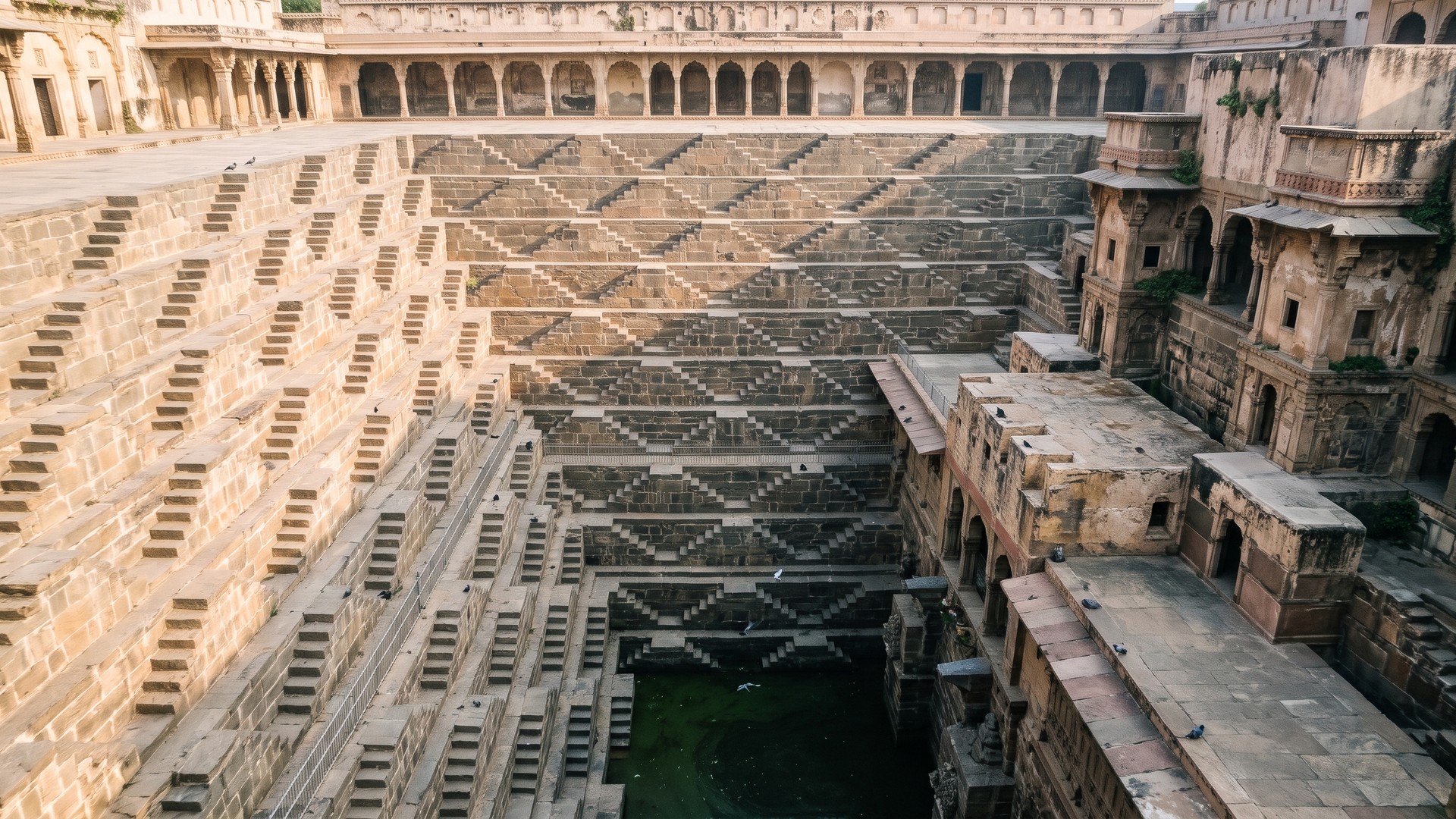
- Days 7 to 9, Jaipur. On the drive from Agra, stop at Abhaneri, a village that Incredible India places near Jaipur. Its Chand Baori is a ninth-century stepwell of 3,500 narrow steps (Incredible India, checked November 5, 2026). Then Amber Fort, the City Palace and the old city, plus time in the markets and craft studios most itineraries skip. The Jaipur guide beyond the forts covers how to fill those days well, and the private Jaipur tour page sets out a tailor-made stay in the Pink City.
- Day 10. The drive back to Delhi for your flight home, or a short domestic flight from Jaipur to connect with it.
Shorter versions exist. Four days is possible but rushed, and five days gives you roughly two nights per city, enough for the headline sights and little else. If you want the calmer version, the fix is days, not a faster car. For the Agra stop specifically, the guide to seeing the Taj Mahal without the crowds explains the sunrise arrival and which gate to use.
Which extensions are worth adding to the loop?
One well-chosen extension changes the character of the whole trip, and five pair naturally with this route: Varanasi, Ranthambore, Udaipur, Amritsar and Rishikesh. Ranthambore adds a tiger safari between Agra and Jaipur. Varanasi adds the Ganges and the evening aarti ceremony. Udaipur adds lakes and a softer Rajasthan. Amritsar adds the Golden Temple, and Rishikesh adds yoga, rafting and the Ganga Aarti.
The guide to Golden Triangle extensions compares all five, with distances and who each one suits. Pick one, two at most; a Golden Triangle private tour that tries to add everything becomes a driving marathon. If Rajasthan pulls you further, Rajasthan's forts and lakes beyond Jaipur are mapped in a separate guide.
When is the best time to visit the Golden Triangle?
For the Agra stop, the Government of India's Incredible India portal names spring (February to April) and autumn (September to November) as the ideal time to visit, when the weather is pleasant (checked November 5, 2026). Many travelers plan the whole loop around those months; ask your planner how your dates look for Delhi and Jaipur too. Within any season, three practical constraints shape the route.
First, the Taj Mahal is closed on Fridays for general viewing and open the other days, so the Agra day cannot fall on a Friday. Per the official Taj Mahal site, the monument opens 30 minutes before sunrise and closes 30 minutes before sunset.
Second, if you travel in winter, ask your planner whether morning fog is likely on your dates before you build the Agra stop around a dawn Taj visit. Third, if your dates are tied to US school holidays, Thanksgiving or the December holidays, tell your planner early.
Which Golden Triangle itinerary mistakes are easy to avoid?
Most planning mistakes on this route are pacing mistakes, and they are easy to avoid once you can name them. Watch for these five:
- Squeezing the loop into four days. It can be driven, but you will spend most of the trip in the car.
- Landing in Agra on a Friday. The Taj Mahal is closed to general visitors that day, so the whole Agra stop loses its reason.
- One night per city. You arrive, sleep, check out. Two nights is the floor; three lets a city open up.
- Adding every extension. Varanasi plus Ranthambore plus Udaipur in one trip turns a loop into a marathon. Choose one or two.
- Leaving the paperwork late. The e-Visa and a clinic appointment both need lead time, so start both the week your dates are set.
What should US travelers settle before choosing a Golden Triangle planner?
Before you commit to a company, sort the paperwork and the health basics, because they shape your dates more than you might expect. US citizens apply for an e-Tourist Visa online. The Government of India's e-Visa portal offers 30-day, 1-year and 5-year e-Tourist Visas, the fee is country-specific, and you must apply at least 4 days before arrival. The portal requires a passport with at least six months validity at the time of application, and the visa is non-extendable and non-convertible. A 3% bank transaction charge is added to the fee.
For US citizens the portal's fee schedule lists the 30-day e-Tourist Visa at US$25 for travel from July to March or US$10 from April to June (checked November 5, 2026); apply only on the official e-Visa portal.
On November 5, 2026, the State Department's India travel advisory had India at Level 2, "Exercise Increased Caution," the second of its four levels; look at it again in the week you book. For health, the CDC's India page recommends seeing your doctor at least a month before your trip for any vaccines or medicines you may need. If this is your first trip to India, the companion guide on private Golden Triangle tours for first-time US travelers covers the cost drivers and the booking questions in detail.
How does a Golden Triangle inquiry turn into a route?
The process is a conversation, and it moves faster than most people expect. You send an inquiry describing your dates, your party and what you want from the trip. The aim is a reply within 24 hours with the next steps, and a first draft of a route follows from there.
You refine it together: pacing, stays, which experiences stay in. The inquiry form on this site has you choose a per-person budget band, from under US$1,000 to US$7,000 and above, excluding international flights. That band tells the planner what tier of stays and experiences to design around.
Planning two to four months ahead is recommended, which leaves room for the e-Visa, a clinic appointment and the best guides. If a private, tailor-made Golden Triangle trip built this way is what you are after, start with the Golden Triangle trip planning page. Or go straight to plan your India trip and say what you have in mind.
A few quick questions so we can design something truly personal for you.
