TL;DR
- This guide helps you choose which parts of Rajasthan to see rather than trying to see all of it. Decide on the mix first: forts, lakes, desert, quiet towns or a wildlife detour, then pick three or four bases with at least three nights each. Winter months suit almost every stop, while a Ranthambore safari needs its October-to-June season. Then turn the list into one route.
Last updated: November 2, 2026
Quick Answer: The places to visit in Rajasthan fall into four kinds: fort cities, lakes, desert and quiet towns. Jaipur, Jodhpur and Jaisalmer carry the forts; Udaipur holds the lakes; Bundi and Pushkar slow things down, and The Unbored Club can link any of these into one private route at your pace. Six hill forts share one UNESCO World Heritage listing.
Rajasthan rewards travelers who choose a theme rather than a checklist. The same state holds hill forts whose walls run up to about 12 miles (20 kilometers) around, palaces that rise out of lakes, and a desert city whose fort is still lived in. This guide groups the state's sights by what they are for, then shows how they fit into one route.
Which places to visit in Rajasthan suit which kind of trip?
| Place | What it is | What it suits |
|---|---|---|
| Jaipur | The state capital, a planned city of palaces | First-time visitors, forts and bazaars |
| Amber Fort | Hilltop fort-palace, palace begun in 1592, 7 miles (11 km) from Jaipur | A half-day trip from Jaipur |
| Jodhpur | The Blue City under Mehrangarh Fort | Photography, food, a slower pace |
| Udaipur | Lake palaces in the Aravalli hills | Couples, a restful few days |
| Jaisalmer | A living desert fort and the Thar | A night in the desert |
| Ranthambore | Tiger reserve with a 10th-century fort | A wildlife detour south-east of Jaipur |
| Pushkar | Pilgrim town around a sacred lake | The camel fair in October or November |
| Bundi | Quiet town of stepwells and murals | Travelers avoiding crowds |
| Chittorgarh | Hill fort of three great sieges | History, a day between Udaipur and Bundi |
| Bikaner | Never-captured Junagarh Fort | A northern loop with Shekhawati |
| Mount Abu | The state's only hill station | Jain temples, a cooler end to a route |
Which fort cities should be first on a Rajasthan route?
Start with Jaipur, Jodhpur and Jaisalmer, because they carry the state's fort story between them. Jaipur was founded in 1727 by Jai Singh II and, as the state tourism department notes, was the first planned city of India; the story goes that its old core was painted pink in 1876 for a visit by the Prince of Wales.
Jodhpur, founded in 1459, is known as the Blue City because most of its houses and havelis are built in shades of blue, and Mehrangarh Fort rises 410 feet (125 meters) above its skyline. Jaisalmer, founded in 1156, sits close to the Thar Desert.
UNESCO inscribed six of Rajasthan's hill forts together as one World Heritage serial site: Chittorgarh, Kumbhalgarh, the fort at Sawai Madhopur, Gagron in Jhalawar, Amber at Jaipur, and Jaisalmer.
The forts reflect the power of Rajput princely states from the 8th to the 18th centuries, and their walls enclose palaces, temples and trading centers. The forts contain extensive water harvesting structures, many of which are still in use. In Jaipur, the capital, Amber Palace, begun in 1592, plus the City Palace and the Jantar Mantar observatory, itself a separate World Heritage Site, fill two full days without rushing.
Where do Rajasthan's lakes and palaces fit in?
Udaipur is the lake stop. The state tourism department describes it as a city of lakes hemmed in by the Aravalli hills, founded in 1553 by Maharana Udai Singh II as the capital of the Mewar kingdom.
The Lake Palace, now a hotel, sits in the middle of Lake Pichola, the City Palace stands on its bank, and Jaisamand Lake nearby is claimed to be the second largest man-made fresh water lake in Asia. The city suits the middle or end of a route, when you want boat rides and palace courtyards instead of another climb up a fort wall. For how long to stay and what the palaces cost, the Udaipur lake city guide covers the city slowly and in detail.
Pushkar is the other lake town, built around a sacred lake. Its Brahma temple is one of the very few in the world dedicated to that god, and the oldest of them according to the Ministry of Tourism's Incredible India guide. The Pushkar Camel Fair takes place each year in October or November, and builds up to the full moon of Kartik Purnima, which falls on November 14 in 2027 according to the Drik Panchang almanac; there is no entry ticket. In Udaipur, the ten-day Shilpgram arts and crafts festival runs December 21 to December 30.
What does the desert side of Rajasthan offer?
Jaisalmer is the gateway to the Thar Desert, in the far west of the state. The state tourism department calls it the Golden City. Its fort, Sonar Qila, is not just a monument: it houses shops, hotels and havelis where generations continue to live, with Jain temples inside the walls dating from the 12th to the 15th centuries.
A typical desert excursion is a camel or jeep ride out to a dune at sunset, dinner and folk music at a tented camp, and a night under a desert sky. The experience varies a lot with the operator, so the camp and the route matter more than the price; the desert safari guide explains how to tell the two versions apart.
Beyond the fort, the Jaisalmer region holds the Desert National Park, home to the Great Indian Bustard, one of the world's heaviest flying birds. About 11 miles (18 kilometers) away lies Kuldhara, a village its residents abandoned in the 1800s.
Can you see tigers between the forts?
Yes. Ranthambore National Park lies near Sawai Madhopur, a detour south-east of Jaipur, best taken before you head west to Jodhpur. The state tourism department describes it as one of the world's best-known wilderness areas and a former private game reserve of the royal House of Jaipur. The park is open from October to June, and the department advises making safari reservations in advance through the official forest portal.
The reserve also shelters sloth bear, leopard, caracal, jackal and hyena, and a 10th-century fortress dominates the landscape inside it. No operator can promise a tiger sighting, so treat the park as a morning in a dry-deciduous forest with a fort in it, and any big cat as a bonus.
Which forts are worth a detour beyond the big three?
Chittorgarh is the one most travelers wish they had made time for. Rajasthan Tourism describes its fort standing on a 590-foot (180-meter) hill and spreading across 700 acres, and it records three great sieges: by Ala-ud-din Khilji in 1303, by Bahadur Shah of Gujarat in 1533 and by the Mughal emperor Akbar in 1568. Inside the walls, the nine-story Vijay Stambh, or Tower of Victory, was built by Maharana Kumbha between 1440 and 1448.
Kumbhalgarh, about 52 miles (84 kilometers) north of Udaipur in the Aravalli hills, was built by Rana Kumbha in the 15th century and is the birthplace of Maharana Pratap, according to the state tourism department. UNESCO notes that it was built in a single process and that its design is attributed to a named architect, Mandan, who worked at Rana Kumbha's court. The Neelkanth Mahadev temple inside the fort, built in 1458, hosts a light and sound show in the evening.
Bikaner, in the north of the state, is the fort city most routes skip. Its Junagarh Fort was built in 1588 by Raja Rai Singh and, as Rajasthan Tourism puts it, has never been captured. The red sandstone Lalgarh Palace followed in 1902, designed by Sir Swinton Jacob in a blend of Rajput, Islamic and European styles. Near the city at Deshnok, the Karni Mata Temple is known for the rats that roam freely in its precincts, a place of worship rather than a curiosity, so dress and behave as you would at any temple.
Which quieter towns reward a slower trip?
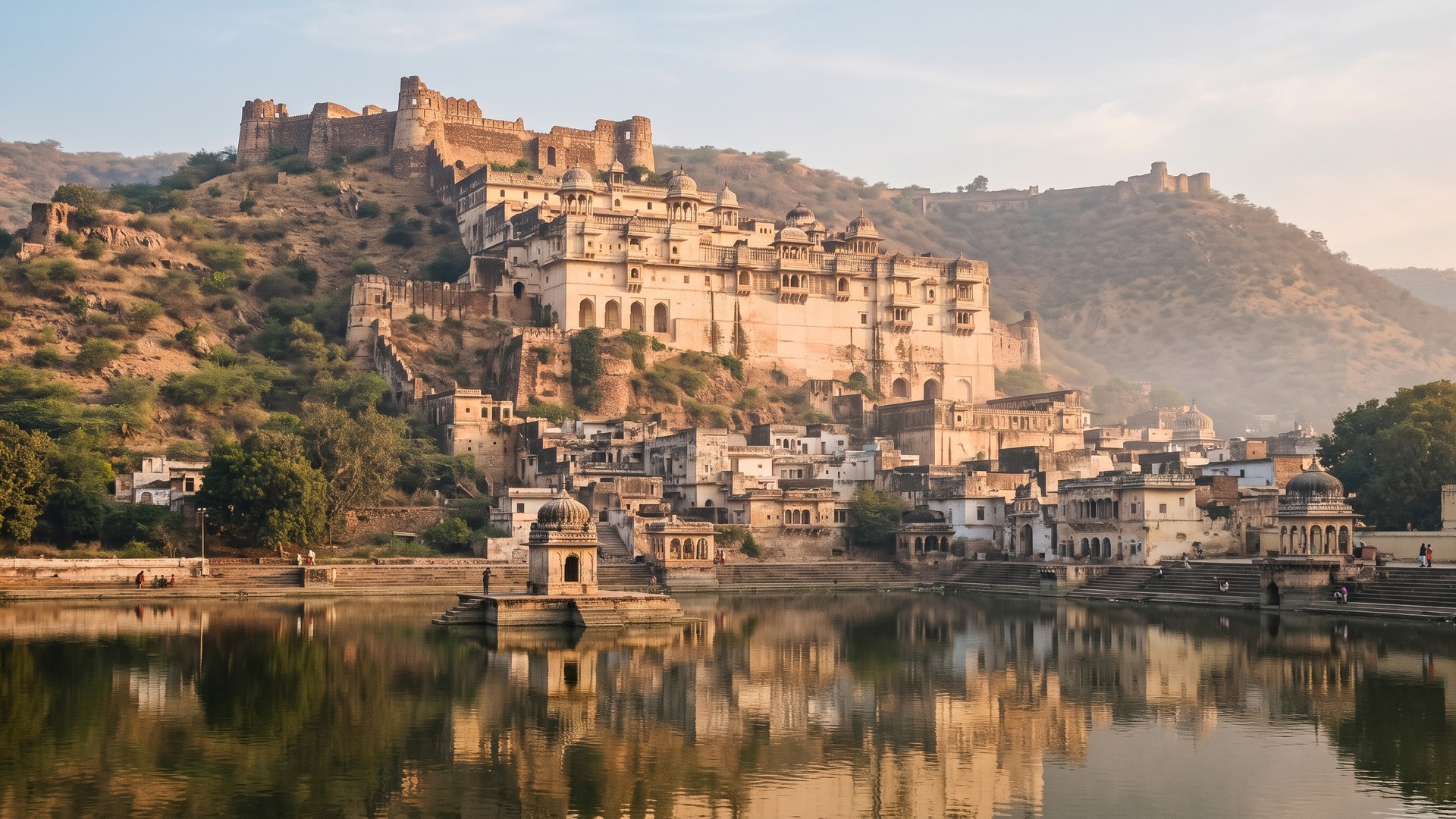
Bundi, around 22 miles (36 kilometers) from Kota, is the town for travelers who want murals and stepwells without the crowds. Rudyard Kipling is popularly believed to have written part of Kim at its Sukh Mahal, and Raniji ki Baori, the Queen's Stepwell built in 1699, is carved with elephants on its pillars.
Shekhawati, the region made up of Sikar, Jhunjhunu and Churu in the north of the state, is known for its painted havelis, the grand merchant mansions whose walls carry murals. In Churu, the Kanhaiyalal Bagla Haveli, built around 1880, shows the folk lovers Dhola and Maru escaping on a camel. Three nights here sit well between Delhi and Bikaner.
Mount Abu, at about 5,650 feet (1,722 meters), is the state's only hill station, according to the state tourism department. The Dilwara Jain temples, about 1.5 miles (2.5 kilometers) from town, are a complex of five white marble temples built between the 11th and 13th centuries, and Nakki Lake offers boat rides at sunset. It suits the end of a route out of Udaipur, when the plains feel hot.
When should travelers from the US plan a Rajasthan trip?
For travelers from the US, Delhi is the usual international gateway and Jaipur the first stop of the route. The cooler months line up well with American holidays. A November trip can take in the Pushkar fair, which builds up to the full moon on Sunday, November 14, 2027, 11 days before Thanksgiving. The December holidays overlap Udaipur's Shilpgram festival (December 21 to 30) and Mount Abu's winter festival in December. Spring break still falls inside Ranthambore's October-to-June season.
For paperwork, US citizens file for an e-Tourist Visa online through India's official e-Visa portal, which accepts applications at least 4 days before arrival. The State Department's India travel advisory belongs on the same booking checklist.
Which places to visit in Rajasthan work in December and January?
If you are weighing places to visit in Rajasthan in December or in January, the answer is almost all of them, and the safari and festival calendar shows why. Ranthambore's season runs October to June, so December and January work for everything: forts, lakes, desert camps and safaris. Late-December travelers can also take in the Shilpgram Festival in Udaipur, which runs December 21 to 30, while November visitors can catch the Pushkar fair, held each year in October or November around Kartik Purnima.
What are the common mistakes in choosing Rajasthan places?
- Trying to cover too much. Six cities in ten days means you see highways and hotel lobbies. Three or four bases, with at least three nights each, work better.
- Skipping the quiet towns. Bundi and Pushkar move slower and often leave stronger memories than a fifth fort.
- Booking safaris late. The state tourism department itself advises advance reservations for Ranthambore, whose season runs October to June.
- Underestimating distances. The cities you want are spread across the state; a train on the longest legs saves a full day of driving.
- Visiting forts at midday. Amber and Mehrangarh are at their best early in the day, before the crowds arrive.
- Ignoring the calendar. A route built around a Ranthambore safari needs the park's October-to-June season, and desert camps are at their best in the cooler months.
How do you fit these places into one route?
A classic route runs Delhi to Jaipur, then Ranthambore or directly to Jodhpur, on to Jaisalmer for the desert, and south to Udaipur, with Pushkar or Bundi as a stop on the way back toward Delhi. Two weeks covers that comfortably. If you have ten days, drop either Jaisalmer or Udaipur rather than shaving every stop to one night.
The Unbored Club, an India-based travel company that designs private, tailor-made India trips, builds routes like this around your pace rather than a fixed template, and its Rajasthan planning page is the place to start a conversation about yours. With no overseas operator between you and the team planning the route, more of your budget reaches the havelis, drivers and guides you actually meet. For a day-by-day version, see the two-week Rajasthan itinerary.
Already mapping cities onto a calendar? Tell us how you like to travel, and the route is designed from scratch around your dates and pace.
A few quick questions so we can design something truly personal for you.
