A good two-week Rajasthan itinerary is built around four cities and the roads between them: Jaipur for its forts, Jodhpur for its blue old town, Jaisalmer for the desert, and Udaipur for its lakes. Two weeks is enough to do those four properly, with a stop at the pilgrim town of Pushkar on the way, without the trip turning into a race between hotels.
This guide sets out that route in detail. It is written for someone flying in from London, Frankfurt, New York or Melbourne who has never travelled in India, does not yet know a haveli, a traditional mansion, from a chhatri, a domed pavilion, and reasonably wants to know how far things are, what it costs, and whether it will be comfortable. I run these trips for a living, so the distances and pacing here are the ones I actually use, not the ones that look neat on a map.
Why build a trip around a Rajasthan itinerary?
Rajasthan is the India most first-time visitors already have in their heads: desert forts, painted cities, palaces on lakes, camels on dunes. The difference between a good trip and a tiring one is almost entirely pacing. This route covers roughly 1,200 kilometres, about 750 miles, over two weeks, which is sensible for the region.
In a fortnight you move through a walled pink city, a blue-painted old town under a cliff-top fort, a golden desert fortress and a lake city of white palaces, never far from a fort, a thali (a platter of many small dishes eaten together) or a rooftop at sunset.
Which cities should a Rajasthan itinerary include?
For a first two-week trip, the core is Jaipur, Jodhpur, Jaisalmer and Udaipur, with Pushkar added as a short stop between Jaipur and Jodhpur. That gives you the forts, the desert and the lakes in one clean loop.
The common temptation is to add Bikaner, Ranthambore, Mount Abu and Shekhawati to the same fortnight. Each is worth seeing, and each is a reason the trip stops working. Ranthambore, the tiger reserve, pulls you east, away from this western loop, so it belongs on a longer trip. If the classic north is also on your list, our North India itinerary pairs naturally with this one.
Is two weeks enough for a Rajasthan itinerary?
Two weeks is close to ideal for this route. Once you allow a day for a long-haul arrival and a day for departure, you have roughly twelve usable days, enough for four cities at two or three nights each.
What two weeks does not allow is all of Rajasthan. The state is larger than England, and the most common planning error I see is a fortnight carved into seven or eight stops with a long drive every day. Fewer places, more nights, is almost always the better trip.
We plan private two-week Rajasthan journeys with realistic drive days, heritage stays, a night in the Thar and specialist local guides in each city. The route is built around your pace, and our team stays on hand while you travel. Plan a private Rajasthan trip.
Which airports should you fly into and out of?
Fly into Delhi or Jaipur, and out of Udaipur. Booking a multi-city or open-jaw ticket rather than a return into one city saves you a long backtrack at the end, and usually costs little more.
Jaipur (airport code JAI) takes direct and one-stop flights from the Gulf and parts of Europe and Southeast Asia, and is the tidiest entry point because the route begins there. Delhi (DEL) has far more long-haul options, and sits about 280 kilometres, roughly 175 miles, from Jaipur: five to six hours by road, or around four and a half to five hours on a fast train. Udaipur (UDR) handles the exit, with domestic flights to Delhi and Mumbai that connect onward.
Most flights from Europe and the Gulf land in the small hours. Book your first hotel night for the day before you land, so the room is yours on arrival rather than mid-afternoon.
The two-week Rajasthan itinerary at a glance
Nights are listed rather than days, because nights are what you book. This eleven-night spine leaves room inside two weeks for a slow arrival and a buffer day.
- Jaipur: 3 nights. The walled Pink City, Amber Fort, crafts.
- Pushkar: 1 night. A small lakeside pilgrim town, on the way to Jodhpur.
- Jodhpur: 2 nights. The Blue City under Mehrangarh Fort.
- Jaisalmer: 2 nights, one in a desert camp. The golden living fort and the Thar.
- Udaipur: 3 nights. Lakes, palaces and a gentle finish.
Days 1 to 3: Jaipur, the Pink City
Jaipur is where the trip begins and where you find your feet: a planned eighteenth-century city, its old quarter painted terracotta pink and laid out on a grid, which makes it unusually legible for a first Indian city and a UNESCO World Heritage Site in its own right.
If you land at three in the morning, sleep. Later, give the old city a slow first day: the Hawa Mahal, the five-storey honeycomb facade of pink sandstone built so royal women could watch the street unseen; the City Palace; and the Jantar Mantar, an eighteenth-century observatory of giant stone instruments that still tell the time. Eat a pyaaz kachori, a fried pastry stuffed with spiced onion, from an old-town sweet shop.
Keep the second morning for Amber Fort, the great hilltop palace-fort just outside the city and one of the Hill Forts of Rajasthan recognised by UNESCO. Foreign-national entry is ₹500, about USD 5 or GBP 4, and it opens from 8:00 in the morning, with last entry at 5:00 in the afternoon. Go early, before the heat and the crowds. A two-day composite ticket at ₹1,000 for foreign visitors, about USD 10 or GBP 8, also covers Hawa Mahal, Jantar Mantar and Nahargarh Fort. Entry fees change, so confirm the current rate at the gate.
What makes Jaipur more than a list of monuments is its craft: block-printed cloth, blue pottery, hand-cut gemstones. The afternoons I remember here are not the forts, they are the ones spent in a printing family's courtyard in a village outside the city, pressing a carved wooden block into dye and getting the registration slightly wrong, then right. A dawn walk down into the Panna Meena ka Kund, a sixteenth-century stepwell of criss-crossing staircases near Amber, before the fort opens, is worth more than another palace.
Days 4 and 5: Pushkar and the road to Jodhpur
Leave Jaipur and drive southwest to Pushkar, about 150 kilometres away, roughly 95 miles, around three hours. It is a small town wrapped around a sacred lake, with one of the few temples to Brahma anywhere and a long, browsable bazaar.
Pushkar runs on ritual. In early November you may catch the Pushkar Camel Fair, a vast livestock market and festival, though the town is busy and prices rise then. On an ordinary day the pleasure is quieter: a havan, a small fire ceremony with chanting and offerings at dusk, a walk through the dunes at the town's edge, and the meditation caves in the hills above the lake. The ghats around the lake, the stepped bathing banks, are places of worship, so dress modestly and ask before photographing anyone.
The next morning, continue to Jodhpur, about 185 kilometres, roughly 115 miles, three and a half hours south, the landscape drying and opening as you go.
Days 6 and 7: Jodhpur, the Blue City
Jodhpur is the Blue City, named for the indigo-washed houses that cluster below its fort, and it is the point where many people fall for Rajasthan. The colour makes more sense from above than from within its tangle of lanes.
Above it all stands Mehrangarh, one of the most impressive forts in India, rising straight out of a rock cliff. Foreign-national entry is ₹600, about USD 6 or GBP 5, which includes an audio guide, and it opens daily from 9:00 to 5:00. The ramparts give you the view every photograph of Jodhpur is taken from: a sea of blue cubes spreading to the desert. A good local guide earns their fee here, turning the walk into the story of a desert kingdom.
Below the fort, Jodhpur is a food town. A walk through the old city, stopping for a plate of dal baati churma, the Rajasthani staple of lentils, baked wheat balls and a sweet crumble, is the best introduction to Marwari cooking. One evening I would spend out of town, at a farm where dinner is foraged and cooked in front of you, millet roti off an open fire under a sky with no city in it. That meal tells you more about Rajasthan than any buffet.
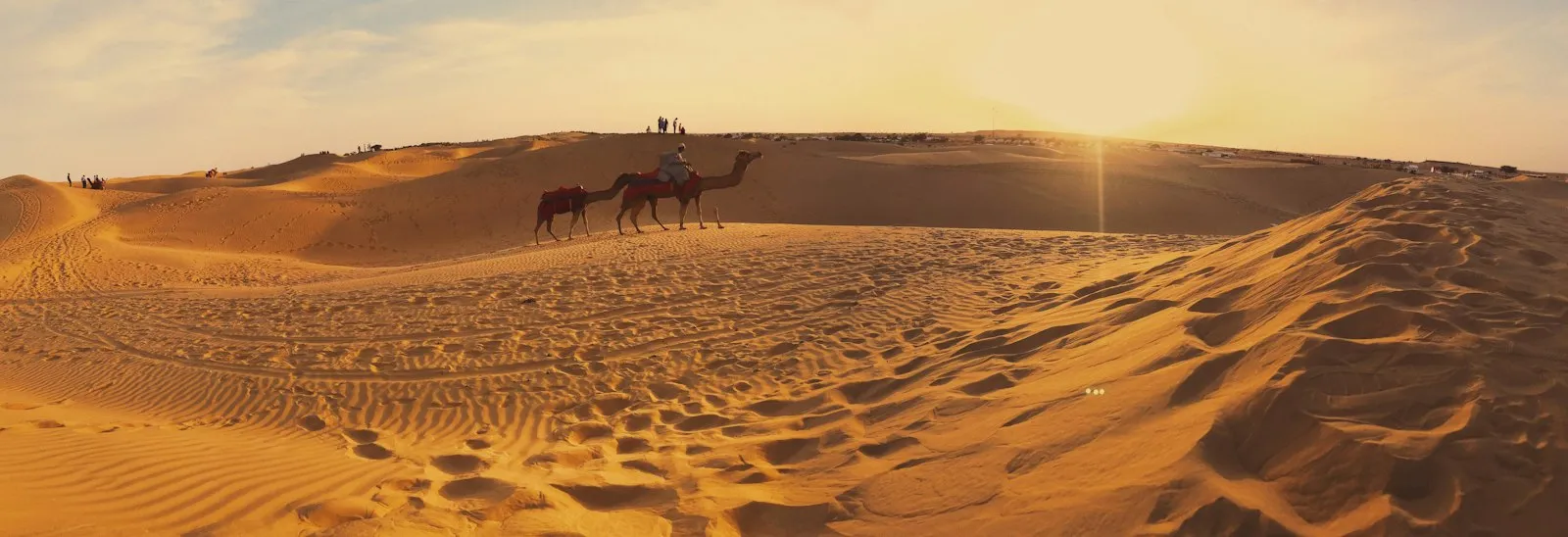
Camels on the dunes of the Thar Desert near Jaisalmer.
Days 8 and 9: Jaisalmer and the Thar Desert
From Jodhpur, drive deeper into the desert to Jaisalmer, about 285 kilometres, roughly 175 miles, five hours west. The city is built of golden sandstone, and its fort glows at dawn and dusk, earning the name the Golden Fort.
Jaisalmer Fort is one of the last living forts in the world: around three thousand people still live inside the walls, among shops, temples and homes, so you walk its lanes rather than tour a ruin. Entry to the fort is free. The Fort Palace museum charges foreign visitors ₹250, about USD 2.60 or GBP 2, and opens from 9:00 to 6:00, and the carved Jain temples inside are free to enter. Outside the walls, the havelis, old merchant mansions with stone facades carved as fine as lace, are the other reason to come.
Spend one of your two nights in the desert. A camp on the dunes near Sam or Khuri, a camel ride at dusk, dinner under the stars and a night away from any light is the experience most people fly to Rajasthan for, and our guide to desert safaris in Rajasthan covers how to choose one. On the best of these nights an astronomer sets up a telescope on the sand and walks you through a sky you cannot see from a city. One safety note: Jaisalmer sits near the India-Pakistan border, and the FCDO advises against all travel within 10 kilometres of that border, so use a reputable operator who keeps excursions well inside the permitted area.
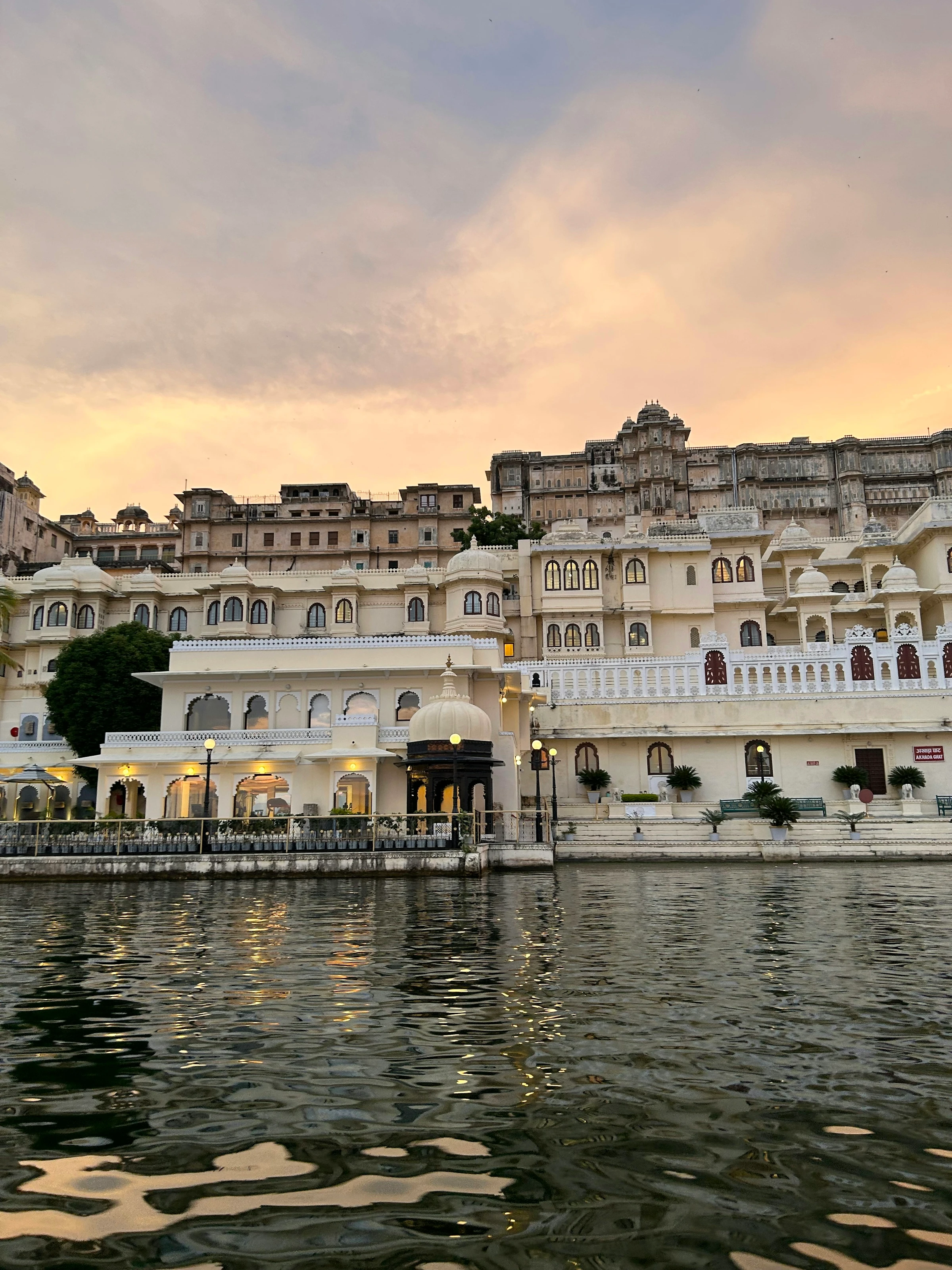
The City Palace on the banks of Lake Pichola, Udaipur, at golden hour.
Days 10 to 12: Udaipur, the Lake City
The drive from Jaisalmer to Udaipur is the longest of the trip, around 490 to 530 kilometres, roughly 305 to 330 miles, and eight to nine hours. I break it rather than drive it in one push, usually with a stop at the Jain temples of Ranakpur, a forest of nearly 1,500 carved marble pillars, no two alike. Routing back through Jodhpur instead shortens the final Udaipur leg to about 260 kilometres, 160 miles, four to five hours.
Udaipur is the softest city in Rajasthan and the right place to end, built around lakes, with white palaces reflected in the water and the Aravalli hills behind. The City Palace complex, a sprawl of courtyards and balconies above Lake Pichola, charges a modest museum entry of a few hundred rupees per person; confirm the rate at the gate. In the evening, the Dharohar folk show at Bagore ki Haveli, a restored lakeside mansion, puts on Rajasthani dance and puppetry in a candle-lit courtyard, and it is unpretentious and genuinely good.
The thing to do in Udaipur is slow down. Take a boat out on Lake Pichola at sunset, when the light turns the palaces amber and the hills go violet. Spend a morning learning to cook a Mewari meal in a family kitchen, the royal mutton curry laal maas among the dishes, rather than eating it in a hotel. By the third day you will have stopped sightseeing and started living there a little, which is the point of two weeks rather than one.
Days 13 and 14: The last day and flying home
Udaipur airport is about 25 kilometres, 15 miles, from the lake, roughly forty-five minutes, so there is no long transfer to dread. Keep the last full day for whatever you underbooked: the Sajjangarh Monsoon Palace above the city, or a rooftop and a book.
Leave three and a half hours before an international connection through Delhi or Mumbai, where domestic and international terminals are sometimes separate buildings.
How do you actually get around Rajasthan?
For this route, a private car with a driver is the most practical way to travel on most days, with trains a good alternative on one or two legs. You do not need domestic flights within the loop.
Private car and driver
This is the normal way visitors cover ground in India, not a luxury. It is an air-conditioned sedan or small SUV with a professional driver who handles the traffic, waits at forts, and knows where to stop for lunch. Indicative cost is roughly ₹4,000 to ₹8,000 per day including fuel, about USD 42 to 83, or GBP 31 to 63. The driver is not a guide, so hire a separate local guide at each city for the history.
Trains
Indian trains are excellent on certain Rajasthan stretches, particularly Delhi to Jaipur and Jaipur to Jodhpur. Classes matter. AC Chair Car, written CC, is airline-style seating for daytime runs. AC 2-tier and 3-tier, written 2A and 3A, are air-conditioned sleeping berths and perfectly comfortable. Sleeper class, SL, is open and not air-conditioned, which is hard going in the desert heat. Book through the official reservation system well ahead, as popular trains sell out weeks early.
Local transport
Within towns you will use auto-rickshaws, the three-wheeled open taxis known locally as autos, or app-based cabs in Jaipur and Udaipur. Agree the fare before you start if the meter is not used.
What does a two-week Rajasthan trip cost?
As a working figure, a well-organised private two-week trip staying in comfortable boutique and heritage hotels typically lands between ₹140,000 and ₹240,000 per person, excluding international flights. That is roughly USD 1,450 to 2,500, GBP 1,100 to 1,900, or EUR 1,300 to 2,200 at rates around ₹96 to the US dollar and ₹127 to the pound when this was written.
Indicative components, all of which move with season and demand:
- Boutique or heritage double room: roughly ₹8,000 to ₹22,000 per night, about USD 83 to 230. Rajasthan is where you sleep inside the history, in a haveli or a small palace, often for less than a bland chain hotel, as our guide to heritage stays in India explains.
- Private car with driver: roughly ₹4,000 to ₹8,000 per day, about USD 42 to 83.
- A good meal: ₹300 in a city thali house to ₹2,500 in a hotel dining room, about USD 3 to 26.
- Half-day walk with a specialist guide: ₹2,500 to ₹6,000, about USD 26 to 63.
Exchange rates and local prices change, so treat every figure here as a planning range rather than a quotation, and see our wider breakdown of how much a trip to India costs for other styles. The largest single variable is your choice of hotel: the same route runs at half this cost in simple homestays, or several times it in the grand palace hotels, and the forts and the desert are the same from either.
When is the best time to travel Rajasthan?
October to March is the window, and November to February is the heart of it. In those months the days are warm and dry, roughly 25 to 30 degrees Celsius, about 77 to 86 Fahrenheit, and the nights are cool. December and January nights in the desert can drop into single figures, the mid-40s Fahrenheit, so pack a warm layer even though you are heading somewhere hot.
April to June is the opposite. Temperatures regularly cross 45 degrees Celsius, about 113 Fahrenheit, and sightseeing in Jaisalmer or Jodhpur becomes genuinely punishing. July to September brings the monsoon, lighter in the desert than elsewhere in India, but the heat and humidity make it the quietest season. If your dates are flexible, aim for November, February or early March, and book several months ahead, as these fill early. For how the seasons play out across the rest of the country, see our guide to the best time to visit India.
What should you pack and wear in Rajasthan?
Dress modestly and for a wide temperature range. Loose cotton or linen that covers shoulders and knees works for both forts and temples, and a warm layer matters for desert mornings and evenings in winter. Bring shoes you can slip off easily for temples.
Also pack sunscreen, a sunhat, a scarf for desert dust, insect repellent and a plug adapter. A tourist SIM or an eSIM is worth having. Cards and mobile payments work in hotels and cities, but carry rupee cash for temples, drivers, tips and markets.
What do first-time visitors get wrong in Rajasthan?
- Booking too many stops. Four cities and Pushkar in two weeks is already a full trip; five or six means a long drive most days and no time to enjoy any of them.
- Underestimating drive times. Roads are decent but rarely fast: assume 45 to 55 kilometres per hour, about 28 to 34 miles per hour, on most intercity routes, and treat a drive as part of the day.
- Sightseeing at midday. Forts are at their best in the first two hours after opening and the last two before closing, both for the light and the temperature.
- Travelling in May. The heat is not a minor inconvenience in the desert, it is the whole day. If your only option is high summer, rethink the destination rather than the itinerary.
- Treating the desert camp as the whole of the trip. A night on the dunes is memorable, but Rajasthan is cities, crafts and food as much as camels and sand.
Who is this Rajasthan itinerary best suited for?
This route works particularly well for couples, for first-time visitors who want the postcard India without the stress, for photographers, and for anyone drawn to history, architecture and crafts. It suits honeymooners especially, because Udaipur at the end is one of the most romantic places in the country.
It works less well, unchanged, for families with very young children, for whom the drives are long and the forts demanding, though it adapts by cutting Jaisalmer and slowing the rest. It is not the right trip if your priority is wildlife or the Himalayas. And if you have already seen Jaipur, the loop rebalances easily towards Jodhpur, Jaisalmer and Udaipur.
How would this change with ten days or three weeks?
With ten days, drop Jaisalmer. Run Jaipur, Pushkar, Jodhpur and Udaipur, which keeps the forts, the Blue City and the lakes without the long desert drive, and does not feel like a compromise.
With three weeks, keep this spine and add depth rather than more cities. A tiger safari at Ranthambore, reached from Jaipur, is the obvious addition, though the reserve's core zones close on certain days, so build the dates around the safari. Alternatively, add Bikaner and the painted havelis of Shekhawati, or slow the whole route to three nights per city, which is when a Rajasthan trip stops being an itinerary and becomes a stay.
Frequently asked questions
How many days do you need for a Rajasthan itinerary?
Ten days covers Jaipur, Jodhpur and Udaipur comfortably. Two weeks adds Jaisalmer and the desert at a sensible pace, which is what this route does. Three weeks lets you add Ranthambore, Bikaner or Shekhawati. Anything under a week is better spent in one or two cities.
Is Rajasthan safe for tourists?
Rajasthan is generally considered one of the more straightforward Indian states for visitors, including solo women, with the usual precautions: dress modestly, use booked transport rather than unmarked cars, avoid unlit areas late at night, and keep valuables discreet. The FCDO does not advise against travel to Rajasthan, though it does warn against travel within 10 kilometres of the India-Pakistan border near Jaisalmer. Check your own government's current travel advice before you go.
What is the best month to visit Rajasthan?
November, February and early March are the sweet spot: dry, warm by day, cool by night, and comfortable for long days in the forts. December and January are lovely but cold after dark in the desert. Avoid April to June, when temperatures cross 45 degrees Celsius, about 113 Fahrenheit.
Do you need a visa to travel to India?
Yes. Visitors from the UK, most of Europe, the United States, Canada, Australia and New Zealand need a tourist visa, and an electronic option has been available to many nationalities. Rules, fees, validity and eligible entry points change, so apply only through the official Indian government visa portal and verify current requirements before booking flights.
Should you travel Rajasthan by car or by train?
Both, on different legs. A private car with a driver is the most flexible way to cover the route and reach the forts and villages, while trains are excellent and inexpensive on the busy Delhi to Jaipur and Jaipur to Jodhpur stretches. Most well-planned trips use a car as the backbone and a train or two where it genuinely saves time.
Is Jaisalmer worth the detour?
For most first-time visitors, yes. The living golden fort, the carved havelis and a night in the Thar desert are experiences you will not get in the other cities, and are the reason many people choose Rajasthan over the standard Golden Triangle. If you are short on time, though, it is the first stop to cut.
Planning your own version of this route
A good Rajasthan itinerary is not a list of forts. It is a sequence with the right rhythm: a fort at dawn, a long lunch in the shade, a rooftop at sunset, a road that runs into the desert. Four cities, two weeks, and the time to let each one land.
We design private, personalised India journeys for visitors who want depth rather than a checklist. If you would like this route shaped around your own dates, pace and interests, Plan my India trip.