Udaipur earns the word romantic honestly, and that is a problem. The label arrives before you do, in the form of white palaces floating on still water, and sets you up to photograph the city rather than spend time in it. I have watched visitors do the lake, do the palace and leave in a day and a half, convinced they have seen Udaipur. They have seen the postcard.
If you are flying in from London, Frankfurt, New York, Toronto or Melbourne, this guide answers the practical questions first: how long to stay, when to come, what things cost in your own currency, and how to see the palaces when the light is good and the crowds are not.
Where is Udaipur, and how do you get there?
Udaipur sits in the south of Rajasthan, in the Aravalli hills, about 660 kilometres or 410 miles south-west of Delhi. It is the old capital of Mewar, a kingdom ruled by the Sisodia Rajputs, whose ruler carried the title Maharana, meaning great king. If you are building a broader route, our classic North India itinerary shows where Udaipur fits.
The city has its own airport, Maharana Pratap Airport, about 22 kilometres or 14 miles east of the centre, roughly 45 minutes by road. It handles domestic flights only, with regular direct services from Delhi and Mumbai, so international visitors almost always connect through one of those cities. There is also an overnight train from Delhi to Udaipur City station, a comfortable way to arrive if you book an air-conditioned sleeper berth well ahead.
Within Rajasthan, Udaipur pairs naturally with Jodhpur, around 250 kilometres or 155 miles north, roughly five hours by road, and with Jaipur, about 395 kilometres or 245 miles away, closer to seven hours. Those are long drives, so many people fly or train one leg rather than sit in a car all day.
How many days do you need in Udaipur?
Three nights is the sensible answer, and two the minimum. One full day covers the City Palace and a boat on the lake. A second gives you the temples, the gardens, a sunset viewpoint and time to sit by the water. A third lets you take a day trip to one of the great forts nearby without robbing the city.
The common mistake on first Rajasthan itineraries is a single night in Udaipur, treated as a photo stop between Jodhpur and the airport. Its pleasure is in slowing down, so protect the time before you book anything else.
When is the best time to visit Udaipur?
The clear window is late September to March, and the heart of it is October to February. In those months the days are warm and dry, usually around 25 to 28 degrees Celsius, the high seventies to low eighties Fahrenheit, and the nights cool, sometimes dropping to eight or ten degrees, the high forties Fahrenheit, so pack a layer.
April to June is hot, frequently 38 to 42 degrees Celsius, roughly 100 to 108 Fahrenheit, which makes midday sightseeing hard work. July to September is the monsoon, when rain fills the lakes and the hills turn green. A full Lake Pichola matters, because in a dry year the lake can shrink and the floating palaces end up on mud, which is why the post-monsoon months read so well.
Udaipur also has a festival calendar. The Mewar Festival, tied to the spring celebration of Gangaur, usually falls around March, and the Shilpgram crafts fair runs in late December at a rural arts village outside the city. Festival dates move with the Hindu calendar each year, so confirm them locally rather than planning around a date you read online. For the national picture, our guide to the best time to visit India sets the seasons region by region.
We plan private Rajasthan trips that give Udaipur the slow days it deserves: a lakeside heritage stay, evening boat rides, old-city walks with a local guide and a dedicated driver. The route is built around your pace, and our team stays on hand while you travel. Plan a private Rajasthan trip.
What does the City Palace actually contain?
The City Palace is the one thing you must see, and it is larger than photographs suggest. It is not a building but a complex that successive Maharanas added to over nearly four centuries, begun in 1559 when Maharana Udai Singh II founded the city after leaving the besieged hill fort of Chittorgarh. You enter through the Tripolia, a triple-arched gate from 1725, and move through courtyards, mirrored halls, painted rooms and balconies that lean out over Lake Pichola. Allow two to three hours. The museum is open daily, generally from around nine in the morning, and the standard adult ticket is about INR 400, roughly USD 4 or GBP 3, with a lower child rate, as of October 2026. Separate tickets cover the Crystal Gallery and the vintage car collection. Prices and timings change, so check the official Eternal Mewar website before you go.
Go early. The palace absorbs tour groups from mid-morning, and the light on the lake from its upper terraces is best in the first hour after opening. Rooms that feel like a scrum at noon are quiet at half past nine.
Which lake experiences are worth your time?
Lake Pichola is the reason the city looks the way it does. It is an artificial lake, created in 1362 and later expanded, and it holds two island palaces. One is the Taj Lake Palace, a white marble building from the 1740s that is now a hotel and not open to non-residents. The other is Jag Mandir, a seventeenth-century island palace with a garden, which you can visit.
A boat ride on Pichola is the classic thing to do, and the one worth taking is the late-afternoon departure that lingers on the water as the light softens, ideally one that lets you step off at Jag Mandir rather than a quick loop that turns straight back. Boats run from the City Palace jetty and from a government ghat, a set of stone steps leading down to the water, and prices vary by operator and time of day, so confirm the fare and route before you board. I check this on the day rather than booking blind, because the jetties shift with the water level.
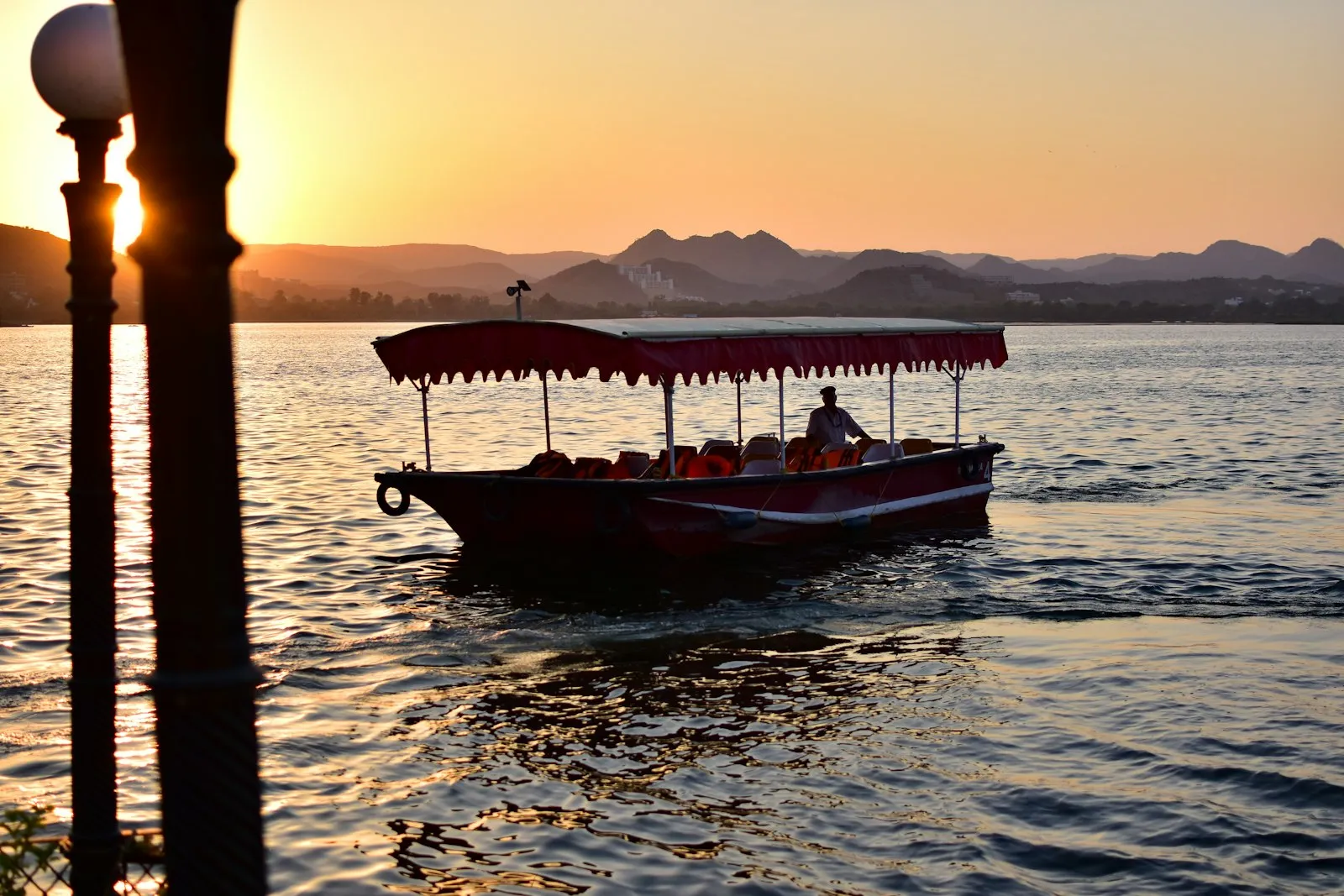
A boat on Lake Pichola in the late afternoon, when the light is at its best.
How do you see Udaipur's palaces without the crowds?
Udaipur is a city of light, and the light is a tool you can plan around. The palaces and lakes are busiest and harshest between about eleven and four, and they look like their own legend in the first hour after sunrise and the last before dusk. So invert the standard day: see the City Palace at opening, rest through the heat, and give the golden hour to a rooftop, a boat or a viewpoint rather than a queue. This is the real argument for three nights over two, letting the light rather than the ticket list set the pace.
What should you know before visiting Jagdish Temple and the sacred sites?
A short walk from the City Palace gate stands the Jagdish Temple, built in 1651 and dedicated to Vishnu, the Hindu god of preservation. It is not a museum but a working temple, busy with worshippers, and one of the easiest places in the city to see daily devotion up close.
A few courtesies help, and the same temple etiquette applies across India. Remove your shoes before the steps and leave them with the attendant. Dress so your shoulders and knees are covered. Walk clockwise around the inner shrine, the direction of worship. Do not photograph people at prayer without asking, and stay to one side during an aarti, the ceremony in which lamps are offered with bells and song. You are welcome at these moments as a guest, not an audience, and that small shift is the difference between watching a ritual and being allowed into one.
Where do the best views of Udaipur come from?
The city rewards height, and three viewpoints are worth your evenings. The Monsoon Palace, properly Sajjangarh, is a hilltop palace from 1884 that looks over the lakes and the Aravalli hills. It sits inside a wildlife sanctuary, so there is an entry fee and usually a shared jeep for the final climb, and it is the classic sunset spot. Closer in, a short cable car, the Mansapurna Karni ropeway, lifts you to the Karni Mata temple on a ridge above Lake Pichola for a modest fare and a long view over the old city. And simplest of all, the rooftop cafes of the old town give you the palace, the lake and the hills in one frame for the price of a pot of chai, the spiced milk tea that is India's default drink.
What is there to do beyond the palaces?
Udaipur is a craft city as much as a palace city, and this is where it becomes a place. The old town around the lake is a grid of narrow lanes full of miniature painters, puppet makers and textile workshops, and a few things here genuinely reward the time. A food walk through the old quarter, led by someone who eats there, takes you past the kachori and samosa stalls and sweet shops a first-timer would never pick alone. A folk dance performance in the courtyard of a restored lakeside haveli, a haveli being a traditional mansion built around a central court, is the one cultural show worth your evening, because it happens in the right setting rather than a hotel function room. And a home cooking session, learning a Mewari dish such as laal maas, a fiery red mutton curry, in a family kitchen rather than a demonstration hall, is the kind of afternoon people remember long after the palaces blur together. These are the days we most enjoy building in Udaipur, and the thread is that each one puts you with a person rather than in front of a monument.
Which day trips are worth taking from Udaipur?
Udaipur is the best base in southern Rajasthan for two of India's great forts, both part of the Hill Forts of Rajasthan inscribed by UNESCO, the United Nations cultural body, in 2013. Kumbhalgarh, about 82 kilometres or 51 miles north-west, roughly two hours by road, has a perimeter wall often called the second-longest continuous wall in the world. Chittorgarh, around 115 kilometres or 70 miles north-east, a similar two hours away, is the vast, scarred fort that Udai Singh II abandoned when he founded Udaipur. Either makes a full day. Closer options include the Jain temple complex at Ranakpur and the pilgrimage towns of Nathdwara and Eklingji, which suit a half day.
How much does a trip to Udaipur cost?
Udaipur can be done simply or in full palace-hotel splendour, and the city is the same from both. Accommodation is by far the largest variable. As a planning guide, at rates current in October 2026, roughly INR 97 to the US dollar and INR 128 to the pound, expect these indicative ranges, all of which move with season and demand:
- A comfortable boutique or heritage double room: roughly INR 6,000 to 25,000 per night, about USD 62 to 259, or GBP 47 to 196.
- A car with a driver for a local day: roughly INR 2,500 to 4,500, about USD 26 to 47, or GBP 20 to 35.
- The City Palace museum ticket: about INR 400 per adult, about USD 4 or GBP 3.
- A meal, from a simple thali to a hotel dining room: roughly INR 250 to 2,500, about USD 3 to 26.
- A guided food or heritage walk: commonly INR 1,500 to 4,000 per person, about USD 16 to 41.
Taken together, a comfortable day in Udaipur tends to land between INR 8,000 and 20,000 per person, about USD 83 to 207, or GBP 63 to 157, excluding flights. Simple homestays run well below that and palace hotels far above. Treat every figure as a planning range rather than a quotation, and see our breakdown of how much a trip to India costs for the wider picture.
How do you get around Udaipur?
The old town is small and best walked, and the lanes near Lake Pichola are too narrow for cars anyway. For anything further, the everyday option is the auto-rickshaw, a three-wheeled open taxi known locally as an auto. Agree the fare before you set off, as meters are rarely used, or use an app-based cab, which takes the haggling out of it. For the viewpoints and the day-trip forts, a car with a driver for the day is the practical choice.

Udaipur rises straight from its lakes, which is why the city reflects the way it does.
What should you eat in Udaipur?
Udaipur is in Mewar, and the regional food is Rajasthani: vegetarian-leaning and built for a dry land. The dish to try is dal baati churma, baked wheat balls broken into lentils and served with a sweet crumble of flour, ghee and sugar. Mewari kitchens are also known for laal maas, the fiery mutton curry, and safed maas, a milder white version made with yoghurt and cashew. A thali, a platter of many small dishes eaten with rice and bread, is the easiest way to taste the range at once. Many visitors eat dinner on a rooftop for the view, which is lovely, but the better food is often a floor or two down in the plainer family restaurants.
Where should you stay in Udaipur?
Three broad choices suit most first visits. A lake-facing heritage hotel or haveli near Lake Pichola puts you in the view and within walking distance of the City Palace. A quieter boutique property a little back from the water trades the direct view for calm and value. And a converted palace hotel turns the stay itself into the attraction; Rajasthan has some of India's finest heritage stays.
Wherever you choose, ask two questions before booking: whether the room genuinely faces the lake, since many listings stretch the definition, and whether a car can reach the door, because the oldest lanes are walk-in only and that matters with luggage.
What should you wear, and how should you behave?
Udaipur is relaxed by Rajasthani standards, but it is still a traditional, temple-rich city. Loose cotton or linen covering shoulders and knees keeps you comfortable in the heat and appropriate at the temples, and slip-on shoes save time at the many thresholds where footwear comes off.
Carry rupee cash for autos, small shops and temple donations, even though cards and mobile payments work in hotels and larger restaurants. Pack sunscreen, a hat and a warm layer for winter evenings. Visa, vaccination and travel health requirements vary by nationality and change over time, so confirm them through the official Indian government e-visa portal and your own government's travel advice rather than relying on any article, including this one.
What do first-time visitors get wrong in Udaipur?
- Giving the city a single night. Udaipur is a place to slow down, and one night turns it into a car park with a view.
- Sightseeing at midday. The palaces and lakes are harsh and crowded from late morning, and luminous early and late.
- Treating the boat ride as a box to tick. The late-afternoon departure that lingers, or stops at Jag Mandir, is a different experience from the quick turnaround.
- Staying only for the view. The craft lanes, the food and a fort day trip are what turn a pretty stop into a real visit.
- Booking a dry-spring trip expecting full lakes. In a low-rain year Pichola can recede, so the post-monsoon months are the safe bet for the classic reflections.
Who is Udaipur best suited for?
Udaipur suits couples, honeymooners and anyone drawn to heritage, craft and slow mornings over a packed sightseeing list. It is kind to older travellers, because the core is walkable and the days need not be long, and it makes the gentle stop that balances the harder-edged forts and deserts of Rajasthan. It suits families less naturally than a beach or a wildlife park, though children often take to the boat rides and the ropeway. If your priority is relentless monument-ticking, Udaipur will frustrate you, because its best thing is doing less.
Frequently asked questions
Is Udaipur worth visiting?
Yes, particularly if you value atmosphere over a checklist. Give it two to three days rather than a single night, and come in the cooler, post-monsoon months when the lakes are full.
How many days should you spend in Udaipur?
Three nights is ideal and two the practical minimum: a day for the City Palace and a lake boat, a day for temples, gardens and a sunset viewpoint, and a day trip to Kumbhalgarh or Chittorgarh.
What is Udaipur famous for?
Udaipur is known as the City of Lakes and as India's most romantic city, for its artificial lakes, its white island and lakeside palaces, and the sprawling City Palace of the Mewar royal family.
Do you need a visa to visit Udaipur?
Yes. Most visitors from the UK, Europe, North America and Australasia need a tourist visa for India, and an electronic option is available to many nationalities. Rules and fees change, so apply only through the official Indian government portal and check current requirements before booking.
Is Udaipur safe for tourists?
Udaipur is generally considered a comfortable, straightforward city for visitors, including solo women, with the usual precautions around unlit areas late at night and unbooked transport. It is well away from any area covered by UK or US travel warnings, but always check your own government's current advice.
What is the best month to visit Udaipur?
October to February is the strongest window: warm dry days, cool nights and full lakes after the monsoon. March is still pleasant and brings the Mewar Festival, while April to June is very hot and July to September is wet.
Planning your own version of Udaipur
Udaipur is not a list of five sights. It is a rhythm: a palace at opening, the heat waited out, a boat as the light turns gold, a quiet dinner a floor below the rooftop crowd. The city gives its best to the people who give it time. We design private, personalised India journeys for travellers who want depth rather than a checklist, and Udaipur is one of the places we most enjoy shaping around someone's own pace. If you would like this city built into a wider India trip, on your dates and at your speed, Plan my India trip