Most golden triangle tours run Delhi, Agra and Jaipur in five or six days, and there is nothing wrong with that. You see three great cities, the Taj Mahal and a couple of forts, and you leave with the headline images of North India. The trouble is that the loop is short, the roads are busy, and by day four the temples and palaces start to blur. What the classic route gives you is breadth. What it rarely gives you is a moment that stops you.
This guide is for someone flying in from London, Frankfurt, New York or Melbourne who has half-decided on the Golden Triangle and is wondering what to add. I have built these trips for years, and the honest answer is that one well-chosen extension changes the character of the whole journey. Below are five, each with a plain account of what it adds, how far it is, what it costs in your own currency, and who it suits. Pick one. Two at most.
What are golden triangle tours, and why extend them?
Golden triangle tours run the Delhi, Agra and Jaipur circuit, so named because the three cities form a rough triangle on the map of northern India. Delhi to Agra is about 230 kilometres, roughly 145 miles; Agra to Jaipur about 240 kilometres, roughly 150 miles; and Jaipur back to Delhi about 270 kilometres, roughly 170 miles. It is the most travelled tourist route in the country, and the reason is sound: it packs the Mughal capital, the Taj Mahal and a Rajput city into a week.
You extend it because a week is not much time in a country this large. Add a few days and you can trade one more fort for a sunrise on the Ganges, a tiger, a lake palace, a Sikh temple that feeds a hundred thousand people a day, or a morning of yoga where the river leaves the Himalayas. That is the difference between a tour and a journey, and it is the argument of our piece on Beyond the Golden Triangle: 12 Layers of India Most Tours Never Show You.
How much extra time do you need to add an extension?
Plan on three to four extra days for one extension, and eight to ten for two. The classic triangle needs about six days done properly. A single add-on such as Ranthambore or Amritsar slots in with two nights and a travel day; a further-flung one such as Varanasi or Rishikesh is better with three.
The most common planning mistake is to keep the six-day triangle fixed and bolt an extension onto the end without adding nights, so a travel day pretends to be a sightseeing day. If you cannot add the time, drop a night in Delhi or Jaipur and give it to the extension, because the extension is the part you will talk about when you get home.
The five Golden Triangle extensions at a glance
Nights are listed rather than days, because nights are what you book.
Varanasi, for the river and the ritual: 2 to 3 nights, a short flight or long train from Delhi. Ranthambore, for tigers: 2 nights, slotted between Agra and Jaipur. Udaipur and deeper Rajasthan, for lakes and forts: 3 to 4 nights, after Jaipur. Amritsar, for the Golden Temple and the langar: 2 nights, from Delhi. Rishikesh, for the Himalayan foothills: 2 to 3 nights, from Delhi or Dehradun.
We plan private Golden Triangle journeys that include the extensions in this guide, timed to beat the crowds and the heat, with private guides and a dedicated driver throughout. The route is shaped around your dates and pace, not a fixed departure. Plan a private Golden Triangle trip.
Extension one: Varanasi, for the river and the ritual
Add Varanasi when you want the trip to have a spiritual centre of gravity. It is the oldest living city on the route and, for many Hindus, the holiest, a place people travel to in order to die and be cremated on the banks of the Ganges, the river Indians call the Ganga.
The experience that justifies the detour is the water at either end of the day. At dusk on Dashashwamedh Ghat, a ghat being the wide stone steps that run down to a river, priests perform the Ganga aarti, a fire ceremony of lamps, bells and chanting that draws a crowd every evening. Better still is the reverse of it: a small rowing boat pushed out before sunrise, when the ghats fill with people bathing and the light comes up pink over the far bank. On the trips we plan, we pair that sunrise row with a walk through the lanes behind the ghats and, where a guest wants it, a short session of live devotional music on the water at first light rather than in the packed evening crowd. It is a gentler way to meet a city that can otherwise overwhelm.
Varanasi is not next door. From Delhi it is a flight of about an hour and twenty minutes, or a train of roughly eight hours on the fast Vande Bharat service, which does not run on Thursdays. Most visitors fly. Give it two nights, three if you also want Sarnath, the quiet deer park about ten kilometres away, roughly six miles, where the Buddha gave his first sermon.
Extension two: Ranthambore, for a tiger on the way to Jaipur
Add Ranthambore when someone in your party has always wanted to see a wild tiger, because it is the extension that costs the least time. Ranthambore National Park sits near Sawai Madhopur, about 180 kilometres from Jaipur, roughly 110 miles and three to three and a half hours by road, so it drops neatly into the gap between Agra and Jaipur rather than adding a separate leg.
The park is open for safaris from 1 October to 30 June and closes in the monsoon, so a winter Golden Triangle lines up well with it. Safaris run twice a day, early morning and mid afternoon, each about three to three and a half hours, in an open jeep or a larger open truck called a canter, across dry forest studded with the ruins of an old hill fort. A tiger is never guaranteed anywhere, and honest planning says so; what you are buying is the chance, plus a beautiful landscape of lakes and crumbling gates. Permits are limited and sell out, so book ahead through the Rajasthan forest department's official safari portal, and some zones close on certain weekdays, worth checking before you fix a date.
There is a second reason to build in a full day here. On the edge of the park, a village craft centre set up to give former hunting communities a living runs a visit that ends with a home-cooked Rajasthani meal at a family table. It turns a wildlife stop into something with people in it, usually the part travellers remember longest. Two nights is right: one full day gives you two safaris and the craft visit.
Extension three: Udaipur and deeper Rajasthan, for lakes and forts
Add Udaipur when Jaipur leaves you wanting more of Rajasthan rather than less. Jaipur is the state's front door; Udaipur, its lake city, is the room you actually want to sit in. It is about 400 kilometres from Jaipur, roughly 250 miles and six to seven hours by road, or a domestic flight of around an hour, so most people fly this leg.
Udaipur is built around Lake Pichola, with a vast City Palace rising straight from the water and two island palaces on it, one now a famous hotel. The pleasure of the place is slowness: a boat on the lake at golden hour, a rooftop dinner, a morning in the old city's craft workshops. If you have the days, the classic pairing adds Jodhpur, the blue city under the cliff-top Mehrangarh Fort, on the way. On our Rajasthan trips the meal people talk about is not in a hotel but a farm-to-table dinner in the countryside outside Jodhpur, and a food walk through the old town led by someone who grew up eating in it.
This is the extension for travellers who found the Golden Triangle too fast and want to slow down inside the same region. Give it three nights for Udaipur alone, four or five with Jodhpur. It sits naturally after Jaipur, and you can fly home from Udaipur rather than doubling back to Delhi.
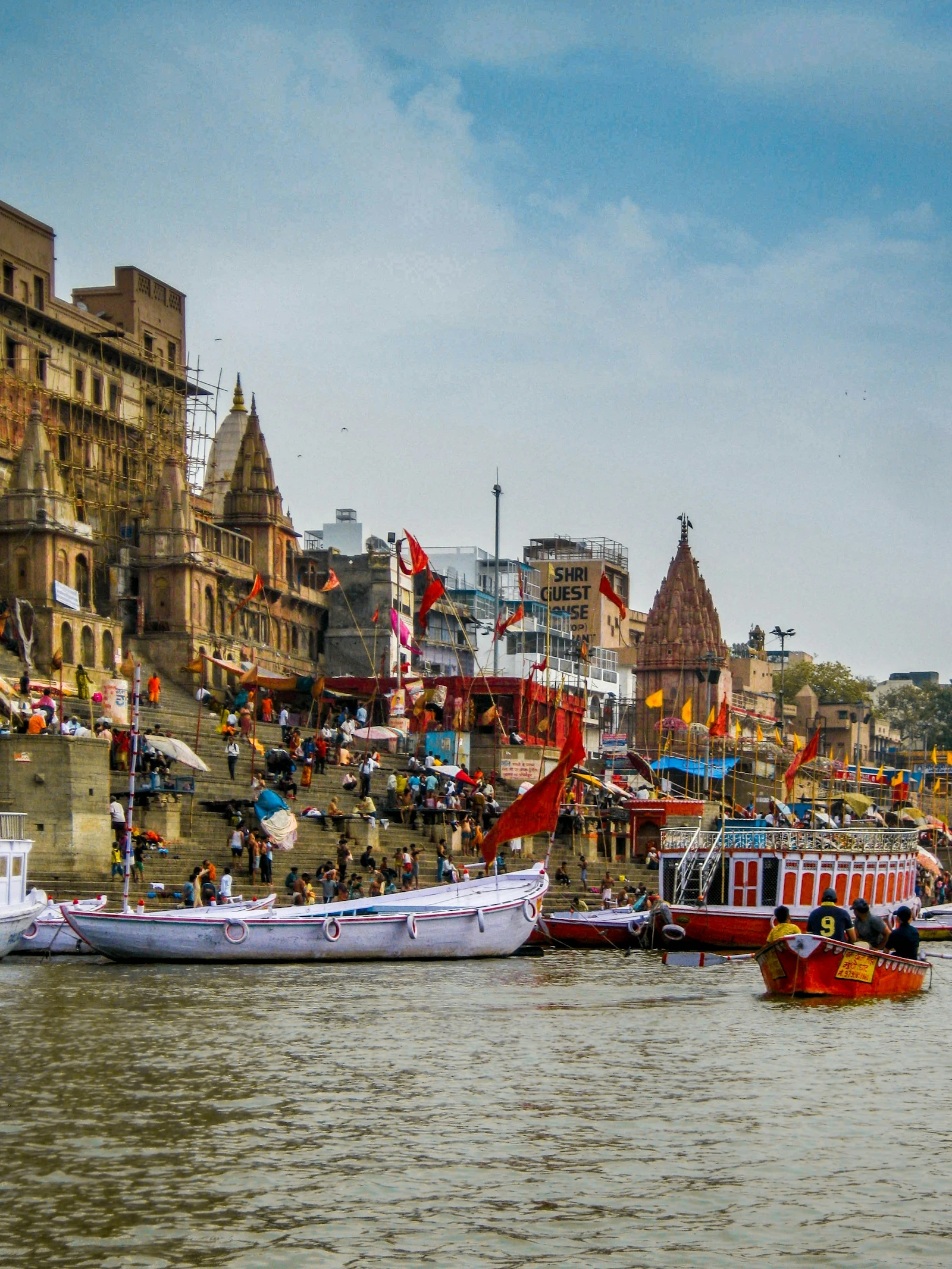
A sunrise boat before the ghats of Varanasi, the extension that gives the trip a spiritual centre.
Extension four: Amritsar, for the Golden Temple and the langar
Add Amritsar when you want the single most moving hour of the trip. In the far northwest, near the Pakistan border, the Golden Temple is the holiest site of the Sikh faith, a gilded shrine that appears to float on a tank of still water, open to everyone of any religion, and busy from before dawn until late at night.
What stays with people is not the gold. It is the langar, the temple's free community kitchen, which serves a simple vegetarian meal to everyone who sits down for it, with no charge and no distinction of wealth or faith. It runs around the clock and feeds, by the temple's own accounts, somewhere between fifty thousand and a hundred thousand people a day, more on festival days, largely through volunteers who wash the steel plates and roll the bread. You sit cross-legged in long rows, someone ladles dal onto your plate, and the scale of the kindness is the point. We wrote a whole piece on why that meal lands the way it does, in Amritsar and the Golden Temple: The Most Moving Meal You'll Ever Share. Cover your head, go barefoot, and go at dawn when the light and the crowds are both kinder.
Amritsar is about 450 kilometres from Delhi, roughly 280 miles, and most visitors take a fast train of around six hours or a flight of about an hour and a quarter. Two nights lets you add the sobering Jallianwala Bagh memorial and the Partition Museum. Many people also drive to the daily flag-lowering ceremony at the Wagah border with Pakistan, a piece of choreographed patriotic theatre attended by thousands. Note that the UK Foreign Office advises against all travel within ten kilometres of the India-Pakistan border, which technically covers the ceremony site, so check your own government's current advice on the day.
Extension five: Rishikesh, for the Himalayan foothills
Add Rishikesh when the trip needs to end on a calmer note than a city. Where the Golden Triangle is hot plains and monuments, Rishikesh is where the Ganges leaves the mountains and runs clear and cold between forested hills, and it has been a centre of yoga and meditation for far longer than the word wellness has existed.
The days here are deliberately quiet. There is an evening Ganga aarti on the riverbank, smaller and more intimate than the one in Varanasi. There is white-water rafting on the Ganges from roughly September to June, outside the monsoon, fun and suitable for beginners on the gentler stretches. And there is the slower end: a session of sound healing, where singing bowls and gongs are used to settle the nervous system, a conversation with a temple priest about what the rituals mean, or simply a morning of yoga looking at the river. It is the antidote to a fortnight of forts, and there is more on it in Rishikesh Beyond Yoga: The Spiritual Heart of the Himalayas.
Rishikesh is about 240 kilometres from Delhi, roughly 150 miles and around six hours by road, or a short domestic flight to Dehradun's Jolly Grant airport and a drive of about forty minutes. Two nights is enough to exhale; three to properly rest before a long flight home.
How do you get between the Golden Triangle and these extensions?
The right transport depends on the extension. Ranthambore and Udaipur are road legs within Rajasthan. Varanasi, Amritsar and Rishikesh are better reached by a short domestic flight or a fast train from Delhi, with a private car handling everything on the ground once you arrive.
A private car with a driver is the normal way visitors cover ground in India, and it is not a luxury in the chauffeur sense. It is an air-conditioned sedan or small SUV with a professional driver who handles the traffic, waits while you are inside a temple, and knows where to stop for lunch. Indicative cost is roughly ₹4,000 to ₹8,000 per day including fuel, about USD 42 to 83, or GBP 32 to 63, at rates in late September 2026 of around 96 rupees to the US dollar and 127 to the pound.
For the longer hops, weigh the train against the plane honestly. India's fast intercity trains are comfortable and scenic, but Delhi to Varanasi is a full eight-hour day on rails against under two hours in the air, and Delhi to Amritsar is around six hours by train. Book trains well ahead through the official Indian Railways system, as the good ones sell out weeks in advance, and treat a flight as the time-saver it is over a long distance. Within towns you will use auto-rickshaws, the three-wheeled open taxis known locally as autos, or app-based cabs; agree the fare before you start if there is no meter.
What does adding an extension cost?
As a working figure, a well-organised two to three night extension in comfortable boutique or heritage hotels adds roughly ₹30,000 to ₹90,000 per person on top of the Golden Triangle, about USD 310 to 940, or GBP 235 to 710, before any international flights. The range is wide because the biggest variable is not the destination, it is the hotel you choose.
The components that move the figure, all of which shift with season and demand: a boutique or heritage double room runs roughly ₹8,000 to ₹22,000 per night, about USD 83 to 229; a private car with driver ₹4,000 to ₹8,000 per day, about USD 42 to 83; a one-way domestic flight booked ahead commonly ₹4,000 to ₹9,000, about USD 42 to 94; and a half-day walk with a specialist local guide ₹2,500 to ₹6,000, about USD 26 to 63. A shared jeep safari at Ranthambore is usually a few thousand rupees per person, very roughly USD 20 to 45, though foreign-national and premium-vehicle rates run higher, so confirm the current price on the official forest portal.
Exchange rates and local prices change, so treat every figure here as a planning range rather than a quotation, and see our fuller breakdown in How Much Does a Trip to India Cost? A Transparent Breakdown by Style. The Golden Temple langar, worth saying, costs nothing at all.
When is the best time to travel an extended Golden Triangle?
October to March is the strongest window for the whole of North India, and it lines up neatly with the extensions. The plains are dry and pleasant, Ranthambore is open, and the light is good for photography.
October and November are excellent, with festival colour around Diwali and comfortable temperatures. December and January are the coolest, so pack a warm layer for early mornings and for Rishikesh, where the hills are genuinely cold at dawn. February and March are arguably the sweet spot: dry, warm without the coming heat, and clear. April to June is hot on the plains, often 40 degrees Celsius or more, roughly 104 Fahrenheit, and hard work in Agra and Jaipur, though Ranthambore's afternoon safaris can be superb for sightings as animals gather at water. July to September is the monsoon: green and cheaper, but Ranthambore's main zones close, and heavy rain can interrupt sightseeing.
Which extension should you choose?
Choose by the feeling you want the trip to end on rather than by the map. For spiritual intensity and the most photographed sunrise in India, choose Varanasi. If someone has always dreamed of a wild tiger, choose Ranthambore, which also costs the least time. If the Golden Triangle felt rushed, choose Udaipur and slow down inside the same region. For an hour that quietly rearranges how you think about generosity, choose Amritsar. And to come home rested rather than wrung out, choose Rishikesh.
The one combination I steer people away from is a little of all five. India rewards depth, not distance covered, and two extensions done well beat five done from the window of a car.

A tiger on a forest track in Ranthambore, the extension that costs the least extra time.
How many extensions can you realistically add?
One extension turns a week into a rounded ten-day trip. Two turn it into a proper two-week journey and are the most this route comfortably takes. Three is where people overreach.
The pairs that work share a logic. Varanasi and Rishikesh make a spiritual arc, both on the Ganges at different points of its life. Ranthambore and Udaipur keep you in Rajasthan and string together after Jaipur without backtracking. Amritsar pairs cleanly with anything reached from Delhi. If you find yourself planning three, the better move is almost always to keep two and add nights, which is the logic behind our fuller Classic North India Itinerary: Two Weeks, Done Properly.
What do first-time visitors get wrong when extending the Golden Triangle?
Underestimating internal travel. India is bigger than it looks on a European map, and a line between two dots can be a full day. Assume a road average of 40 to 50 kilometres per hour, about 25 to 30 miles per hour, on non-motorway routes.
Flying home from Delhi out of habit when an open-jaw ticket from Udaipur or Varanasi would save a backtracking day. Scheduling Ranthambore in the monsoon, or without booking permits early. And treating Amritsar's Golden Temple or Varanasi's ghats as photo stops rather than places of live worship, which they emphatically are.
Who is an extended Golden Triangle best suited for?
This approach suits second-time-in-a-week visitors who want more than a highlights reel, couples and solo travellers happy to move at their own pace, and anyone whose interest is culture, faith, wildlife or landscape rather than ticking off monuments. It adapts well for older travellers, who should favour the flight legs over long drives, and for families, who tend to love Ranthambore's safaris and Rishikesh's rafting while finding Varanasi intense for young children.
It suits less well anyone on a strict five-day schedule, for whom the plain Golden Triangle is the honest answer, and anyone who wants beaches or the far south, which are different trips. If you are weighing North against South before you commit, that is worth settling first.
What should you know about etiquette, safety and health?
Dress modestly at religious sites: shoulders and knees covered, head covered at the Golden Temple, and shoes off, sometimes many times a day, so wear ones you can slip. Ask before photographing people at worship, and never photograph cremations in Varanasi. Eat and pass objects with your right hand. Drink only sealed bottled or filtered water, give your stomach a couple of days to adjust, and carry rupee cash for temples, drivers and markets even though cards work in hotels.
On the bigger questions of visas, vaccinations and safety, requirements vary by nationality and change over time, so verify current rules only through official sources: apply for any tourist visa through the Indian government's official e-visa portal, check your own government's travel advice, such as the UK Foreign Office guidance, and speak to a travel clinic about jabs well before you fly. Do not rely on any article, including this one, for those specifics.
Frequently asked questions
What is the best extension to a Golden Triangle tour?
There is no single best one; it depends on the mood you want. Varanasi adds spiritual intensity, Ranthambore adds a tiger safari for the least extra time, Udaipur adds lakes and slower Rajasthan, Amritsar adds the Golden Temple and its community kitchen, and Rishikesh adds the calm of the Himalayan foothills. For a first extension, Ranthambore and Amritsar are the easiest to slot in.
How many days do you need for the Golden Triangle plus an extension?
Around ten days for the Golden Triangle plus one extension, and about two weeks for two. The triangle itself needs roughly six days done properly, a single add-on needs three to four including travel, and a second needs a further three or four.
Can you add Varanasi to a Golden Triangle tour?
Yes, and it is one of the most popular additions. Varanasi is a flight of about an hour and twenty minutes from Delhi, so most people fly. Allow two to three nights to take in a sunrise boat on the Ganges, the evening Ganga aarti, and the Buddhist site of Sarnath nearby.
Is it safe to extend a Golden Triangle tour to Amritsar?
Amritsar city and the Golden Temple are generally considered comfortable and welcoming for visitors. The one caveat is the border: the UK Foreign Office advises against all travel within ten kilometres of the India-Pakistan border, which covers the Wagah ceremony site, so check your own government's current advice before adding that particular outing.
Do you need domestic flights for these extensions?
For Ranthambore and Udaipur you generally do not, as they are road or short flight legs within Rajasthan. For Varanasi, Amritsar and Rishikesh a short domestic flight or fast train from Delhi saves a great deal of time and is usually worth it over a long drive.
When is the best time for an extended Golden Triangle trip?
October to March, when the North Indian plains are dry and pleasant and Ranthambore is open for safaris. February and March are arguably the sweet spot. Avoid the peak summer heat of April to June on the plains and the July to September monsoon, which closes Ranthambore's main zones.
Planning your own extended Golden Triangle
The classic loop is a good week. What turns it into a journey is the second week: one river, one tiger, one lake city, one shared meal or one quiet morning in the hills, chosen because it matches the trip you actually want rather than the one the brochure sells.
We design private, personalised India journeys, and building the right extension onto golden triangle tours is one of the things we do most. If you would like this shaped around your own dates, pace and interests, Plan my India trip.