Almost everyone who plans a first trip to India photographs the Taj Mahal and quietly assumes they have seen the country's great heritage. It is an understandable mistake. The Taj is on every list, every itinerary and every fridge magnet. But it is one of India's UNESCO World Heritage Sites, and there are more than forty of them, most of which the average visitor has never heard of and will drive right past.
This guide is written for someone flying in from London, Frankfurt, New York or Melbourne who has a fortnight, a genuine interest in history, and no wish to spend it in the same three cities as everyone else. It looks at four World Heritage sites in India that reward the effort of reaching them: the ruined city of Hampi, the temples of Khajuraho, the sun temple at Konark and the rock-cut caves of Ellora. For each it answers the questions that decide a trip: what the place is, how to get there, when to go, what it costs, and whether it belongs on your itinerary.
Why look beyond the Taj Mahal at all?
Because the Taj is a single perfect object, and India's heritage is really about depth and continuity rather than one photograph. The four sites here are not consolation prizes. Each is the finest surviving example of something the Taj cannot show you: Hampi an entire imperial capital left where it fell, Khajuraho a thousand years of stone carving lost to the jungle and rediscovered, Konark a temple built as a colossal stone chariot, Ellora a temple carved downward out of a single cliff. None of them draws Taj-scale crowds, which is much of why they are worth your time.
How many UNESCO World Heritage Sites does India have?
India has more than forty UNESCO World Heritage Sites, a figure that grows almost every year. The country's official UNESCO listing stood at forty-five properties as of September 2026, most of them cultural rather than natural, which places India among the countries with the largest collections in the world.
The Taj Mahal, inscribed in 1983, is the famous one. The four in this guide are older on the list than most people expect: Ellora in 1983, Konark in 1984, and both Hampi and Khajuraho in 1986. Inscription is not a marketing badge. It is a formal recognition, verifiable on the UNESCO World Heritage Centre website, that a place has outstanding universal value.
Hampi: what are you actually looking at?
Hampi is the ruined capital of the Vijayanagara Empire, spread across a boulder-strewn landscape in the southern state of Karnataka. It was one of the richest cities in the world in the fifteenth and sixteenth centuries, then it was sacked in 1565 after the Battle of Talikota and never rebuilt. What remains is a whole city of temples, bazaars, aqueducts and royal enclosures sitting among giant granite boulders on the Tungabhadra river.
The most photographed object is the Stone Chariot, a small shrine carved as a temple car in the courtyard of the Vittala temple. The Virupaksha temple, still in daily worship after more than five centuries, anchors the old bazaar. What Hampi gives you that a single monument cannot is scale and silence: you walk or cycle between ruins for a day and the empire assembles itself around you.
In my experience Hampi opens up when you slow down. The most memorable hour I have spent there was not at a temple but on a coracle, a round basket boat that has ferried people across the Tungabhadra for centuries, gliding past half-submerged carvings in the early light. A local storyteller changes the place too: left alone the ruins are handsome but mute; with someone who can read them, the market where diamonds were once sold by the sackful, the water channels, the coronation platform turn back into a living city.
We plan private Golden Triangle journeys that include heritage sites beyond the Taj, timed to beat the crowds and the heat, with private guides and a dedicated driver throughout. The route is shaped around your dates and pace, not a fixed departure. Plan a private Golden Triangle trip.
Khajuraho: are the temples really all about the erotic carvings?
No, and the reputation does the place a disservice. The Khajuraho Group of Monuments in Madhya Pradesh is a set of Hindu and Jain temples built by the Chandela dynasty at its peak between roughly 950 and 1050. Of an original eighty-five or so temples, around twenty to twenty-five survive, and the famous erotic sculptures are a small fraction of a vast programme of carving covering gods, musicians, dancers, animals and ordinary life.
What makes Khajuraho extraordinary is the architecture and the density of the sculpture. These are Nagara-style temples, the North Indian form with a beehive-shaped tower called a shikhara, and the largest, the Kandariya Mahadeva, rises in a mountain of carved stone. The temples were swallowed by forest for centuries, which is partly why they survived, and were brought back to attention by a British engineer in 1838. Go for the craftsmanship. The carvings that made the site notorious are the least interesting thing about it.
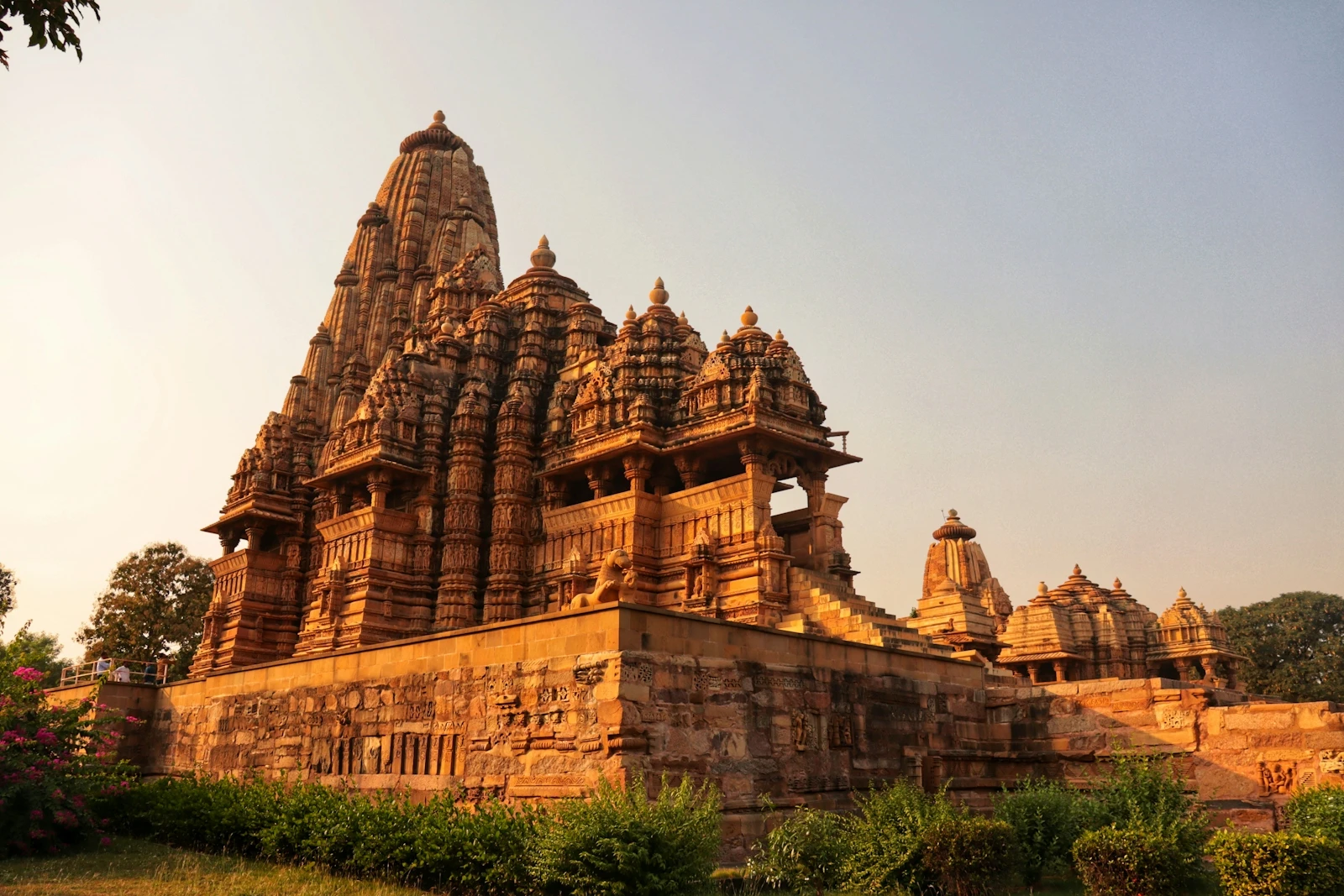
The Kandariya Mahadeva, the largest of the Khajuraho temples.
Konark: why is a temple built to look like a chariot?
Because it is a temple to the sun god, Surya, imagined as his celestial chariot crossing the sky. The Sun Temple at Konark, on the Odisha coast, was built around 1250 by King Narasimha Deva I of the Eastern Ganga dynasty, and the whole structure is conceived as an enormous stone chariot: twelve pairs of carved wheels, each roughly three metres across, about ten feet, drawn by seven straining horses.
The temple has not survived whole. The tall sanctuary that once rose over the shrine collapsed long ago, leaving the great pyramidal audience hall, the jagamohana, as the principal structure today. European sailors called it the Black Pagoda because its dark tower was a landmark from the sea. Even incomplete it is overwhelming, every surface worked into wheels, figures and friezes. The wheels double as sundials, and a good guide will show you how to read the time from the shadow of a spoke.
Ellora: how do you carve a temple out of a single rock?
From the top down, and by removing stone rather than adding it. The Ellora Caves in Maharashtra are thirty-four Buddhist, Hindu and Jain monasteries and temples cut side by side into a basalt cliff between roughly 600 and 1000, and their centrepiece, the Kailasa temple, is the largest monolithic structure of its kind anywhere.
Kailasa, also called Cave 16, was commissioned in the eighth century by the Rashtrakuta king Krishna I and dedicated to Shiva. It is not built but excavated: the carvers began at the top of the hillside and cut downward, freeing a full multi-storey temple, courtyard, gateways and life-sized elephants out of one piece of rock. Everything you see was taken away, not stacked up. What makes Ellora rare is that three religions worked the same cliff across four centuries, so a single visit walks you from a Buddhist prayer hall to a Hindu temple to a Jain shrine.
If you only have time for one, which should you choose?
Match the site to what moves you, because they are very different experiences. Choose Hampi for landscape, space and the feeling of a lost world. Choose Ellora if raw scale and engineering astonish you, and pair it with the painted caves of Ajanta nearby. Choose Khajuraho for the concentrated brilliance of the carving in a compact setting. Choose Konark if you are already drawn to Odisha and the temple town of Puri, and want one unforgettable monument rather than a sprawling site.
For a first trip, Hampi and Ellora tend to leave the deepest impression because their scale is so hard to anticipate. Khajuraho and Konark fold more easily into a wider route as a single, powerful stop.
How do you actually reach each of these sites?
None of the four is truly remote, but each needs a deliberate detour, usually a short domestic flight followed by a road transfer. India's domestic network is extensive and cheap by international standards, so for most visitors a flight plus a private car with a driver is the sensible combination.
Hampi is reached via Hosapete, the nearest railhead about thirteen kilometres away, roughly eight miles, or by air into Hubballi, around one hundred and forty kilometres, about ninety miles, with Bengaluru far better connected internationally at three hundred and forty kilometres, roughly two hundred and ten miles. Khajuraho has its own small airport with direct flights from Delhi and Varanasi in season, which makes it one of the easier sites here. Konark sits about thirty-five kilometres from the temple town of Puri, roughly twenty-two miles, and around sixty-five kilometres, about forty miles, from the airport at Bhubaneswar. Ellora is around thirty kilometres, about nineteen miles, from the airport at the city officially renamed Chhatrapati Sambhajinagar, still widely signposted as Aurangabad. Budget at least two nights at each site, and three at Hampi, which is a city rather than a single monument.
When is the best time to visit?
The broad answer is October to March, India's dry and cooler season, for all four sites. The detail is worth having, because these places sit in different climates.
Hampi is best from November to February; by April the granite bakes and midday becomes hard work. Khajuraho follows the North Indian pattern of cool winters and fierce summers, so aim for October to March, with the Khajuraho Dance Festival in February a particular draw. Konark on the coast is most comfortable from October to February and hosts its own dance festival in December. Ellora is best from November to February, and worth avoiding in the July to September monsoon. Whatever the season, the ruins and carvings are at their most beautiful in the first two hours after opening and the last two before closing.
What does it cost to enter these sites?
Entry to India's major ASI-managed monuments is modest and priced in two tiers. At the World Heritage sites here, foreign nationals pay roughly ₹600, about USD 6, GBP 5 or EUR 6, while Indian nationals pay around ₹40, and children under fifteen generally enter free. A few enclosures within Hampi, such as the Vittala temple and the Zenana enclosure, carry their own combined ticket.
Because government fees change, treat these as a guide rather than a quotation and confirm current prices on the official Archaeological Survey of India ticketing portal before you travel. The figures here are current as of September 2026. Camera rules vary by site, and photography is often restricted inside living shrines.
What does the wider trip cost, beyond the ticket?
The entry fee is the smallest line in the budget. As our breakdown of India trip costs shows, the real costs are getting there, staying, and having someone knowledgeable show you round.
A private air-conditioned car with a professional driver, the normal way to cover ground here, runs roughly ₹4,000 to ₹8,000 per day including fuel, about USD 42 to 84, GBP 32 to 63, or EUR 37 to 73. A comfortable boutique or heritage double room typically falls between ₹6,000 and ₹18,000 per night, about USD 63 to 188. A half-day with a specialist local guide, where these sites come alive, is commonly ₹2,500 to ₹6,000, about USD 26 to 63. Every figure here is a planning range at rates current in September 2026, roughly ₹96 to the US dollar, ₹126 to the pound and ₹109 to the euro.
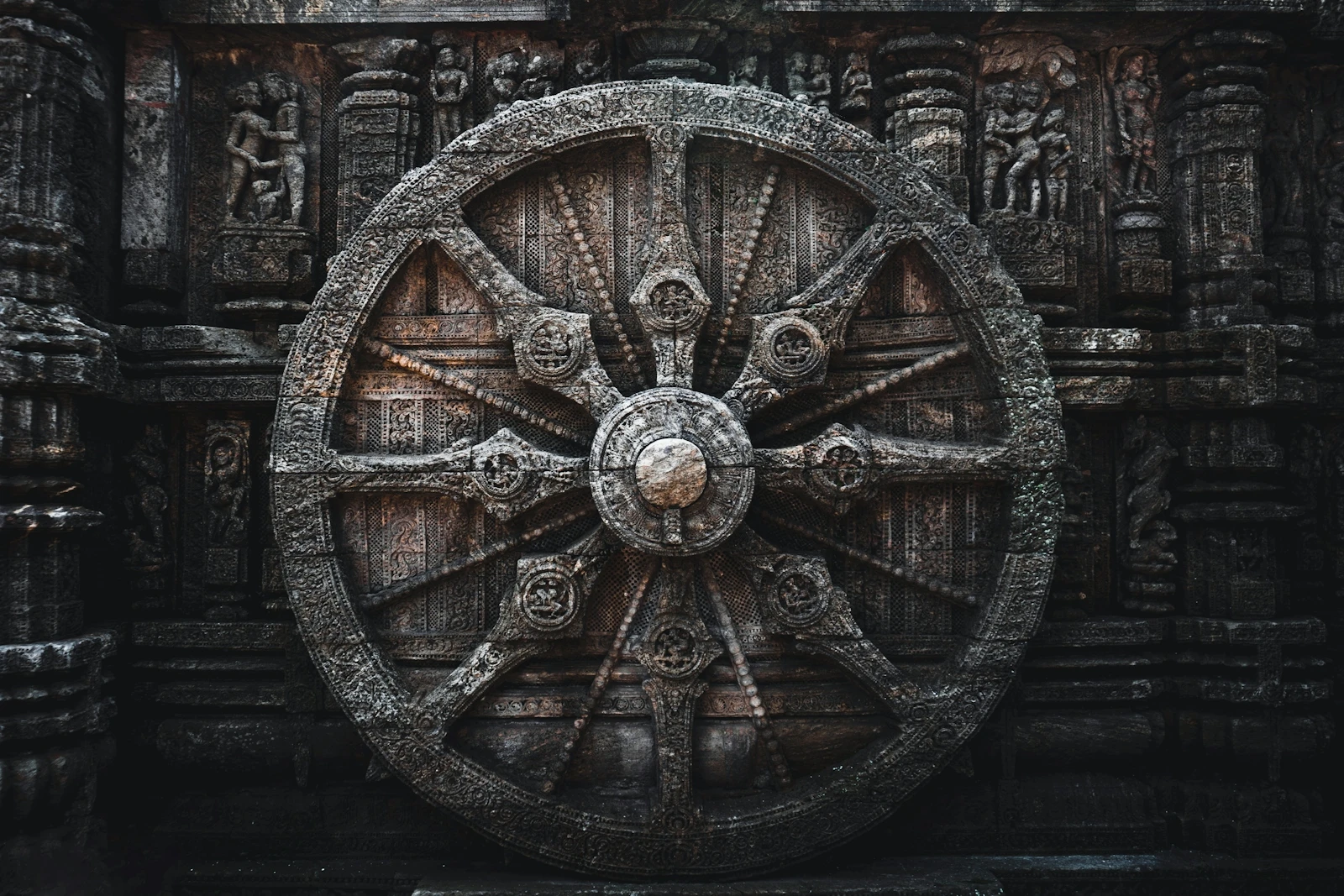
One of the great stone wheels of the Sun Temple at Konark.
How do these sites fit into a first India itinerary?
Each pairs naturally with a route most first-timers are already considering, so you rarely need to build a whole trip around one. Add a single heritage site to a region rather than chase all four across the country in one visit.
Hampi slots into any South India itinerary and pairs beautifully with Karnataka's other UNESCO cluster at Pattadakal and the cave temples of Badami and Aihole nearby, a quiet heritage arc that sees a fraction of the crowds. This is a route we design often for travellers who want the deep cut rather than the obvious one. Ellora combines with the Ajanta caves and a Maharashtra leg. Khajuraho drops neatly between Agra and Varanasi on the classic North India circuit. Konark rounds out an Odisha leg on the eastern coast. Choose the region first, then the site within it.
What should you know about etiquette at these sites?
Some are ruins and some are living temples, and the difference decides how you behave. Hampi's Virupaksha temple is an active place of worship, while much of Hampi, Khajuraho, Konark and Ellora's Kailasa are archaeological sites where the rules are those of any protected monument.
At any working shrine, dress with shoulders and knees covered, remove your shoes where asked, and do not photograph people at prayer without permission. You will often walk barefoot on stone that is cool at dawn and scorching by noon, another reason to go early. Use your right hand to give and receive, and keep your voice low inside sanctums. At Khajuraho, treat the erotic carvings as the sculptors did, as one small part of a sacred building rather than a spectacle.
What do first-time visitors get wrong at these sites?
- Trying to see all four in one trip. They are scattered across four states, and stitching them together burns your fortnight on airports. Pick one or two and go deeper.
- Visiting at midday, when the light is flat and the heat is worst. The carvings and ruins are transformed by low morning and evening sun.
- Seeing Hampi in a single day. It is a city, not a monument, and one rushed day is the classic error.
- Skipping a guide. These sites are dense with meaning that is invisible without someone to unlock it.
- Underestimating road time. Assume an average of 40 to 50 kilometres per hour, about 25 to 30 miles per hour, on the approach roads, and leave generous margins for flights.
Who are these sites best suited for?
They suit travellers who came for substance rather than a checklist: people interested in history, architecture, photography and craft, couples and solo travellers who like unhurried days, and older visitors who would rather understand one great place than sprint between many. They reward patience and curiosity above stamina.
They are a harder sell for families with young children who need pools and short transfers, though Hampi's boulders and coracles can win a certain kind of child over completely, and for anyone whose India wish-list is really tigers, beaches or the Taj itself. Those are simply different trips.
Is it safe to travel to these places?
All four sites sit in parts of India that governments consider straightforward for tourism. Karnataka, Madhya Pradesh, Odisha and Maharashtra are not among the areas the UK Foreign, Commonwealth and Development Office advises against travelling to, which as of September 2026 are chiefly Jammu and Kashmir, the immediate India-Pakistan border zone and the state of Manipur.
That said, no trip is guaranteed safe and advice changes. Check your own government's current travel advice before booking, take out insurance that covers your itinerary, and use the usual sense about unlit areas at night, unbooked transport and discreet valuables. Solo women travellers visit all four regularly and comfortably with these same precautions.
Frequently asked questions
What are the most famous UNESCO World Heritage Sites in India after the Taj Mahal?
Beyond the Taj, the best known include Hampi in Karnataka, the Khajuraho temples in Madhya Pradesh, the Sun Temple at Konark in Odisha, the Ellora and Ajanta caves in Maharashtra, the hill forts of Rajasthan, and the Qutb Minar and Red Fort in Delhi.
Is Hampi worth visiting for first-time visitors to India?
Yes, particularly for travellers who like ruins, landscape and space. Hampi is one of the most atmospheric places in India, easy to explore on foot, by bicycle or by coracle, and far less crowded than the northern icons. Give it two or three days.
Which is better, Ellora or Ajanta?
They are different and best seen together. Ellora is famous for the monolithic Kailasa temple and for holding Buddhist, Hindu and Jain monuments side by side; Ajanta for its ancient Buddhist paintings. They lie within a couple of hours of each other, so see both.
Do you need a guide at these sites?
Not officially, but strongly recommended. These sites are dense with history and symbolism that is easy to miss on your own, and a knowledgeable local guide turns a handsome ruin into a story you remember for little cost relative to the trip.
What is the best time of year to visit these heritage sites?
October to March is the reliable window for all four, avoiding both the summer heat and the monsoon. Early morning and late afternoon are the best hours of any day for light and comfort, and the winter dance festivals at Khajuraho and Konark are worth timing a visit around.
Planning a heritage trip beyond the obvious
India's UNESCO sites reward travellers who choose depth over the checklist, and the ones beyond the Taj reward it most of all. A good heritage trip is not four flights and four monuments. It is one region understood properly: the right site, the right season, the right two hours of light, and someone beside you who can read the stone.
We design private, personalised India journeys for exactly this kind of traveller, built around your dates, your pace and the places that move you. If you would like a route shaped around India's living heritage rather than its most photographed corner, Plan my India trip