Most people give India ten days, see three cities in the north, and fly home slightly stunned, promising to come back for the rest. Three weeks in India is the length that lets you stop doing that. It is enough to travel the famous northern loop without rushing, then drop into the green calm of the south for a week and let the trip breathe before you leave.
This guide sets out a 21 days route for someone flying in from London, Frankfurt, New York or Melbourne who has never been to India, does not yet know a haveli from a ghat, and wants one long, well-paced trip rather than two short ones. It answers the questions that decide whether a long India itinerary works: how far apart things are, when to fly and when to drive, what it costs in your own currency, and where to slow down.
Is three weeks in India too much for a first trip?
Three weeks is close to the ideal length for a first India trip that wants both the north and the south. It gives you around eighteen usable days once you subtract a long-haul arrival, a travel day between the regions and a departure: enough to see the north properly and still spend a restful week in Kerala.
What 3 weeks does not license is a stop in every state. The most common planning error I see on a long India itinerary is fifteen destinations crammed into 21 days, each reduced to a photograph and a checkout. This route holds to eight bases at two or three nights each. The length is spent on depth, not on ground covered.
What does the grand loop cover, and why this shape?
The route is a northern arc followed by a southern week. In the north you travel Delhi, Agra, Jaipur, Udaipur and Varanasi: the Golden Triangle that almost every first trip includes, plus the lake city of Udaipur for slower days and Varanasi on the Ganges for the country at its most intense. Then you fly south for a week in Kerala, where the pace halves and nobody is trying to show you a monument.
The logic is contrast. The north is grand, hot, crowded and historic; the south is quiet, coastal and largely about landscape and food. Doing the demanding half first, while your energy is highest, and finishing in the backwaters is a far kinder shape than the reverse: you arrive tired and leave rested.
Which airports should you fly into and out of?
Fly into Delhi and out of Kochi. An open-jaw ticket, into one city and home from another, saves the best part of two days of backtracking and usually costs little more than a standard return.
Delhi (airport code DEL) is the main international gateway, with direct flights from most of Europe, the Gulf, North America and Southeast Asia, and it sits at the top of the northern loop. Kochi, sometimes still written Cochin (COK), sits on Kerala's west coast and handles comfortable departures via the Gulf, Singapore and Colombo. The single internal flight from the north down to Kerala is the one long hop you cannot avoid, so book it early. Many flights from Europe and the Gulf land in Delhi between two and five in the morning, so book your first hotel night for the day before you land, and the room is yours on arrival.
If this is a lot to work out alone, it is exactly what we do. Tell us your dates, who is travelling and what matters to you, and we reply within 24 hours with a first private itinerary that takes care of a three-week loop, from the internal flights to the southern week. Plan my India trip.
The 21-day India itinerary at a glance
Nights are listed rather than days, because nights are what you book and pay for.
Delhi: 3 nights, arrival and a gentle start. Agra: 2 nights, the Taj Mahal and the craft that made it. Jaipur: 2 nights, forts, pink streets and workshops. Udaipur: 2 nights, lakes and palaces. Varanasi: 2 nights, the Ganges at dawn and dusk. Then the flight south. Fort Kochi: 2 nights, colonial port and food. Munnar: 2 nights, tea hills. The backwaters: 2 nights, one on a houseboat. Marari beach: 3 nights, sea, Ayurveda and a soft landing before home. That is nineteen nights across eight bases, which fills your 21 days once you count the arrival dawn and departure. If your flights force a different count, add or drop a night at Marari or Delhi rather than squeezing the middle of the trip.
Days 1 to 3: Landing in Delhi and finding your feet
Delhi's job at the start of this trip is to absorb your jet lag, not to be conquered. Give it two unhurried days and resist the urge to sightsee hard on day one. Visitors from the UK and Europe lose four and a half to five and a half hours travelling east; those from North America lose nine to twelve and should treat the first forty-eight as recovery.
The city rewards one focused morning in its oldest quarter over a scramble across both New and Old Delhi. A walk through the lanes of Old Delhi on foot, led by someone who grew up in them, turns what can feel like chaos into something legible: the spice lanes of Khari Baoli, a working haveli courtyard, breakfast at a counter that has fried the same thing for eighty years. A haveli is a traditional courtyard mansion, and Old Delhi is full of them, half-hidden behind shopfronts. That single guided morning teaches you more than a day of monuments.
Days 4 and 5: Agra, the Taj Mahal and how to time it
Agra is about three and a half to four hours from Delhi by road, roughly 230 kilometres or 145 miles down the Yamuna Expressway, or around 100 minutes on the fast morning train, which is the more relaxing option. Two nights let you see the Taj Mahal properly and understand how it was made. See it at sunrise: it opens thirty minutes before sunrise, closes thirty minutes before sunset, and is closed all day on Fridays, so plan your nights around that. As of September 2026 the foreign-visitor ticket is 1,100 rupees, about 11 US dollars, 9 pounds or 10 euros, with a further 200 rupees, about 2 dollars, to enter the main mausoleum, and a small discount online. Confirm the current price on the official Taj Mahal site before you go.
Here is the part most itineraries skip. Before you visit the Taj, spend a couple of hours on a crafts walk through Agra's artisan quarters, where families still do the marble inlay work, called pietra dura, that covers the monument: semi-precious stones cut and set into white marble by hand. Watching a craftsman inlay a single flower, and learning how long it takes, changes how the Taj reads. You stop seeing a pretty building and start seeing twenty-two years of that same patient work at an impossible scale.
Days 6 and 7: Jaipur and its craft workshops
Jaipur is around four and a half to five hours from Agra by road, roughly 240 kilometres or 150 miles, and it is worth breaking the drive at Fatehpur Sikri, the preserved Mughal city abandoned for want of water. Jaipur is the Pink City, painted terracotta for a royal visit in 1876 and kept that way since. The headline sights are the Amber Fort on its ridge, the Hawa Mahal's honeycomb facade and the City Palace. The Amber Fort opens at eight in the morning and foreign entry is around 500 rupees, about 4 pounds or 5 dollars at rates current in September 2026; go early, before the coaches.
But Jaipur is really a city of makers, and this is where a long itinerary earns its extra days. Rather than watching a demonstration from a chair, spend a morning in a printer's workshop in a village outside the city, block-printing a length of cotton yourself: pressing carved wooden blocks into natural dye, lining up the repeat by eye, ruining the first metre and getting the hang of the second. The best blue-pottery studios will sit you at the wheel rather than sell you a bowl. These are the mornings people remember long after the forts have blurred together.
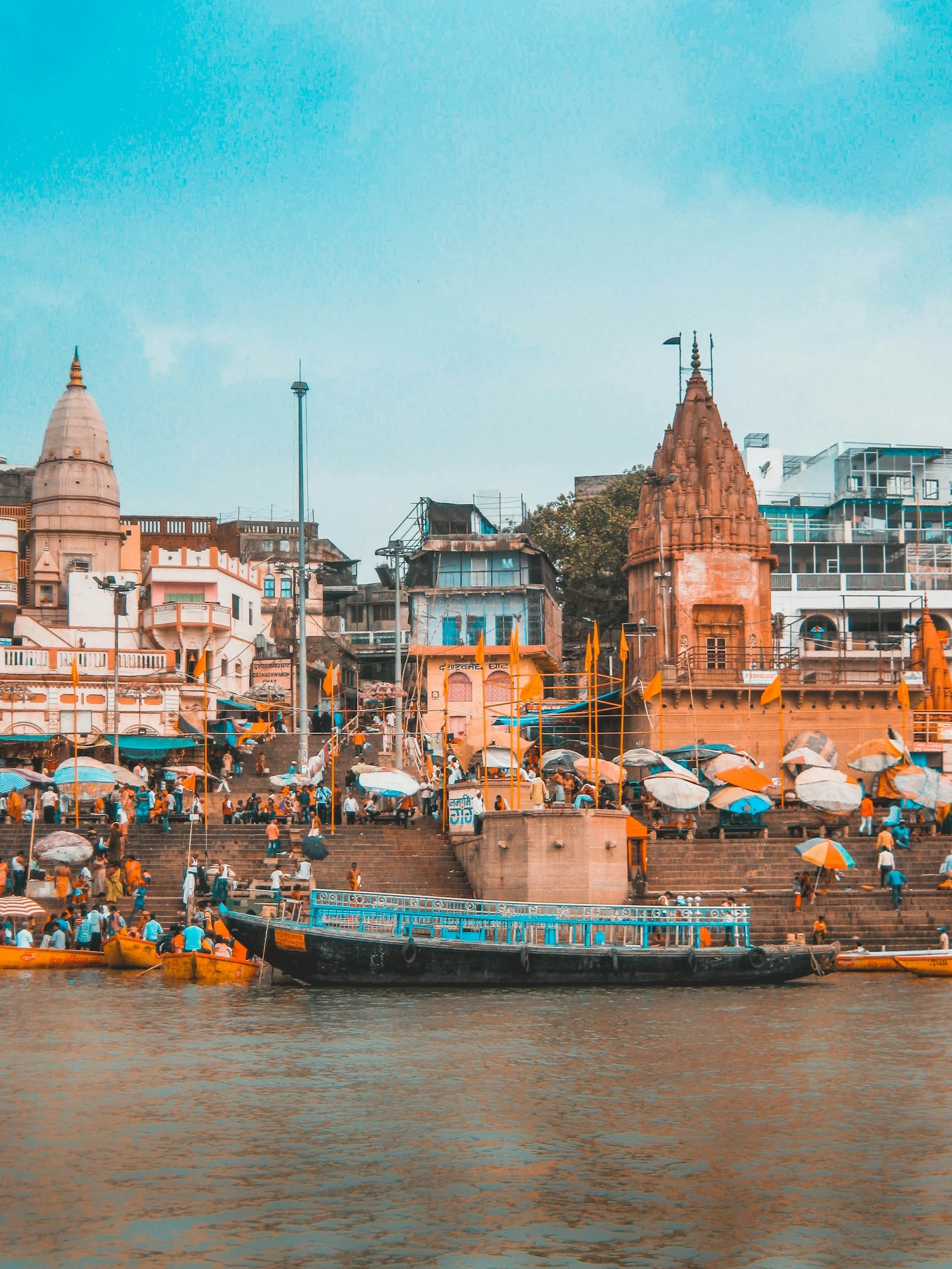
Dawn on the ghats at Varanasi, met gently from a rowing boat on the Ganges.
Days 8 and 9: Udaipur, the lake city
Udaipur is the softest stop on the northern arc, and after the intensity of the Golden Triangle it is where the trip first exhales. It sits around 390 to 420 kilometres, roughly 245 to 260 miles, southwest of Jaipur: a long day of about seven hours by road, or a short domestic flight of an hour, which most people take to protect the day.
The city wraps around Lake Pichola, with the City Palace along one shore and two island palaces seeming to float on the water. Entry to the City Palace museum is modest, a few hundred rupees, and best in the morning. A sunset boat on the lake, drifting past the ghats and palaces as the light goes gold and the temple bells start, is the quiet highlight of the whole north for many travellers. A ghat is a set of steps leading down to water, used for bathing, washing and prayer. Udaipur is also the place to cook rather than only eat: a home-kitchen session learning a Rajasthani dish such as laal maas, a fiery red mutton curry, with the family whose recipe it is, then eating it at their table, is the kind of evening a rushed trip never makes room for.
Days 10 and 11: Varanasi on the Ganges
Varanasi is the oldest living city in India and the most intense stop on this route, which is why it belongs near the end of the north rather than the start. You reach it by a short domestic flight, usually via Delhi, since driving is not sensible over that distance. Two nights are plenty for first-timers.
The city is built along the western bank of the Ganges, a stack of ghats where people bathe, pray, do laundry and, at two of them, cremate their dead in full public view. This is India at its least edited. The way to meet it gently is from the water at dawn: a slow rowing boat pushed off before sunrise, when the ghats are waking and the light is pink. In the evening, the Ganga aarti at Dashashwamedh Ghat is a choreographed fire ceremony performed by young priests with brass lamps, conch shells and bells. In the winter months of October to March it begins around a quarter to six and runs about forty-five minutes; in summer it starts an hour later, at sunset. Arrive well before, or watch from a boat. A small session of classical music on the water beforehand, a raga drifting over the river as the light fades, is one of the more moving hours you can spend in India.
Days 12 to 21: A southern week in Kerala
Fly south from Varanasi to Kochi and everything changes: the language becomes Malayalam, the plates turn to fish and coconut, and the pace roughly halves. Kerala is the reward at the end of the loop, best spent slowly across four bases.
Start with two nights in Fort Kochi, the old peninsula rather than the modern mainland city. This was the first European settlement in India, and in one afternoon on foot or by bicycle you pass cantilevered Chinese fishing nets, a sixteenth-century Portuguese church, a synagogue in the old Jewish quarter and a spice-trade warehouse district. A cooking class in a family kitchen, five or six people round the counter with their hands in the work and the meal served as your dinner, is the best introduction to Keralan food there is.
Move up to Munnar, about four hours and 130 kilometres, roughly 80 miles, inland and uphill. It sits at around 1,600 metres, about 5,200 feet, under tea estates first planted in the 1880s, and mornings can drop to the low teens Celsius, the mid fifties Fahrenheit, so pack a warm layer. Walk a tea slope with a picker rather than driving between viewpoints; the tea is the landscape.
Then descend to the backwaters near Alleppey, properly Alappuzha, a network of lakes and canals where villages live along the water. Spend one night on a private houseboat, a converted rice barge called a kettuvallam, with a crew who cook for you and moor by late afternoon. Take a small punted village canoe too, because the narrow canals a houseboat cannot enter are where the real life of the backwaters happens. Finish with three nights at Marari, a former fishing village about thirty minutes from Alleppey: a beach, slow meals and, for those who want it, genuine Ayurvedic treatment with a consulting physician who takes a history and prescribes, rather than a spa menu. Kochi airport is around ninety minutes away, so leave three and a half hours before an international departure.
How do you actually get between all these places?
A long India itinerary uses three modes, matched to the leg rather than defaulting to one. For most of the north a private car with a driver is the practical choice; for two legs the train is better; and one internal flight is unavoidable.
A private car with a driver is not a luxury here. It is the normal way visitors cover ground: an air-conditioned sedan or small SUV with a professional driver who handles the traffic and knows where to stop for lunch. Expect roughly 4,000 to 8,000 rupees per day including fuel, about 42 to 83 US dollars, 31 to 63 pounds, or 37 to 73 euros. Indian trains are excellent on the right stretches, and Delhi to Agra is the best example, covered in around 100 minutes in air-conditioned comfort; book through the official reservation system well ahead, as good trains sell out weeks out. For Jaipur to Udaipur and for Varanasi, short domestic flights save a day each. Within towns you will use auto-rickshaws, three-wheeled open taxis known locally as autos, and app-based cabs in the cities; agree the fare before you start if the meter is not used.
What does a three-week India trip cost?
As a working figure, a well-organised private three-week trip in comfortable boutique and heritage hotels typically lands between 200,000 and 350,000 rupees per person, excluding international flights. See also how a trip to India costs by style, since the range widens at both ends. That is roughly 2,100 to 3,650 US dollars, 1,600 to 2,750 pounds, or 1,850 to 3,200 euros at rates current in late September 2026, when one pound bought about 127 rupees and one US dollar about 96.
The components move with season and choice: a boutique or heritage double room runs roughly 8,000 to 22,000 rupees a night, about 63 to 173 pounds; a private car with driver 4,000 to 8,000 rupees a day, about 31 to 63 pounds; a private overnight houseboat for two with all meals commonly 15,000 to 35,000 rupees, about 118 to 276 pounds; and a good dinner from 250 rupees, about 2 pounds, in a temple-town canteen to 2,500, about 20 pounds, in a hotel dining room. Treat every figure as a planning range. The largest variable is your choice of hotel: the same route runs at half this cost in homestays or three times it in palace hotels, and the Taj, the Ganges and the backwaters are identical from either.
When is the best time to travel this route?
October to March is the window for this loop, because it is the only stretch when both the north and Kerala are comfortable at the same time. Our guide to the best time to visit India breaks this down region by region. Both halves are dry, the northern plains are cool rather than punishing, and the Kerala coast is pleasant. November to February is the strongest run, and December and January the busiest, so book several months ahead.
Two seasonal cautions matter on a trip this long. North India can get thick fog on winter mornings, especially late December and January, which occasionally delays flights and trains around Delhi and Agra, so leave buffer on the internal flight. April and May are very hot on the northern plains, frequently 40 degrees Celsius or above, roughly 104 Fahrenheit, and hard work in the forts. From June to September the southwest monsoon greens Kerala and drops prices, but northern sightseeing is less appealing then.
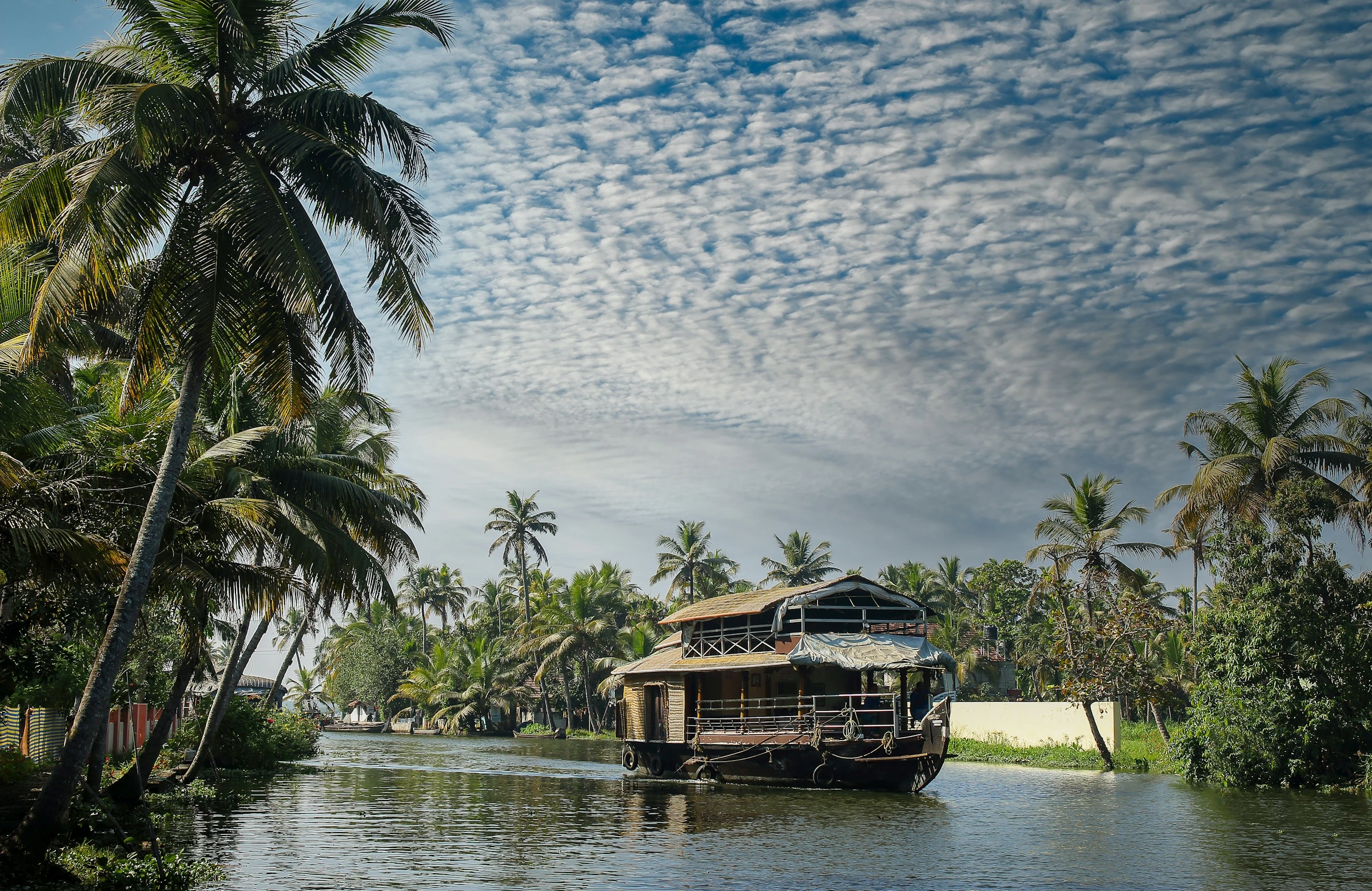
A kettuvallam houseboat on the Kerala backwaters near Alleppey.
What should you know about food, water and staying well?
The food changes completely from north to south: rich, wheat-based and meat-friendly in the north, lighter, rice-based and coconut-and-fish-forward in Kerala. It is one of the main reasons to come. Eat widely, but sensibly for the first few days.
Drink bottled or filtered water only, and check that seals are intact. Eat where there is turnover, since a busy stall frying fresh is usually safer than a quiet buffet holding food warm. Give your stomach two or three days to adjust and carry rehydration salts. Speak to a travel clinic or your own doctor about vaccinations and any anti-malarial advice well before you fly, because requirements vary by nationality and region and change over time. Verify current medical guidance officially rather than relying on any article, including this one.
What should you wear, and how does temple etiquette work?
Dress modestly and comfortably: shoulders and knees covered at religious sites, loose cotton or linen for the northern heat, and shoes you can slip off easily, since you will remove them at every temple and many homes. Some Hindu temples do not admit non-Hindu visitors to their innermost sanctums, worth knowing in advance so it does not feel like a rebuff.
Eat and pass objects with your right hand, ask before photographing anyone at worship, and expect to be photographed yourself, warmly and often, by Indian families. Pack a warm layer for Munnar and Delhi mornings, sunscreen, insect repellent and a plug adapter. Mobile coverage is good throughout, and an Indian tourist SIM or an eSIM bought before departure is worth having. Cards and mobile payments work in hotels and cities, but carry rupee cash for temples, drivers, autos and markets.
What do first-time visitors get wrong on a three-week trip?
The mistakes on a long India itinerary are mostly about pace and expectation. Getting them right is what separates a trip people love from one they merely survive.
They add stops instead of nights, turning 21 days into a blur of nine-hour drives. They front-load the trip and leave nothing restful at the end, flying home more tired than they arrived; this route puts Kerala last for exactly that reason. They sightsee at midday, when monuments are hottest and busiest, rather than at the dawn and late-afternoon hours when India is at its best. They underestimate road time, forgetting that an average of 40 to 50 kilometres an hour, about 25 to 30 miles an hour, is realistic on most non-highway routes. And they treat the houseboat, or the Taj, as the whole of a region rather than one night or one morning of a much larger place.
Who is this grand India tour best suited for?
This route suits travellers who have the time and want to see India whole rather than in a single region. It works especially well for couples, for sabbatical and career-break travellers, for retirees who can travel slowly, and for anyone whose interest is culture, food and landscape as much as monuments.
It works less well for families with very young children, for whom three weeks and long transfers are a lot, though it adapts by trimming the north and adding beach time. It is also not the right shape for a single deep region: if the Himalayas, the Rajasthan desert or a wildlife-only trip is the dream, those are more focused journeys. This loop is for the first-timer who wants the definitive introduction and has three weeks to give it. Getting that balance right, the nights in the right places and the rhythm between them, is the part we spend most of our time on when we plan these privately.
How would you shorten or extend this loop?
The route flexes cleanly. To do it in two weeks, keep the north, close to the classic North India itinerary, and cut Kerala to a three-night tail in Fort Kochi and the backwaters; or keep the south, along the lines of a two-week South India itinerary, and drop Udaipur and Varanasi. Either half stands on its own.
To extend beyond 3 weeks, add one region rather than more stops: Amritsar and the Golden Temple in the northwest, where the free community kitchen feeds tens of thousands a day; a wildlife stop such as Ranthambore between Agra and Jaipur, remembering that safari zones there are closed some days and permits sell out, so book early; or a few days in Rishikesh in the Himalayan foothills for yoga and the river. A fourth week also lets you slow to three nights per base, which is when a long India itinerary stops being an itinerary and becomes a stay.
Frequently asked questions
Is three weeks enough to see India?
Three weeks is enough to see India's headline north and one southern region properly, which is what this route does. It is not enough to see the whole country, and trying to means seeing none of it well. The 21 days here spent on eight thoughtful bases beats the same time spread across fifteen.
How many days do you need in India for a first trip?
Ten days covers one region, such as the Golden Triangle or Kerala alone. Two weeks covers the north comfortably, or the south. Three weeks, as here, is what lets you combine the north and a southern week in a single trip without rushing either.
Do you need a visa to travel to India?
Yes. Visitors from the UK, most of Europe, the United States, Canada, Australia and New Zealand need a tourist visa, and an electronic tourist visa is available to many nationalities in thirty-day, one-year and five-year versions. Rules and fees change, so apply only through the official Indian government portal and check the current requirements before you book flights.
Is it safe to travel around India for three weeks?
The destinations on this route, Delhi, Agra, Jaipur, Udaipur, Varanasi and Kerala, are generally considered comfortable for visitors, including solo women, with the usual precautions. As of 2026 the UK Foreign Office advises against travel to Jammu and Kashmir, to within 10 kilometres of the Pakistan border, and, for non-essential trips, to Manipur, none of which this route goes near. Always check your own government's current advice before you travel.
What is the best month to visit India on this route?
December to February is the strongest window, dry and cool across both the north and Kerala. November and March are close behind. Avoid April and May for the northern plains, when the heat is severe, and expect some winter-morning fog around Delhi.
Should you use trains, cars or flights across three weeks?
All three, matched to the leg. Take the fast train from Delhi to Agra, a private car with driver for the shorter Golden Triangle and Kerala legs, and short domestic flights for the long hops to Udaipur, Varanasi and down to Kochi.
Planning your own version of this route
A trip to India in 3 weeks is not a longer list of places. It is a sequence with the right rhythm: the demanding north while you are fresh, the Ganges at dawn, and a southern week that lets the whole trip settle before you fly home.
We are an India-based travel company that designs private, personalised journeys for visitors who want depth rather than a checklist, and this grand loop is one of the trips we know best. If you would like it shaped around your own dates, pace and interests, Plan my India trip.