Ask most people to picture India and they will describe the north: the Taj Mahal, Rajasthan's forts, the crowds of Old Delhi, the Ganges at Varanasi. Those places deserve their fame, but they leave out half the country. Below an invisible line running roughly across the middle of the map, the land turns green, the temples get older, the food changes entirely, and the pace slows down. This is Southern India, and for a great many first-time visitors it is the easier, gentler and quietly more rewarding half to begin with.
If you are flying in from London, Frankfurt, New York, Melbourne or Toronto and weighing up where in India to spend two or three weeks, this guide is written for you. It does not assume you know a gopuram, the tall pyramid-shaped gate tower of a South Indian temple, from a ghat, the stone steps that run down to a river. It sets out what the south actually is, how its three main states differ, how you move between them, when to come, what it costs, and who it suits, so that you can decide whether the south is your India before you commit to a route.
What actually counts as Southern India?
Southern India is the peninsular part of the country: the five southern states of Kerala, Tamil Nadu, Karnataka, Andhra Pradesh and Telangana, plus a few small union territories. For a first trip, three of those states carry almost everything a visitor comes for, and this guide concentrates on them: Kerala on the west coast, Tamil Nadu on the east, and Karnataka in the interior above them.
Geographically the region is a triangle of land narrowing to a point at Kanyakumari, the southernmost tip of mainland India, where the Bay of Bengal, the Arabian Sea and the Indian Ocean meet. Running down its western edge is a mountain range called the Western Ghats, older than the Himalayas and a UNESCO-listed biodiversity hotspot, which catches the monsoon and keeps the whole south green. That single geographical fact shapes almost everything else: the tea and coffee in the hills, the backwaters on the coast, the rice on every plate.
How is Southern India different from the North?
The honest short answer is that it is calmer, greener and less monumental. The north gives you the great set pieces of Indian history and some of the most demanding travel in the country. The south trades the obvious icons for continuity, comfort and a slower rhythm, which is why it tends to suit a first visit.
Distances are shorter and the roads are generally good. The great southern temples have been in daily worship for a thousand years, so what you see is living ritual rather than a preserved monument. Each state speaks its own language, Malayalam in Kerala, Tamil in Tamil Nadu and Kannada in Karnataka, and English is widely spoken in tourism. The food is largely rice-based and, in Tamil Nadu especially, heavily vegetarian. And the intensity that some first-timers find overwhelming in the north is dialled down a notch here, without the country becoming any less itself.
Kerala: the green, coastal, wellness-first south
Kerala is the state most people mean when they say the south looks like nowhere else in India. A thin, humid strip between the Western Ghats and the Arabian Sea, it is defined by water and by green: rice paddies, coconut palms, tea hills and the famous backwaters.
The backwaters are a network of lakes, rivers and canals running parallel to the coast around Alappuzha, still widely called Alleppey, where people genuinely live along the water. The classic experience is a night on a kettuvallam, a converted rice barge with a crew who cook for you. It is lovely for one night, though the barges are too big for the narrow channels where the real life of the backwaters happens. In my experience the better half of a backwater day is the hour in a small punted country canoe, slipping down canals a houseboat cannot enter, past someone washing clothes on a step and a man cutting toddy from a palm. Inland and up, the tea hills of Munnar sit at around 1,600 metres, roughly 5,200 feet, cool enough for a warm layer in the mornings. Kerala is also the home of serious Ayurveda, the traditional Indian system of medicine, and the place to tell a genuine clinical treatment from a hotel spa menu. If wellbeing is your reason for coming, read our guide to authentic Ayurveda in Kerala before you book anything called a package.
We plan private Kerala trips around the slower, greener side of the south, with handpicked stays, a dedicated driver and local guides chosen for what you care about. Every route starts with your dates and pace, and our team stays on hand while you travel if plans need to change. Plan a tailor-made Kerala trip.
Tamil Nadu: the temple heartland and a quieter coast
Tamil Nadu is the south at its most deeply, unapologetically traditional. This is the temple heartland, where the great gopurams rise over towns built in concentric squares around a shrine, and where a priest lights a lamp at seven in the morning because it is the hour, not because a tour is booked.
The temple cities are the reason to come: Madurai, built around the Meenakshi Amman temple with its fourteen painted gate towers; Thanjavur, whose Brihadeeswarar temple has stood in worship for a thousand years; and the eighth-century shore carvings at Mahabalipuram. Three of Tamil Nadu's sites carry UNESCO World Heritage status, including the Great Living Chola Temples and the monuments at Mahabalipuram. But the state is more varied than its temples suggest. The east coast has the old French territory of Puducherry, all shuttered villas and a car-free sea wall. The Nilgiri hills hold the tea town of Ooty, at 2,240 metres or 7,350 feet, reached on a UNESCO-listed metre-gauge mountain railway that has climbed the same track since the early 1900s. On the high Nilgiri grasslands you can still walk with a naturalist from the Toda, an indigenous pastoral community whose buffalo herding and barrel-vaulted temples predate almost everything around them.
Karnataka: the state that surprises people most
Karnataka is the south's quiet all-rounder, and the one first-timers most often leave off a plan and later regret. Its capital, Bengaluru, is India's technology city, but the state's real gift to travellers is a run of ruins, palaces and coffee hills that rival anything in the north for scale and beat most of it for peace.
Hampi is the headline: the boulder-strewn remains of Vijayanagara, once one of the largest cities in the world, now a UNESCO site of temples and a stone chariot scattered across a surreal landscape of granite. The slow way to see it is from the river, in a coracle, a round basket boat spun across the Tungabhadra by a boatman with a single paddle. Beyond Hampi, and almost untravelled by foreigners, lies a heritage circuit I rate among the most underrated in India: the sandstone cave temples of Badami, the early shrines at Aihole and Pattadakal where South Indian temple architecture was effectively invented, and the twelfth-century Hoysala temples at Belur, Halebidu and Somanathapura, so densely carved they look poured rather than cut, and added to the UNESCO World Heritage list only in 2023. Add Mysuru's lamp-lit palace, the coffee estates of Coorg and the wildlife of Kabini, and Karnataka quietly becomes a trip of its own. We built exactly this arc for a solo traveller last autumn, and the surprise was never whether there was enough to see. It was how few other visitors were there to see it.
Which airports should you fly into and out of?
For a first trip focused on the south, the most useful long-haul gateways are Bengaluru, Chennai and Kochi, and it is almost always worth flying into one and out of another rather than booking a return into a single city.
- Bengaluru (airport code BLR) has the widest choice of long-haul routes and is the natural entry for a Karnataka-led trip.
- Chennai (MAA), on Tamil Nadu's east coast, is the gateway for the temple heartland and has good connections via Europe, the Gulf and Southeast Asia.
- Kochi, sometimes still written Cochin (COK), sits on Kerala's coast and is the obvious exit for a trip that ends in the backwaters, with easy links through the Gulf, Singapore and Colombo.
Trivandrum (TRV) in southern Kerala, Madurai (IXM) and Coimbatore (CJB) are all useful domestic hubs for shortening a road day. Most flights from Europe and the Gulf land in the small hours, so book your first hotel night for the day before you land, so the room is yours on arrival rather than at two in the afternoon.
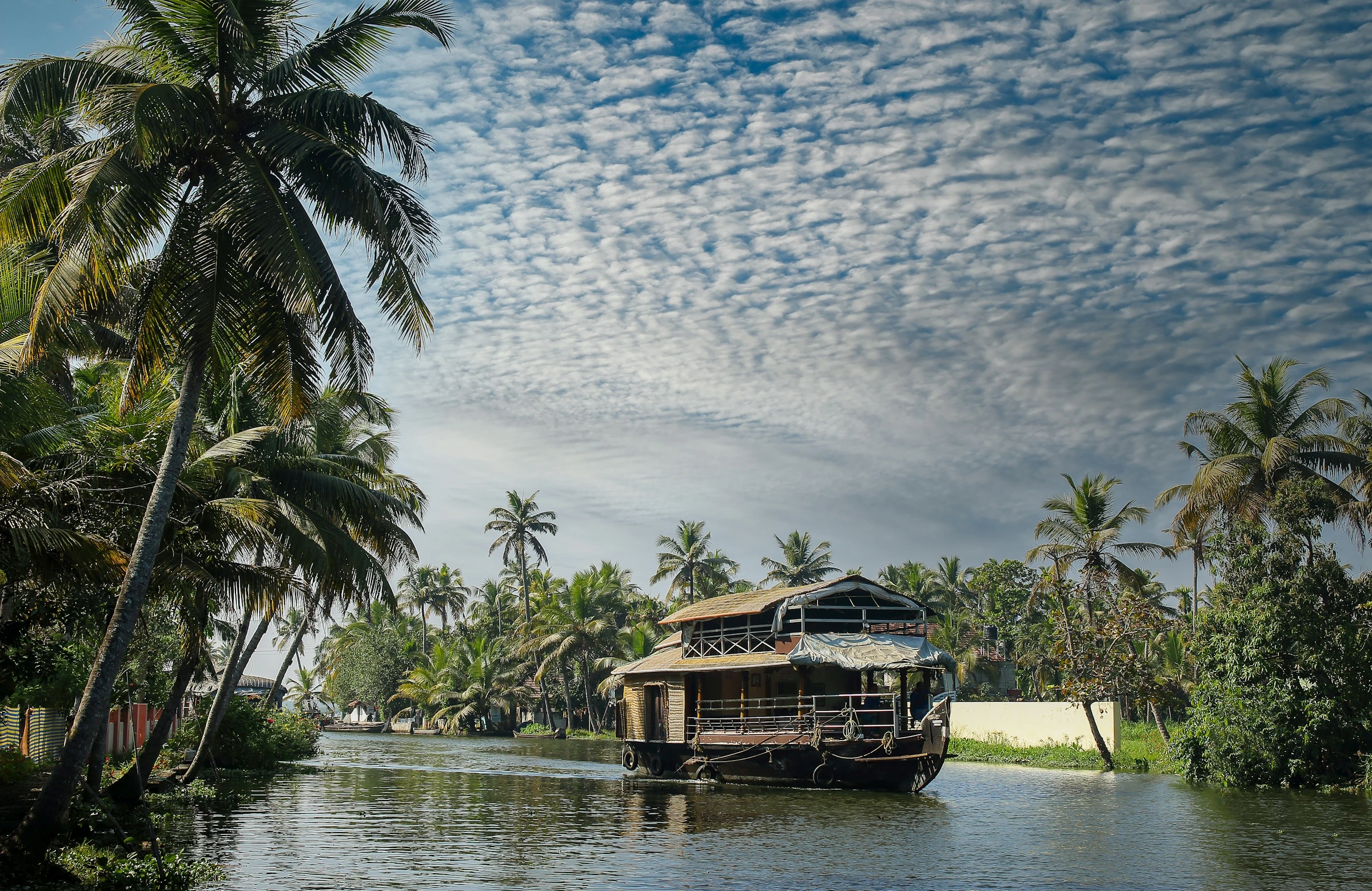
A houseboat on the Kerala backwaters, the maze of canals and lakes that defines the state's coast.
How do you get around Southern India?
For most first-time visitors, a private car with a driver is the practical backbone of a southern trip, with the train an excellent choice on a few specific legs and domestic flights reserved for the longest jumps. You do not hire a car to drive yourself; almost nobody visiting does.
A private car with driver is the normal way visitors cover ground in India: an air-conditioned sedan or small SUV with a professional driver who handles the traffic, waits at temples and knows where to stop for lunch. Indicative cost is roughly ₹4,000 to ₹8,000 per day including fuel, about USD 42 to 83, or GBP 31 to 62, at exchange rates in September 2026. Trains are genuinely good on certain runs, Chennai to Madurai for instance, and worth booking well ahead through the official reservation system, as popular services sell out weeks out. Within towns you will use auto-rickshaws, the three-wheeled open taxis known locally as autos, or app-based cabs; agree the fare before you set off if the meter is not running. As a rule of thumb, assume an average of 40 to 50 kilometres per hour, about 25 to 30 miles per hour, on most non-highway roads. Kochi to Munnar, for example, is only about 130 kilometres, roughly 80 miles, but takes around four hours because the last stretch climbs into the hills.
How long do you need for Southern India?
Ten days is enough for one state done well, two weeks covers two states at a sensible pace, and three weeks lets you add a third or simply slow down. The most common planning mistake is trying to fit all three states into a fortnight.
Ten days suits Kerala on its own: Kochi, the tea hills, the backwaters and a few days of beach or Ayurveda, without a single rushed morning. Two weeks is close to ideal for a combined Tamil Nadu and Kerala route, flying into Chennai and out of Kochi, which is the classic southern loop and the subject of our two-week South India itinerary. Three weeks is where the south really opens up: keep that fortnight spine and add a Karnataka week of Mysuru, Hampi and the Coorg coffee hills, or slow the whole thing to three nights a stop, which is the point at which a trip stops being an itinerary and becomes a stay. Anything under a week is better spent in one place than spread thin.
When is the best time to visit Southern India?
The reliable window for the south is roughly November to March, when both coasts are dry and the hills are cool without being cold. Within that, the specifics matter, because the south does not have one weather but several.
- November to March: the main season across the south, and the busiest, so book several months ahead for the peak weeks of December to February.
- October to December: watch the east coast. Tamil Nadu around Chennai and Puducherry catches the northeast monsoon in these months and can see heavy rain, while Kerala on the west is drying out and lovely.
- April and May: hot on the Tamil plains, frequently 35 to 40 degrees Celsius, roughly 95 to 104 Fahrenheit, and hard work in the temple towns, though the hill stations stay pleasant.
- June to September: the southwest monsoon, which makes landfall over the Kerala coast around the first of June each year. The state turns spectacularly green and cheaper, and some Ayurvedic practitioners consider the monsoon the best season for treatment, while Tamil Nadu sightseeing is less appealing.
If you want the full month-by-month picture across the country, our guide to the best time to visit India breaks it down region by region.
What does a trip to Southern India cost?
As a working figure, a well-organised private trip in comfortable boutique and heritage hotels typically lands between ₹150,000 and ₹250,000 per person for a two-week southern route, excluding international flights. That is about USD 1,560 to 2,600, GBP 1,160 to 1,940, or EUR 1,350 to 2,250 at rates current in September 2026.
The individual pieces move with season and demand, but as indicative components:
- Boutique or heritage double room: roughly ₹8,000 to ₹22,000 per night, about USD 83 to 229.
- Private car with driver: roughly ₹4,000 to ₹8,000 per day, about USD 42 to 83.
- A private overnight houseboat for two with all meals: commonly ₹15,000 to ₹35,000, about USD 156 to 365.
- A half-day walk with a specialist local guide: ₹2,500 to ₹6,000, about USD 26 to 63.
Exchange rates and local prices change, so treat every figure here as a planning range rather than a quotation, and confirm current rates when you book. The single biggest variable is not the country but your choice of accommodation: the same route runs at half this in simple homestays or three times it in palace hotels, and the temples and the backwaters are exactly the same in both. For a fuller breakdown by travel style, see our guide to how much a trip to India costs.
What is the food like, and how do you stay well?
Southern Indian food is one of the best reasons to come, and it is not the north Indian food most visitors know. It is largely rice-based, with each state cooking differently: vegetarian and lentil-forward in Tamil Nadu, coconut and seafood-rich in Kerala, and something all its own in the interior of Karnataka.
You will eat idli, steamed rice cakes, and dosa, a fermented rice and lentil crepe, for breakfast with sambar and coconut chutney. In Kerala the great set-piece meal is the sadya, a feast of a dozen or more vegetable dishes served onto a banana leaf and eaten with the right hand; in Tamil Nadu the everyday version is the banana-leaf meal or thali, rice with a rotating cast of curries, sambar, rasam and curd. To stay well, the rules are simple: drink bottled or filtered water with intact seals, eat where there is turnover because a busy stall frying fresh is safer than a quiet buffet holding food warm, give your stomach two or three days to adjust, and carry rehydration salts. Speak to a travel clinic or your own doctor about vaccinations and any anti-malarial advice well before you fly, because requirements vary by nationality and change over time. If food is a big part of your reason to travel, our guide to India's regional cuisines maps the country plate by plate.
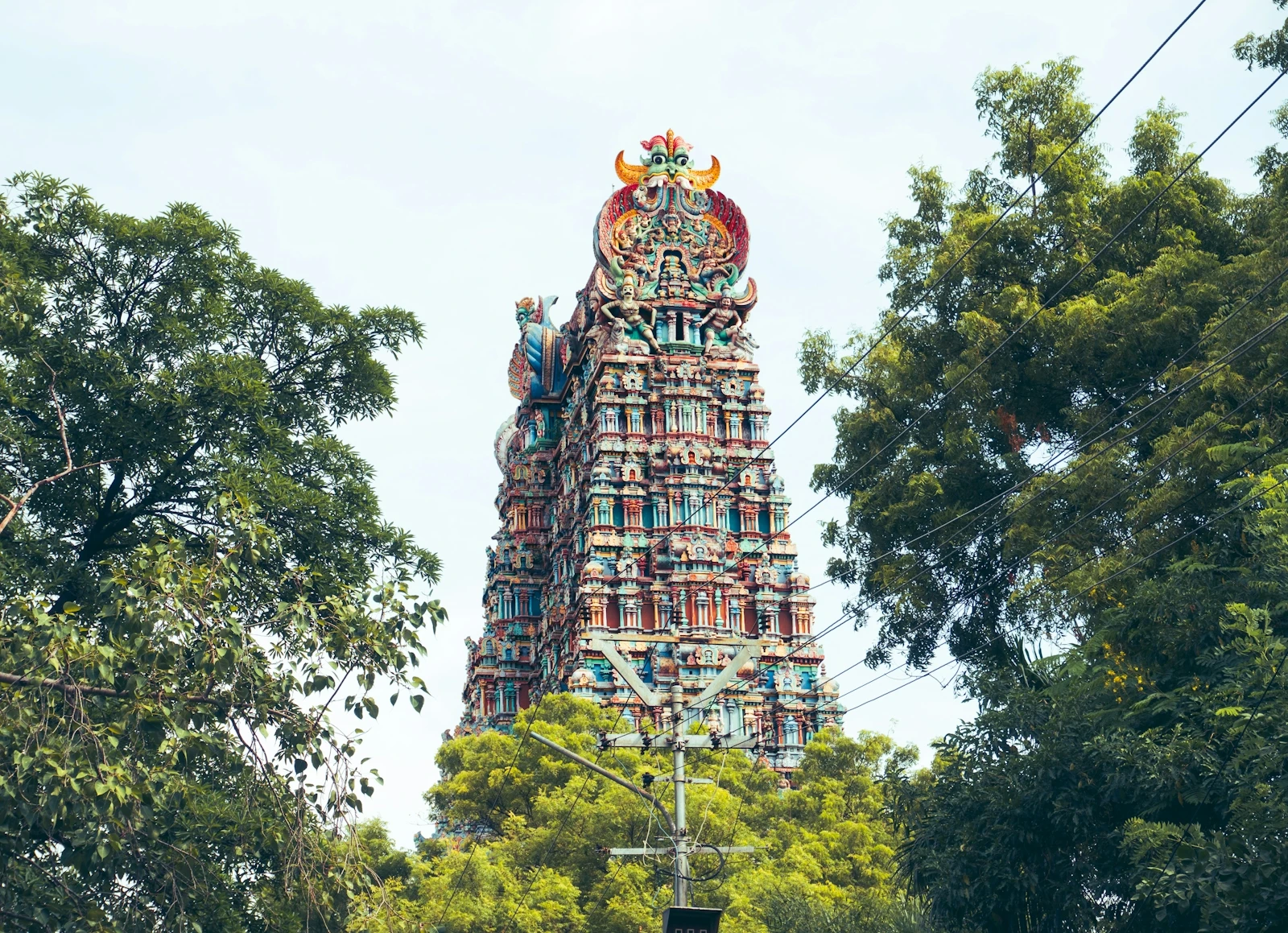
A gopuram, the sculpted gate tower that rises over the great temples of Tamil Nadu.
What should you wear, and how do temples work?
Dress modestly and comfortably: shoulders and knees covered in temples, loose cotton or linen against the heat, and shoes you can slip off dozens of times a day, because you remove them at the gate of every temple. This is the single etiquette point that most shapes a southern trip, because temples are so central to it.
A few things surprise first-timers. Some Tamil Nadu temples ask men to remove their shirts before entering the inner areas. Non-Hindu visitors are not admitted to the innermost sanctums of many South Indian temples, which is worth knowing in advance so it does not feel like a rebuff at the door. Photography is often restricted inside shrines, and you should always ask before photographing anyone at worship. Eat and pass objects with your right hand. Beyond temples, pack a warm layer for the hills, insect repellent, sunscreen and a plug adapter, and carry rupee cash for temples, drivers and markets even though cards work in hotels and cities. Much of what makes a temple legible rather than merely impressive is having someone explain what is happening at each shrine, which is where a good local guide earns their fee several times over.
Do you need a visa, and is Southern India safe?
Yes, you need a visa. Visitors from the UK, most of Europe, the United States, Canada, Australia and New Zealand require a tourist visa for India, and an electronic option has been available to many nationalities. Rules, fees, validity and eligible entry points change regularly, so apply only through the official Indian government e-visa portal and check the current requirements before you book flights, rather than relying on any article, including this one.
On safety, the south is generally considered among the more comfortable and straightforward regions of India for visitors, including solo women, with the usual sensible precautions: dress modestly, use booked transport rather than unmarked cars, avoid unlit areas late at night and keep valuables discreet. As of September 2026, the UK Foreign, Commonwealth and Development Office does not advise against travel to Kerala, Tamil Nadu or Karnataka; its warnings for India concern the far north and northeast, not the south. Always check your own government's current travel advice before you go, as advisories can change.
Who is Southern India best suited for?
Southern India suits couples, solo travellers wanting a gentler first taste of the country, older visitors who would rather not spend whole days in a car, and anyone whose interest is culture, food, landscape and wellbeing rather than ticking off monuments. If you want to come back rested rather than wrung out, this is the half of India to choose.
It works less well as a first choice for travellers whose hearts are set on the great northern icons. There is no Taj Mahal in the south, no Rajasthani desert fort, no Varanasi. Those are extraordinary and they are different trips. Families with young children can absolutely enjoy the south, particularly Kerala's beaches and backwaters, but will want to trim the temple-heavy days and keep transfers short. And travellers who measure a trip by how many famous sights they photographed will find the south quietly resistant to that way of travelling, which is rather the point of it.
What do first-time visitors get wrong about Southern India?
The commonest mistakes are all versions of trying to make the south behave like the north, or like a checklist.
- Cramming in three states in two weeks. Two states in a fortnight is already a firm pace; three is a blur of car journeys.
- Sightseeing at midday. Temples are at their best between six and nine in the morning and again after five; the middle of the day is for a long lunch and a rest.
- Treating the houseboat as the whole of Kerala. It is one memorable night of a far more varied state.
- Expecting Munnar to have coffee or a safari. Munnar is tea country; Kerala's coffee grows over in Wayanad and its easy wildlife is at Thekkady, while the region's coffee estates and big cats are mostly in Karnataka, around Coorg and Kabini.
- Booking Kerala for July and expecting sunshine, or Chennai for November and expecting dry weather.
- Underestimating road time, and packing a day with more driving than seeing.
Frequently asked questions
Is Southern India better than North India for a first trip?
Neither is objectively better, but the south is generally gentler for a first visit: shorter distances, less crowding, food that suits many palates and a slower rhythm. The north offers the Taj Mahal, Rajasthan and Varanasi, which are extraordinary but more demanding. Many people do the south first and save the north for a return trip.
How many states can I realistically cover in Southern India?
One state in ten days, two in a fortnight, three in about three weeks. The most reliable two-state pairing for a first trip is Tamil Nadu and Kerala, flying into Chennai and out of Kochi. Add Karnataka only if you have the full three weeks, or make it a trip of its own.
What language is spoken in Southern India, and will English be enough?
Each state has its own language: Malayalam in Kerala, Tamil in Tamil Nadu and Kannada in Karnataka, and they are unrelated to the Hindi of the north. English is widely spoken in hotels, tourism and cities, so you will manage comfortably, though a few words of the local language are always warmly received.
What is the best month to visit Southern India?
January and February are the safest all-round months: dry across the region, warm without the April heat, and cool in the hills. November and December are excellent in Kerala but can be wet on the Tamil Nadu coast. Book several months ahead for the peak December-to-February weeks.
Is Southern India safe for solo female travellers?
It is generally considered one of the more comfortable parts of India for solo women, with the usual precautions of modest dress, booked transport and avoiding unlit areas late at night. Always check your own government's current advice before travelling.
Do I need a car and driver, or can I use trains?
Both, ideally. A private car with driver is the practical backbone for temple towns and hill roads, while trains are excellent on a few longer flat legs. Most well-planned southern trips mix the two rather than relying on either alone.
Planning a Southern India trip that fits you
Southern India is not a checklist of sights. It is a rhythm: a temple at dawn, a long banana-leaf lunch, a road that climbs into cloud, a canoe down a canal too narrow for anyone else. Get the pace right and the south gives back far more than it asks, which is why so many first-time visitors to India quietly end up starting here.
We design private, personalised journeys through Kerala, Tamil Nadu and Karnataka for visitors who want depth rather than a checklist, shaped around your own dates, pace and interests. If you would like a southern India trip built around the way you actually want to travel, Plan my India trip