Type "Kerala holiday packages" into a search engine and you will mostly find the same five days on repeat: a houseboat night, a tea garden, a Kathakali show, a beach, and a spa massage sold as Ayurveda. It looks full and photographs well, and it misses the one thing Kerala is actually good for, which is slowing a person down.
This guide is for someone flying in from London, Frankfurt, New York, Toronto or Melbourne who has never travelled in India, is comparing Kerala holiday packages, and suspects there is a better version than the coach-tour checklist. There is. It asks you to see less and feel more, and treats wellbeing as the point rather than an add-on. Here is how to plan it, what it costs in your own currency, and how to tell a real package from a repackaged one.
What is a Kerala holiday package, really?
A Kerala holiday package is simply a pre-arranged trip: stays, transport, a driver and a set of experiences booked as one. What varies is the thinking behind it. A weak package strings together sights to look generous; a good one is a sequence with a rhythm, built around how you want to feel by the end. The reframe here is simple: instead of measuring a package by how many places it crams in, measure it by how well it lets you rest, eat well, move gently and pay attention. Kerala rewards that choice more than any other Indian state, because its landscape is quiet water, hills and coast rather than monuments you must queue for.
Why choose wellness over sightseeing in Kerala?
Because Kerala's real assets are restorative, not monumental. There is no Taj Mahal here, no single icon you have flown around the world to tick off. Instead there is the traditional home of Ayurveda, a coastline of calm backwaters, tea hills at a cool altitude, and a food culture built on rice, coconut and vegetables, and each of these is better slow. In my experience running trips here, the travellers who leave happiest are not the ones who saw the most, but the ones who booked three nights somewhere instead of one, walked a tea estate rather than driving between viewpoints, and gave a genuine Ayurvedic course enough days to work.
What do the best Kerala holiday packages include?
The best Kerala holiday packages include fewer stops held for longer, at least one genuine strand of Ayurveda or yoga, unhurried backwater and hill time, and meals treated as part of the therapy rather than an afterthought. A typical week-to-ten-day shape pairs a few nights of Ayurveda or restorative stay near the coast with a spell in the tea hills, a night or two on the backwaters, and a short cultural window in a heritage town such as Fort Kochi. Crucially, the days are not packed: one meaningful thing before lunch, a long slow afternoon, and an early night is the correct pace. If a package promises three activities a day for ten days, it is selling you sightseeing with a wellness label on the tin.
We plan private Kerala trips around Ayurveda, the backwaters and the tea hills, with handpicked stays, a dedicated driver and local guides chosen for what you care about. Every route starts with your dates and pace, and our team stays on hand while you travel if plans need to change. Plan a tailor-made Kerala trip.
How do you tell real Ayurveda from a spa menu?
The clearest test is whether a qualified Ayurvedic physician assesses you before any treatment begins. Real Ayurveda starts with a consultation: a doctor takes your pulse, asks about your digestion, sleep and constitution, then prescribes a course. A spa hands you a menu and asks which oil you would like. Both can feel pleasant, but only one is medicine. Two more signals help. First, duration: genuine treatment is prescribed over days, not sold as a single one-hour massage. Second, official recognition: Kerala's Department of Tourism classifies approved Ayurveda centres against a checklist covering the physician's qualifications, the therapists' training and the facilities. This long ran as the Green Leaf and Olive Leaf grades and is moving to a newer tiered system, so the exact label may be in transition, but what matters is that the centre is classified by Kerala Tourism at all, which you can check on the official Kerala Tourism site. A serious operator will name the physician without being pushed; if the answer is vague, treat the "Ayurveda" as a spa. Our guide to telling real Ayurvedic treatment from a spa menu goes deeper.
How many days do you need for genuine Ayurveda?
Enough to complete a course, which usually means allowing a minimum of a week, and ideally two or three, if rejuvenation or Panchakarma is your aim. A single massage on a general holiday is a fine treat, but it is not treatment. Panchakarma, the deep cleansing and rebalancing programme at the heart of classical Ayurveda, is a staged process of preparation, elimination and recovery, and it cannot be rushed into a two-day slot. Physicians commonly prescribe programmes of roughly seven, fourteen or twenty-one days depending on your constitution and goals, with the diet and daily routine forming part of the cure. Because the specifics are medical and personal, agree the length with the consulting physician, not a booking form.
When is the best time for a wellness holiday in Kerala?
For a general Kerala holiday, the dry window from roughly September or October to March is the reliable choice: warm on the coast, cool without being cold in the hills. It is also the busiest and priciest stretch, so book several months ahead for the December to February peak. The interesting exception is Ayurveda. Kerala's own tradition holds that the monsoon, from about June to September, is the ideal season for treatment, and the Malayalam month of Karkidakam, roughly mid-July to mid-August, is the classic season of rejuvenation. The reasoning is that cool, humid, rain-washed air is believed to leave the body more receptive to the oil therapies at the core of a course, as Kerala Tourism itself explains, and rates are lower with the hills at their greenest. If your holiday is mostly about Ayurveda, do not rule out the monsoon; for a broad first trip with beaches and hills, aim for the dry months. Our guide to the best time to visit India sets Kerala in the national picture.
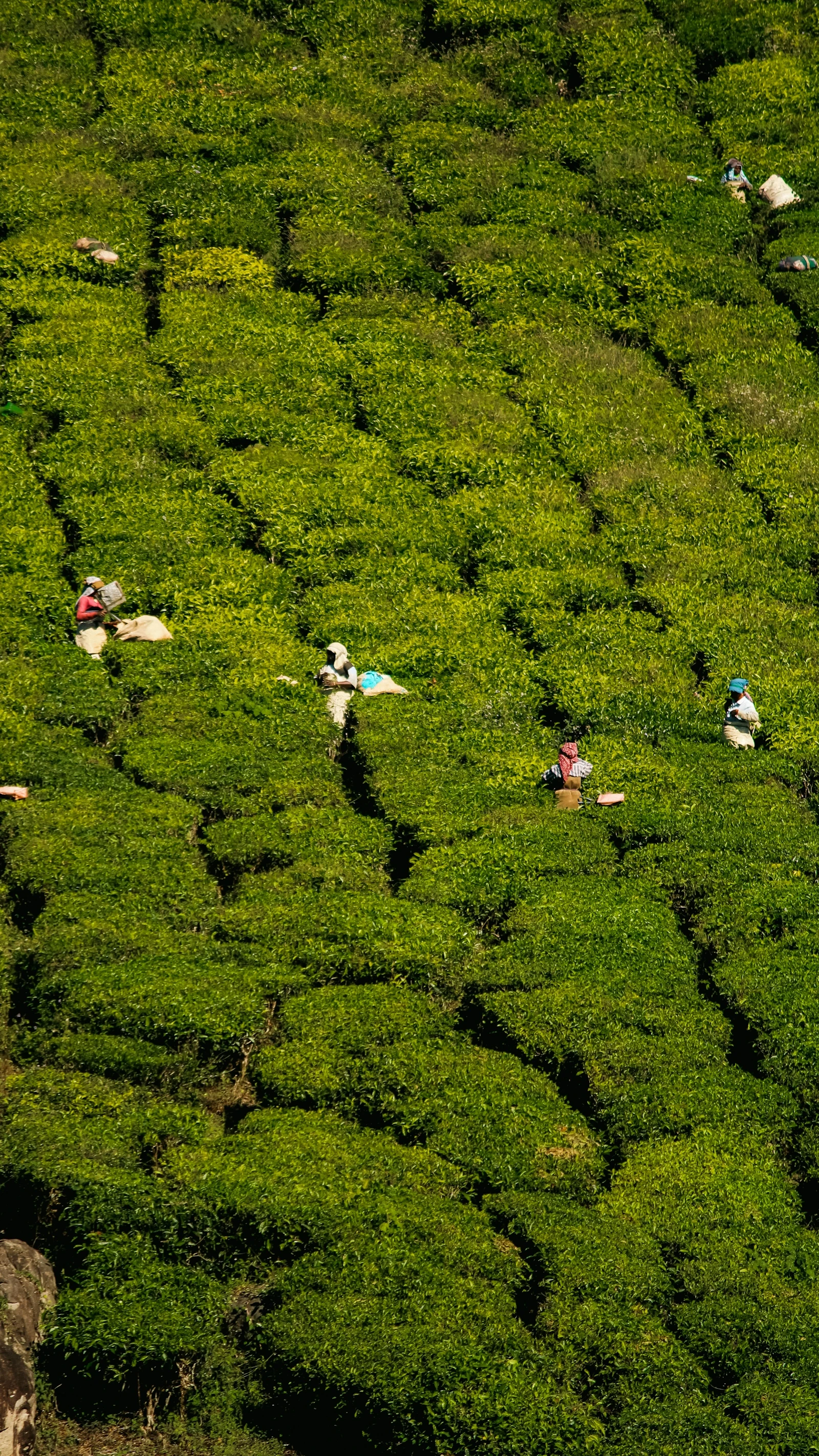
Walking the tea slopes above Munnar, better done slowly than from a car window.
How much does a wellness-led Kerala package cost?
As a working figure, a private wellness-led Kerala trip of seven to ten nights in comfortable boutique and heritage stays, land only, typically lands between ₹120,000 and ₹220,000 per person. That is roughly USD 1,250 to 2,300, GBP 945 to 1,730, or EUR 1,100 to 2,020 at exchange rates current in late September 2026, when one US dollar was about 96 rupees, one pound about 127, and one euro about 109. Rates and local prices move, so treat every figure here as a planning range, not a quotation.
Indicative components, all of which shift with season, standard and demand:
- Boutique or heritage double room: roughly ₹8,000 to ₹22,000 per night, about USD 85 to 230, or GBP 63 to 173.
- Private car with driver: roughly ₹4,000 to ₹8,000 per day including fuel, about USD 42 to 83, or GBP 31 to 63.
- A genuine residential Ayurveda day, with accommodation, prescribed meals, physician oversight and treatments: commonly ₹6,000 to ₹20,000 per person per day, about USD 63 to 208, or GBP 47 to 157, depending heavily on the centre.
- Private overnight houseboat for two, all meals included: commonly ₹15,000 to ₹35,000, about USD 156 to 365, or GBP 118 to 275.
- A single standalone spa massage: roughly ₹1,500 to ₹4,000, about USD 16 to 42, or GBP 12 to 31, worth knowing to spot when a "package" is really a stack of one-off treatments.
The largest variable is never the country; it is your choice of stay. The same route runs at half this in simple homestays or three times it in palace-grade properties, and the backwaters and the physician's hands are much the same in both. For context, see our transparent breakdown of India trip costs.
Where should a wellness Kerala package take you?
A strong wellness route links three or four settings rather than a long list of towns: a stretch of coast for Ayurveda or beach recovery, the tea hills for cool air and walking, the backwaters for stillness, and a short heritage stop for culture and departure. A restful ten-night version might run Fort Kochi for two nights to land and adjust, the tea hills around Munnar for two or three, the backwaters near Alleppey for two including one on the water, and the coast for three at the end for Ayurveda by the sea. It keeps driving days short and never asks you to repack every morning. If you would like it laid out day by day, our ten-day Kerala itinerary walks the same arc.
What is a night on the backwaters actually like?
Quieter than the brochures suggest, and better for it. The Kerala backwaters are a network of lakes, rivers and canals running parallel to the coast, with villages along the banks, and you spend the night on a private houseboat, a converted rice barge called a kettuvallam, with a small crew who cook for you. The detail most people miss is that houseboats generally moor by late afternoon rather than cruising after dark, so the evening is spent tied to a bank, listening to water and birdsong over a plate of just-caught fish. The version worth asking for adds a smaller punted village canoe, sometimes called a shikara, because the narrow canals a bulky houseboat cannot enter are where the real life of the backwaters goes on. One night afloat is memorable; two can feel confining, so pair it with a night on land. Our piece on a night on a Kerala houseboat covers it in full.
Resort, homestay or Ayurveda centre: where should you stay?
Match the stay to the strand of the trip. For serious Ayurveda, stay at the classified centre itself, because the prescribed diet, daily routine and treatment timings are easier to keep under one roof. For the hills and backwaters, a small boutique property or a family homestay gives you more of Kerala than a large resort does. Homestays are a quiet strength here: waking in a family home in the paddy country and eating what the household eats is restorative in a way no spa treatment matches. A good package mixes registers on purpose, with one or two refined nights and the rest in characterful, human-scale places. Comfort helps a wellness trip; insulation from the place works against it.
How do you get around Kerala?
For a wellness-led package, a private air-conditioned car with a driver is the most practical option on almost every day, with the occasional train a pleasant alternative. This is not a chauffeur in the luxury sense; it is the normal way visitors cover ground in India, with a professional driver who handles the traffic and waits while you are in a treatment or on a walk. Distances are short by Indian standards: Kochi's airport to the Munnar hills is around four hours, roughly 110 kilometres or 68 miles, and Kochi to the Alleppey backwaters is about an hour and a half, roughly 55 kilometres or 35 miles. Kerala has four airports, at Kochi, or Cochin (airport code COK), Thiruvananthapuram (TRV), Kozhikode (CCJ) and Kannur (CNN), so a well-planned package can fly you in and out of different ones to avoid backtracking. Within towns you will use auto-rickshaws, the three-wheeled open taxis known locally as autos, or app-based cabs.
What should you eat on a wellness trip to Kerala?
Simply, and often vegetarian. Kerala's everyday food is built on rice, coconut, vegetables, lentils and, on the coast, fresh fish, and it is naturally light before anyone calls it wellness. The classic meal is the sadhya, rice and many vegetable dishes served on a banana leaf and eaten with the right hand. On a genuine Ayurvedic course the physician prescribes a specific diet as part of the treatment, worth following rather than slipping out for something rich. Otherwise the usual first-trip advice applies: drink bottled or filtered water only, eat where there is high turnover, and carry rehydration salts.
Do you need a visa, and what about vaccinations?
Yes, most visitors need a tourist visa, and you should confirm the current rules yourself rather than rely on any article, including this one. Travellers from the UK, most of Europe, the United States, Canada, Australia and New Zealand require a tourist visa for India, and an electronic option has been available to many nationalities. Fees, validity, eligible entry points and the process change over time, so apply only through the official Indian government e-visa portal and check before booking flights. For health, speak to a travel clinic or your own doctor about vaccinations and any anti-malarial advice well before you travel, as guidance varies by nationality, region and season.
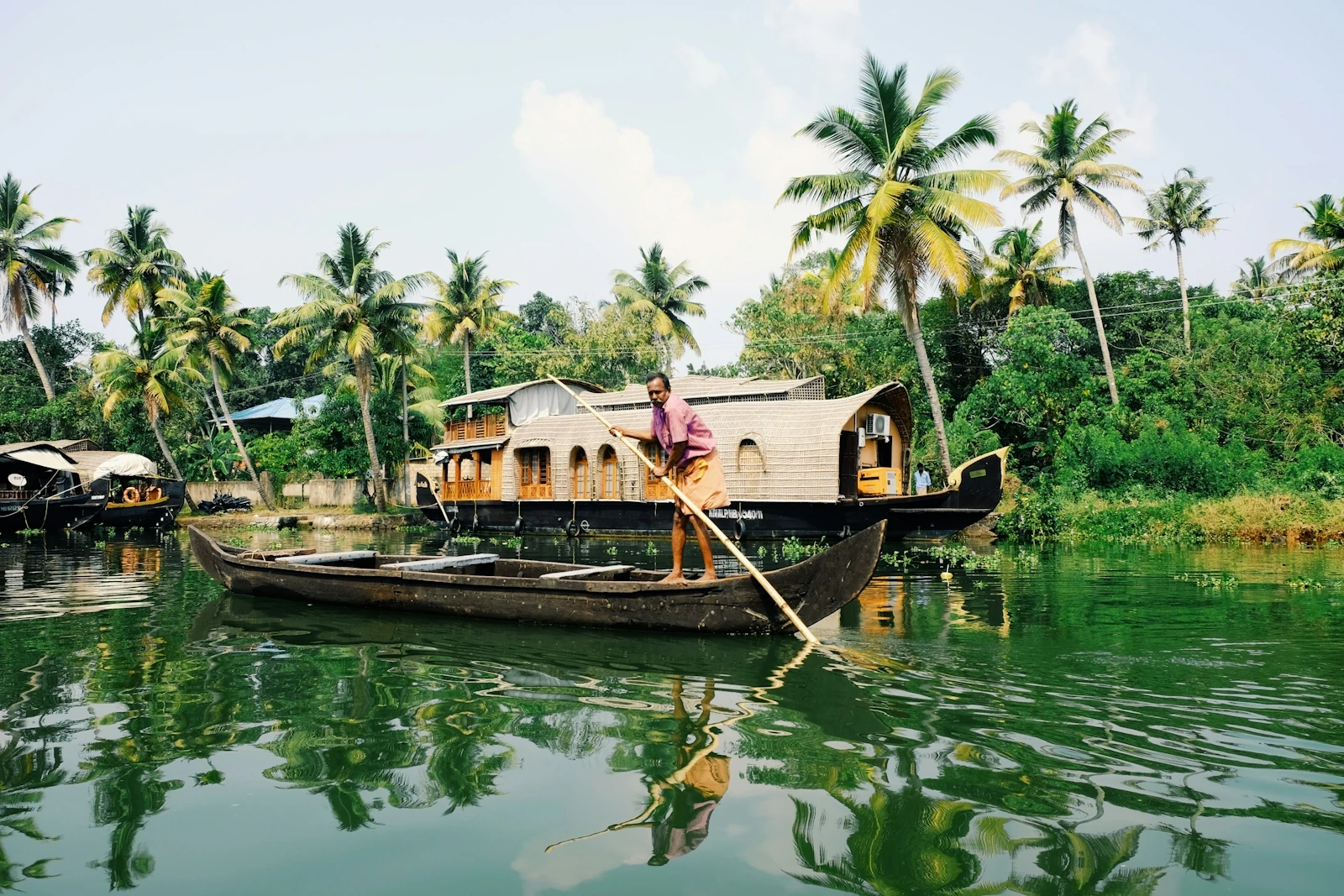
A punted village canoe reaches the narrow canals a houseboat cannot.
Is Kerala safe for a wellness holiday, including solo travellers?
Kerala is generally considered one of the more relaxed and straightforward Indian states for visitors, including solo women, with the usual sensible precautions. As of September 2026, neither the UK Foreign Office nor equivalent advisories single out Kerala or the wider south as areas to avoid. The UK's Foreign, Commonwealth and Development Office concentrates its warnings on regions well to the north, such as Jammu and Kashmir, the immediate India-Pakistan border area, and Manipur in the northeast, none of which is near this route. You can read the current guidance on the FCDO India travel advice page, and US travellers can check the State Department's India information. Otherwise the ordinary rules apply: dress modestly, use booked transport late at night, and check advisories close to your departure date.
What should you pack, and how do treatments and etiquette work?
Pack loose, modest, breathable clothing, a warm layer for the hills, and easy shoes you can slip off often. Shoulders and knees should be covered at temples and, generally, at Ayurveda centres, where treatments are given in simple provided garments and modesty is respected throughout. Munnar's mornings can drop to around twelve to fifteen degrees Celsius, roughly the mid to high fifties Fahrenheit, so a fleece earns its place even on a tropical itinerary. Bring insect repellent, sunscreen, a plug adapter, and an Indian tourist SIM or eSIM bought before departure. Cards and mobile payments work in hotels and cities, but carry rupee cash for drivers, small eateries and markets. Eat and pass objects with your right hand, ask before photographing anyone at worship or mid-treatment, and expect an early-to-bed, early-to-rise rhythm, which is part of what makes a wellness trip work.
What do first-time visitors get wrong about Kerala packages?
Mostly, they try to do too much, and they mistake a spa for Ayurveda. The most common mistakes we see:
- Booking too many stops. Three or four settings over a week to ten days is right; seven towns is a sightseeing trip wearing a wellness label.
- Treating one houseboat night as the whole of Kerala. It is one restful strand of a far more varied state.
- Confusing a resort spa with a classified Ayurveda centre and a consulting physician.
- Booking a dry-season beach holiday and expecting deep Ayurveda, or booking Karkidakam in the monsoon and expecting constant sunshine.
- Staying only in top-tier resorts and never meeting a Kerala family, which quietly removes the best part of the place.
Who is a wellness-led Kerala package best suited for?
It suits couples, solo travellers wanting a gentle and safe first taste of India, and anyone in need of a genuine reset rather than a busy holiday. It works especially well for people whose interest is rest, food, landscape and wellbeing rather than monuments and hard sightseeing. It works less well for travellers who want a fast, many-cities trip, or for families with young children who need pools and very short transfers, though it adapts easily by leaning into the beach and dropping the contemplative days. And if your heart is set on the Taj Mahal, Rajasthan's forts or a tiger safari, be honest with yourself: that is a northern trip, and Kerala will feel too slow.
Frequently asked questions
What is the best Kerala holiday package for wellness?
The best wellness package is a shape rather than a fixed product: fewer stops held longer, at least one genuine strand of Ayurveda under a qualified physician, and days that are not overloaded. Judge it by its pace and its Ayurveda credentials, not by how many places it lists.
How much does a Kerala holiday package cost per person?
A private, wellness-led trip of seven to ten nights in comfortable stays, land only, typically runs between ₹120,000 and ₹220,000 per person, about USD 1,250 to 2,300 or GBP 945 to 1,730 at late-September 2026 rates. Simpler homestays cost far less, palace-grade stays far more, so treat all figures as planning ranges.
Is Ayurveda in Kerala worth it, or is it just a massage?
It is genuinely worth it when it is real, and largely pointless when it is not. Real Ayurveda begins with a physician's consultation and runs as a prescribed course over days at a Kerala Tourism classified centre; a single oil massage at a resort spa is relaxing but is not treatment.
When is the best time to visit Kerala for a wellness trip?
For a general wellness holiday, September or October to March is warm, dry and comfortable. For serious Ayurveda, Kerala's own tradition favours the monsoon from June to September, and Karkidakam in particular, when the humid air is believed to make the body more receptive to treatment.
Is Kerala safe for solo and first-time travellers?
Kerala is generally regarded as one of the easier and more relaxed Indian states for visitors, including solo women, with normal precautions, and as of September 2026 mainstream government advisories do not warn against travel to Kerala. Always check your own government's current advice close to departure.
Do I need a visa for a Kerala holiday?
Yes. Most international visitors need an Indian tourist visa, and an electronic option is available to many nationalities. Rules, fees and eligible entry points change, so apply only through the official Indian government portal and confirm current requirements before booking.
Planning your own wellness-led Kerala trip
A good Kerala holiday package is not a longer list of sights. It is a shorter one, arranged with care: a physician's consultation before a treatment, a tea path walked slowly, a boat that stops before dark, a family table instead of a buffet. We design private, personalised Kerala holiday packages for visitors who want wellbeing and depth rather than a checklist. If you would like this route shaped around your own dates, pace and health goals, Plan my India trip