The phrase most people picture when they hear wellness travel in India is a luxury spa with an Ayurvedic menu, or a week of photogenic yoga poses at dawn. Both exist, and both mostly miss the point. What India actually offers is older, quieter and closer to medicine than to pampering: a system of treatment with a resident doctor, a physical practice that began here as a discipline rather than a workout, and landscapes used for rest and repair for centuries.
This guide is for someone flying in from London, Frankfurt, New York, Melbourne or Toronto who wants to come home lighter rather than more tired, and who has never done this before. It explains the four threads a good wellness trip is woven from, Ayurveda, yoga, sound and forest, then answers the practical questions: how long you need, when to come, what it costs in your own currency, and whether it is safe. I have planned a lot of these trips, and I will be honest about what works and what does not.
What does wellness travel in India actually mean?
Wellness travel in India means a trip built around restoring your health rather than seeing sights, using native traditions rather than spa imitations: some combination of Ayurvedic treatment, yoga, meditation, sound and time in restorative landscapes.
The distinction that matters is between wellness as decoration and wellness as substance. A hotel that offers an aromatherapy massage and calls it Ayurveda is selling decoration; a centre where a doctor reads your constitution, prescribes a course of treatment and diet, and treats you daily for a week is offering the substance.
Why does India suit a wellness trip more than an ordinary spa holiday?
India suits a wellness trip because the practices you are paying for were developed here, are still in daily use, and are supervised by trained practitioners rather than repackaged for tourists. You are closer to the source, and it usually costs less than abroad.
Ayurveda is a formally recognised system of medicine in India, regulated by the government's Ministry of AYUSH, with its own colleges, hospitals and a national accreditation scheme for clinics. Yoga was born here, and the United Nations named 21 June the International Day of Yoga in 2014 at India's proposal. None of that guarantees quality on its own, but it means the depth is real, and that with a little care you can reach practitioners who trained for years, not a weekend.
The four threads: Ayurveda, yoga, sound and forest
A wellness route through India is strongest when it braids four threads rather than leaning on one, each doing a different job. Ayurveda is the medical thread: treatment, diet and rest under a doctor. Yoga is the physical and mental thread: breath, movement and stillness. Sound is the subtle thread, working on the nervous system through singing bowls, chanting and gongs. Forest is the thread most people forget but often remember longest: unhurried time under trees. You do not need all four in one trip. Two, done properly, beat four done shallowly.
We plan private Kerala trips around Ayurveda, yoga and quiet time in nature, with handpicked stays, a dedicated driver and local guides chosen for what you care about. Every route starts with your dates and pace, and our team stays on hand while you travel if plans need to change. Plan a tailor-made Kerala trip.
Where do you go for authentic Ayurveda?
Kerala, on the southwest coast, is the heartland of authentic Ayurveda, and where you should go for treatment you can trust. The tradition is strongest there, and the humid climate is considered ideal for the oil-based therapies at its centre. Look for a residential centre rather than a hotel spa. The retreats worth your time start the same way: a consultation with an Ayurvedic physician who reads your prakriti, your individual constitution, before anything is decided. Only then does a plan follow, usually two treatments a day, an all-vegetarian diet cooked in the same kitchen, medicines included, and rest built in. A serious course of panchakarma, the deep-cleansing programme at the core of Ayurveda, runs from one to three weeks. A single afternoon massage is not Ayurveda any more than one painkiller is a course of treatment. India's accreditation body certifies Ayurveda hospitals, so ask whether a centre is accredited and whether a doctor is resident.
How do you tell real Ayurveda from a spa massage?
You tell them apart by whether a doctor is involved before the treatment is. Real Ayurveda begins with a consultation and a diagnosis. A spa begins with a menu.
A few honest signals: a genuine centre asks about your health, sleep, digestion and history before it touches you, and may decline a treatment that does not suit you. The food is part of the prescription, not a buffet. Abhyanga, the warm-oil massage most visitors meet first, is one step in a sequence, not the whole offering. If the only question you are asked is which oil you would like, you are in a spa.
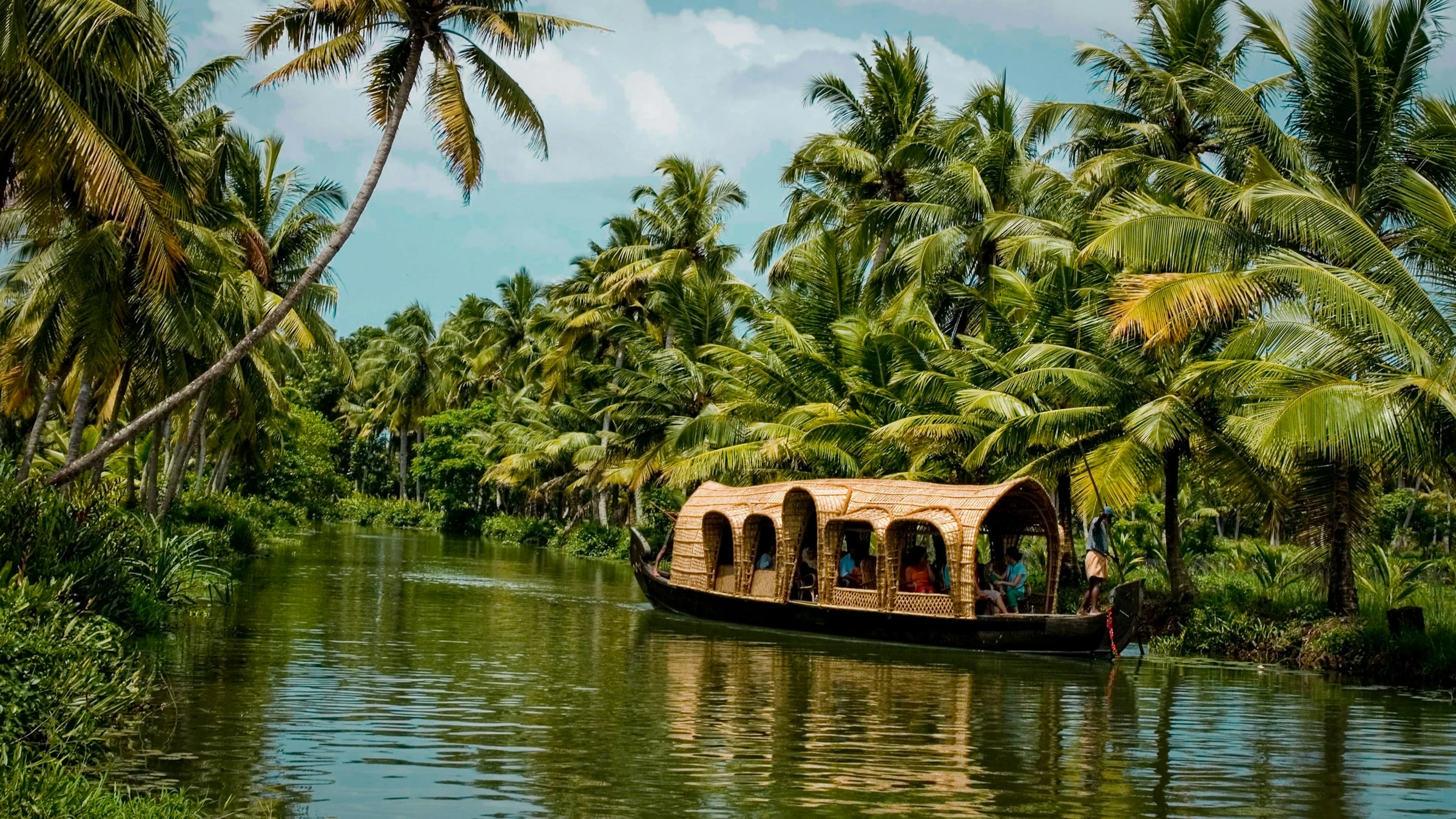
Kerala's backwater country, the heartland of authentic Ayurveda.
Where should you actually practise yoga in India?
For most first-time visitors the two best yoga bases are Rishikesh in the Himalayan foothills and Mysore in the south, with Goa a gentler third. Where you go depends on the style you want and the atmosphere you can enjoy.
Rishikesh, where the Ganges leaves the mountains for the plains, is the most famous, dense with schools teaching hatha and the wider practice, from a drop-in class to a month-long teacher training. Mysore is the home of Ashtanga, the vigorous, sequenced style, taught in small shalas, the word for a yoga hall, where you take a room, eat simple vegetarian meals and practise early each morning. Goa suits those who want yoga beside the sea and a softer pace. Whichever you choose, remember that yoga here is more than asana, the postures; it includes pranayama, breath work, and meditation, and the best classes treat it that way.
What is a sound healing session, and where do you find one?
A sound healing session is an hour or so of lying still while a practitioner plays singing bowls, gongs and sometimes the voice, letting the vibration settle your nervous system. You do nothing except listen, and most people are surprised by how physical the effect is. Rishikesh, Varkala in Kerala and the yoga towns are where you find them.
The best ones I have sat in are small: six or eight people on the floor of a plain room, no theatre to it, the sound washing over you until you lose track of time. A single session is a low-risk way to try something that sounds unlikely on paper. None of it asks you to believe anything; you just lie down and stop.
What is forest bathing, and where does India do it well?
Forest bathing means slow, attentive time in woodland, and India has practised a version of it for centuries through its sacred groves and hill forests. It is the restorative thread most wellness itineraries leave out, and the one I most often add back in.
The two forms worth seeking are the guided nature walk and the sacred grove. A good nature walk in the Himalayan foothills near Rishikesh, or in the Western Ghats hills of Kerala, is led by a village naturalist who names the birds, the trees and the medicinal plants. Sacred groves are older and stranger: patches of forest that communities have protected for generations by custom, where nothing may be removed, not a fallen leaf or a stone, and the rule is kept by belief rather than a ticket gate. Kerala's are called kavu; Meghalaya, in the northeast, has the Mawphlang sacred grove near Shillong, listed on India's official tourism portal, where a guide explains what may and may not be done. Standing in one is the closest thing to a cathedral a forest can be.
A suggested wellness route at a glance
A good wellness trip is built around one anchor, usually an Ayurveda course. A restorative two- to three-week shape that works well is: a week or more in Kerala for Ayurveda; then a flight north for four to five nights in Rishikesh for yoga, meditation and sound; and, if you have a third week, a forest extension, either two or three nights in the Himalayan foothills near Rishikesh, or a longer add-on to Meghalaya's sacred groves in the northeast. If your interest is chiefly yoga rather than treatment, swap the Kerala week for Mysore. Getting the sequence and pacing right is most of the work of planning a trip like this; our first-timer's roadmap to India covers the wider logistics. Ten days is one anchor done properly. Three weeks is where a wellness trip stops being an itinerary and becomes a stay.
How long do you need for a wellness trip to India?
You need at least ten days for the trip to do its job, two weeks to combine two threads comfortably, and three weeks to add a forest extension without rushing. Anything shorter than a week is a taste rather than a treatment.
Ayurveda in particular does not respond to a long weekend. A doctor will tell you plainly that a meaningful course runs a week at the very least, and that panchakarma wants two to three, and yoga and sound reward repetition too. If you only have a week, spend it in one place on one thread rather than scattering it.
When is the best time to travel for wellness?
For most wellness travel the strongest window is November to March, when most of India is dry and comfortable, as our month-by-month guide to the best time to visit India sets out. But Ayurveda is the interesting exception, because Kerala's monsoon is traditionally considered its best season. Kerala Tourism itself explains that Karkidakam, the Malayalam month falling around mid-July to mid-August, is regarded as the ideal time for rejuvenation therapy, because the cool, humid, rain-washed air is thought to make the body most receptive to treatment. It is also the quietest and greenest season, though a monsoon trip should be a treatment trip, not a sightseeing one. Come in winter for a broad wellness trip, and consider the monsoon if Ayurveda is the whole reason you are travelling.
How do you get between these places?
Within a region a private car with a driver is the most practical way to move, and between regions you fly, since a wellness route spanning Kerala and the Himalaya is a country apart at each end.
Inside Kerala or around Rishikesh, hire an air-conditioned car with a professional driver, at roughly INR 4,000 to 8,000 a day including fuel, about USD 42 to 83, or GBP 31 to 62. Between the far south and the north, take a domestic flight: Kochi to Delhi or to Rishikesh's nearest airport at Dehradun is a short hop that saves days. From Dehradun airport, Rishikesh is about an hour away, roughly 35 kilometres or 22 miles. Within towns you will use the auto-rickshaw, the three-wheeled open taxi known locally as an auto, or an app cab; agree the fare first if there is no meter.
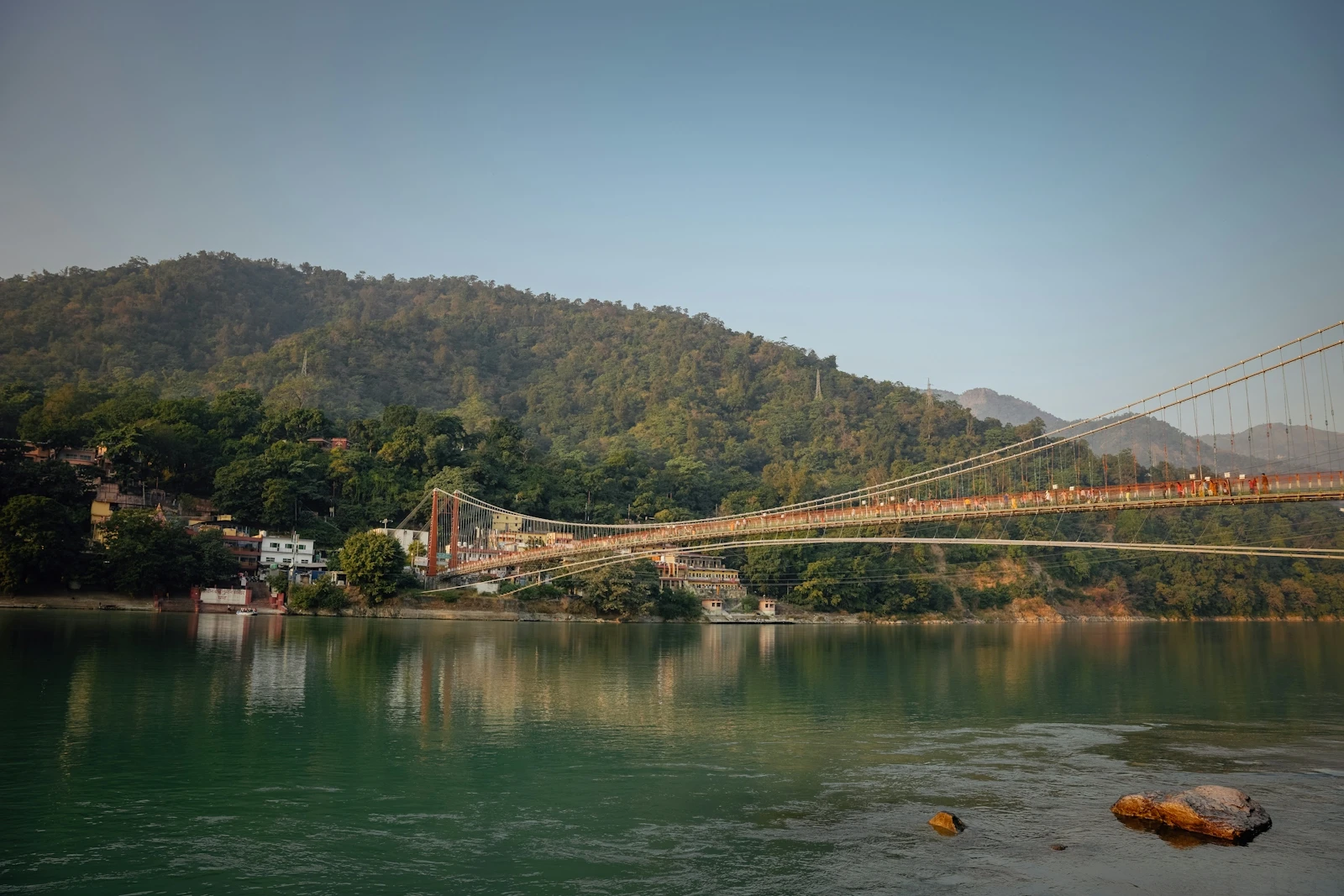
Rishikesh, where the Ganges leaves the mountains, is a base for yoga, sound and forest walks.
What does a wellness trip to India cost?
A well-organised two- to three-week wellness trip in comfortable places typically lands between INR 150,000 and 350,000 per person, excluding international flights. That is roughly USD 1,560 to 3,650, GBP 1,160 to 2,715, or EUR 1,360 to 3,180, at rates current in September 2026. Exchange rates and prices move, so treat every figure as a planning range, not a quotation. Indicative components, all of which shift with season and standard:
- Authentic Ayurveda retreat, full board with a doctor and daily treatments, per night for two: roughly INR 10,000 to 25,000, about USD 105 to 260, or GBP 78 to 194.
- Yoga stay with a room, meals and shala access: roughly INR 3,000 to 6,000 per person a night, about USD 31 to 63, or GBP 23 to 47.
- Group sound healing session: roughly INR 1,000 to 2,000 per person, about USD 10 to 21, or GBP 8 to 16.
- Guided nature or sacred-grove walk with a naturalist: roughly INR 1,500 to 6,000, about USD 16 to 63, or GBP 12 to 47.
- Private car with driver: roughly INR 4,000 to 8,000 a day, about USD 42 to 83, or GBP 31 to 62.
The largest variable is not the country, it is where you sleep. The same route runs at half this in simple ashrams and homestays, or several times it in flagship wellness resorts, and the treatment is often the same in both.
Is a wellness trip to India safe, and are there regions to avoid?
Yes, the parts of India this kind of trip visits, Kerala, the Rishikesh area and Mysore, are generally considered comfortable and straightforward for visitors. But a few regions do carry official warnings, and it is worth knowing which. As of September 2026 the US State Department places India at Level 2, "exercise increased caution", and both it and the UK Foreign Office advise against travel to the Union Territory of Jammu and Kashmir, to areas within about 10 kilometres of the India-Pakistan border, and to Manipur, with further "reconsider travel" cautions for parts of central and eastern India and some northeastern states. None of the core wellness destinations is affected, and Meghalaya's tourist areas around Shillong are not on the do-not-travel lists, though the wider northeast carries mixed advice. The US advisory also currently advises against women travelling entirely alone in India. Safety guidance changes, so verify your own government's latest advice before you book rather than relying on any article, including this one.
What should you know about food, etiquette and treatment?
Wellness settings in India are usually vegetarian, often alcohol-free, and quieter than a resort. On an Ayurveda course the food is part of the treatment, not a restriction to work around. Dress modestly in and around ashrams and treatment centres: shoulders and knees covered, loose cotton or linen. Drink only bottled or filtered water and give your digestion a few days to settle. During Ayurvedic treatment, follow the doctor's advice on food, rest and alcohol, because the diet is doing half the work. Remove your shoes where asked, eat and pass things with your right hand, and ask before photographing anyone at practice. Speak to a travel clinic about vaccinations well before you fly, since requirements vary by nationality and are best confirmed officially.
Who is a wellness route through India best suited for?
This kind of trip suits people who want to come back rested rather than with a full camera. It works particularly well for anyone recovering from a hard year, for couples who want time rather than activity, for solo travellers, and for older visitors who do not want long driving days.
It suits you less if you need constant novelty, or if you are travelling with young children. And it is not a medical substitute: a wellness trip is not treatment for a serious condition, and anyone managing one should travel on their doctor's advice.
What do first-time visitors get wrong about wellness travel in India?
The commonest mistake is treating it like sightseeing with massages bolted on, trying to fit Ayurveda, yoga, temples, backwaters and a tiger safari into ten days. A few others to avoid:
- Booking a hotel spa and expecting real Ayurveda. Ask whether a doctor is resident before you pay.
- Coming for three days. The treatment needs a week to begin working.
- Choosing the monsoon for a broad trip. It is right for Ayurveda and wrong for everything else.
- Over-planning the days. Rest is the active ingredient, and a packed schedule defeats the purpose.
- Skipping the quiet threads. Sound and forest cost little and often do the most.
Frequently asked questions
Is Ayurveda in India safe and properly regulated?
Ayurveda is a government-recognised system of medicine in India, overseen by the Ministry of AYUSH, with its own colleges, qualified doctors and a scheme that accredits hospitals. As with any medicine, quality varies, so choose an accredited centre with a resident physician, tell them your full medical history, and keep your own doctor informed if you take prescription medication.
Do you need to be experienced at yoga to practise in India?
No. Schools in Rishikesh, Mysore and Goa teach every level, and beginners are welcome. Say where you are starting from, choose a beginner or mixed-level class, and remember that yoga in India includes breath work and meditation, so it is gentler in parts than the fitness version many visitors expect.
Can you combine Ayurveda and yoga in one trip?
Yes, and many people do. Intensive Ayurvedic treatment involves deep rest and can leave you low on energy, so a hard yoga practice at the same time is unwise. The usual solution is to sequence them, a treatment week first and a yoga stint once you are rested, or keep the yoga gentle while under treatment.
Is India safe for a solo woman on a wellness trip?
Many solo women travel to India for wellness and have a good, safe experience, particularly within established retreats where the structure and community add comfort. That said, the US State Department currently advises against women travelling entirely alone in India, so take sensible precautions and read your own government's current advice before deciding.
Do you need a visa for a wellness trip to India?
Yes. Visitors from the UK, most of Europe, the United States, Canada, Australia and New Zealand need a tourist visa, with an electronic option for many nationalities, and India also runs a specific AYUSH visa for longer medical wellness stays. Rules and fees change, so apply only through the official Indian government portal and check current requirements before booking flights.
What is the best month for a wellness trip to India?
For a broad trip, February is hard to beat: dry, warm and comfortable across most of the country. For Ayurveda specifically, Kerala's monsoon around July and August is traditionally considered the finest treatment season, though it is wet and poor for sightseeing, so choose your month around your main purpose.
Planning your own wellness route through India
A good wellness trip is not a longer holiday. It is a shorter list, held longer: one treatment done properly, one practice each morning, an hour of sound, an afternoon under trees. Get the rhythm right and two weeks of wellness travel in India can undo a year.
We design private, personalised wellness journeys through India for people who want depth and rest rather than a checklist. If you would like a route like this shaped around your own dates, Plan my India trip