The yoga you do in a studio in Bristol or Brooklyn is younger than you might think. The flowing sequences, the alignment cues and the props were shaped in the twentieth century, much of it in one palace town in southern India, and most of the teachers who carried yoga to the West trained with the same man. You are not going to India to find something untouched, but to trace a living lineage back to the rooms it grew in.
Yoga in India divides by town: Ashtanga comes from Mysuru, Iyengar from Pune, Satyananda from Munger, Sivananda's lineage from Rishikesh and research-led hatha from Lonavla. This guide is for someone flying in from London, Frankfurt, New York, Melbourne or Toronto who already rolls out a mat most weeks: which style comes from which town, where to practise it, what it costs, and how to tell a serious school from a photogenic one. Prices and rules here were checked in September 2026 and move constantly, so confirm specifics before you book.
Where does yoga actually come from?
Yoga is old, but the postural yoga most visitors practise is largely modern. Patanjali's Yoga Sutras set out an eight-limbed path in which physical posture, asana, is only the third limb, alongside ethical restraints, observances, breath control, sense withdrawal, concentration, meditation and absorption.
The dating is worth getting right, because school websites round it up. Proposed dates range from roughly 500 BCE to 450 CE, and the later end is now more widely accepted. The Sanskritist Philipp Maas dates it to around 400 CE, making it about sixteen hundred years old rather than the "five thousand years" on brochures.
The postures came later still. The Hatha Yoga Pradipika, the best known hatha manual, was compiled by a sage called Svatmarama in the fifteenth century, drawing on earlier hatha texts rather than inventing the tradition. Even then, the athletic yoga of a modern class did not exist. It was assembled in the last hundred years from those roots, Indian physical culture and a handful of twentieth-century masters. Holding both facts at once is the honest starting point.
Mysore: where modern postural yoga was born
The cradle of modern postural yoga is Mysore, officially Mysuru since 2014, a palace city in the southern state of Karnataka. The scholar Tirumalai Krishnamacharya, 1888 to 1989, came there in 1926 at the invitation of the maharaja, the princely ruler, Krishna Raja Wadiyar IV. He taught first at the palace, and on 11 August 1933 his yogashala, or yoga school, opened in the Jaganmohan Palace.
He is often called the father of modern yoga, and the reason is his students: K. Pattabhi Jois, who would systematise Ashtanga; B.K.S. Iyengar, his brother-in-law, who would create Iyengar yoga; Indra Devi, who began with him in 1938 and opened Los Angeles's first yoga studio in 1948; and his son T.K.V. Desikachar. Four of the world's most influential lineages lead back to one teacher in one southern town. The shala closed in 1950, Krishnamacharya moved to Madras, now Chennai, in 1952, and his students carried the method outward.
One caution about what is often said next. Krishnamacharya claimed the Ashtanga sequences came from an ancient palm-leaf text, the Yoga Korunta, later eaten by ants. No scholar has seen a copy, Pattabhi Jois said he never saw it, and it goes unmentioned in Krishnamacharya's own books. A school presenting that as proven history is telling you something about its standards. Mark Singleton's research instead traces much of the modern asana repertoire to hatha yoga, Indian wrestling and British-era gymnastics, all circulating in Mysore in exactly those years.
The map of styles: which style comes from where
Most named styles trace to a specific town and teacher, and matching your style to the right place is the most useful thing you can do before booking.
- Ashtanga Vinyasa: Mysuru, Karnataka. The set, breath-linked sequence taught by K. Pattabhi Jois, 1915 to 2009, who founded his Ashtanga Yoga Research Institute in Lakshmipuram in 1948 and moved it to Gokulam in 2002.
- Iyengar: Pune, Maharashtra. Precise alignment and props, taught by B.K.S. Iyengar, 1918 to 2014, whose book Light on Yoga appeared in 1966.
- Individualised yoga therapy, sold abroad as Viniyoga: Chennai, Tamil Nadu, at the Krishnamacharya Yoga Mandiram, founded by T.K.V. Desikachar in 1976. Desikachar later dropped the word Viniyoga and asked that what he taught simply be called yoga, so the term does not appear on his own institution's site.
- Satyananda yoga and modern yoga nidra: Munger, Bihar. The meditative school founded by Swami Satyananda Saraswati, 1923 to 2009, whose book Yoga Nidra appeared in 1976.
- Sivananda yoga: the lineage begins with Swami Sivananda in Rishikesh, but the twelve-posture sequence taught worldwide was systematised by his disciple Swami Vishnudevananda from 1959. Its main Indian training base is at Neyyar Dam in Kerala.
- Scientific and therapeutic hatha: Lonavla, Maharashtra, in the hills between Mumbai and Pune. The research tradition of Swami Kuvalayananda.
Hatha, vinyasa, yin, restorative and hot yoga are not tied to one town: they are broad categories or later Western developments, which matters when a school promises the "original" version of something assembled abroad.
A note on the names, which describe how you practise rather than where you go. Hatha is the physical practice of posture and breath, and in India a hatha class usually means postures held steadily rather than flowed. Vinyasa is movement linked to breath, pranayama is breath control, and yoga nidra is guided deep relaxation lying down, or yogic sleep.
Rishikesh: how a Himalayan town became the yoga capital
Rishikesh, in the northern state of Uttarakhand, is widely called the yoga capital of the world and is certainly the busiest hub. It sits where the Ganges, India's most sacred river, leaves the Himalayas for the plains.
Its modern reputation has three roots. Swami Sivananda settled here and founded the Divine Life Society in 1936, and his disciples spread a classical style worldwide. In February 1968 the Beatles arrived at the ashram, or spiritual retreat centre, of Maharishi Mahesh Yogi, staying until April; that site, Chaurasi Kutia, is now a ruin inside Rajaji Tiger Reserve, open daily for around ₹600 for foreign nationals, about USD 6 or GBP 5. Third, each March the town hosts the International Yoga Festival at Parmarth Niketan.
Rishikesh now has the greatest concentration of drop-in classes, month-long trainings and ashrams with a structured daily routine. It is intense and, in parts, commercialised. Alcohol sales are prohibited within the municipal area, so it is dry by law, not only by custom.
Where should you go to practise each style?
Go to the town a style came from if authenticity matters, or to Rishikesh or Goa if convenience does. The source institutes are far harder to get into than most visitors expect.
For a strong, self-disciplined practice, Mysuru remains the home of Ashtanga and of the "Mysore style" of self-paced practice in a shared room. The Sharath Yoga Centre, founded by Pattabhi Jois's grandson and successor R. Sharath Jois, continues under his family. Places are allocated by seasonal application, not by turning up, and the 2026 season had closed when I checked, so plan a year ahead. A separate shala run by Pattabhi Jois's daughter also teaches there.
If you have an injury, are older, or want precision, Iyengar in Pune is the answer, and the Ramamani Iyengar Memorial Yoga Institute, opened in 1975 and named after Iyengar's wife Ramamani, who died in 1973, is the source. National Iyengar associations state that students need around eight years of Iyengar practice, including headstand and shoulderstand held for eight to ten minutes, that classes are booked one to two years ahead, and that a month of up to six classes a week costs around USD 500 plus a deposit.
Kaivalyadhama in Lonavla, founded in 1924 by Swami Kuvalayananda, still runs teacher training and postgraduate diplomas, and is the most academic option. The Bihar School of Yoga in Munger, founded in 1963 and inaugurated on 19 January 1964, is the deep end: it currently advertises a twelve-month residential programme in English, not short courses for passing visitors.
Rishikesh's Sivananda Ashram confuses people. The Divine Life Society there is a different organisation from the international Sivananda Yoga Vedanta Centres, and its flagship residential course is open to Indian male citizens only, with written permission needed before any visit. It is the Kerala ashram at Neyyar Dam, founded in 1978, that runs month-long teacher training for international students. For most first-timers, Rishikesh in the cooler months is the practical answer, with Goa as the winter alternative.
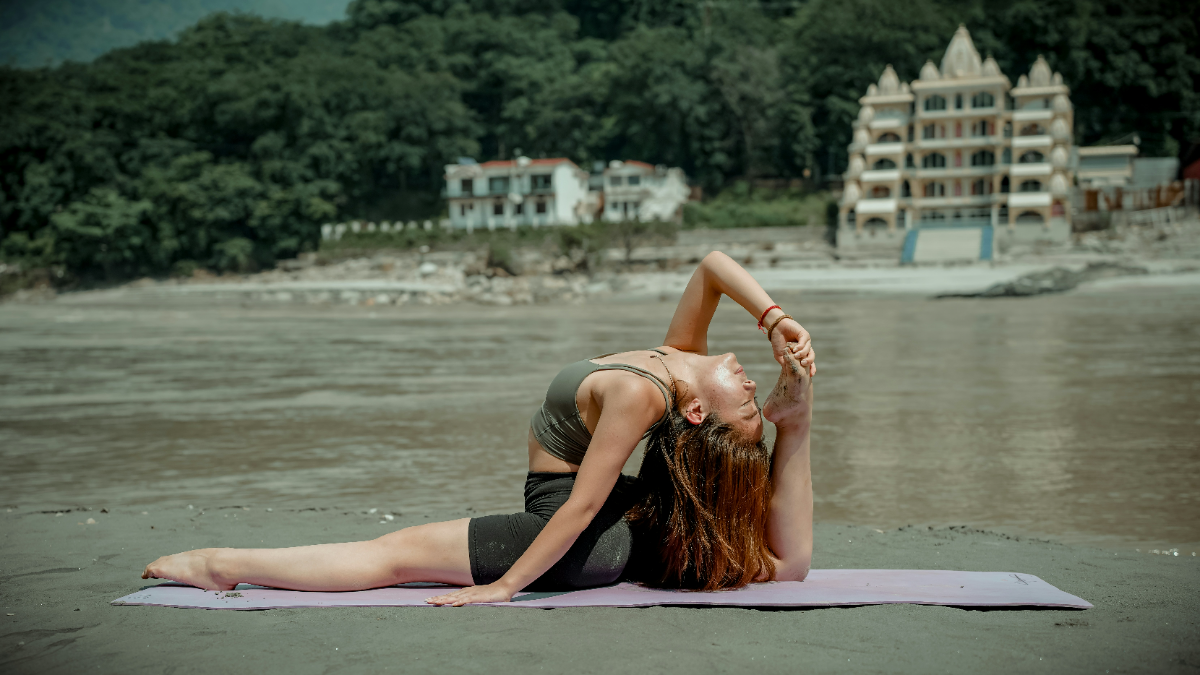
Practising on the sand beside the Ganga, with the ashrams of the far bank behind.
How do you get to the main yoga towns?
Each hub has a straightforward route from a major airport: usually a domestic flight and a short drive.
Rishikesh lies about 230 kilometres from Delhi, roughly 145 miles. The drive used to take six hours or more and is now around four to five, since the Delhi to Dehradun Expressway was inaugurated in April 2026. The alternative is a short flight to Dehradun's Jolly Grant airport, code DED, only about 15 to 20 kilometres from Rishikesh, roughly 9 to 12 miles, or 30 to 45 minutes by car.
Mysuru is reached via Bengaluru, formerly Bangalore, about 145 kilometres away, roughly 90 miles, and two to three hours by road on the expressway opened in March 2023, or by frequent trains. Mysuru's own small airport, code MYQ, has limited flights to Chennai and Hyderabad.
Pune's airport, code PNQ, has frequent Delhi flights and a few international routes, but none direct from Mumbai, a road transfer of three to four hours. Goa has two airports: Dabolim in the south, code GOI, and Manohar International at Mopa in the north, code GOX, opened in January 2023.
What does a yoga trip to India cost?
Yoga in India ranges from almost free to genuinely premium, and the practice itself is cheap by Western standards. Your accommodation, not the classes, is the main variable. Figures below were checked in September 2026 at roughly ₹95 to 1 USD and ₹129 to 1 GBP.
- A drop-in class in Rishikesh or Goa: roughly ₹300 to ₹800, about USD 3 to 8.50, or GBP 2.50 to 6.50.
- A private lesson with an experienced teacher: roughly ₹1,000 to ₹4,000, about USD 10 to 42, or GBP 8 to 31.
- A 200-hour teacher training over three to four weeks, usually with room and meals: commonly ₹85,000 to ₹190,000, about USD 900 to 2,000, or GBP 660 to 1,470.
- A week-long guided retreat with accommodation and food: roughly ₹35,000 to ₹110,000, about USD 365 to 1,150, or GBP 270 to 850.
- An ashram stay per night, with practice and vegetarian meals: often ₹500 for a dormitory bed up to around ₹3,500 for an air-conditioned single, about USD 5 to 36, or GBP 4 to 27.
The rupee has weakened against both currencies this year, so check the rate on the day rather than trusting figures in any article, this one included.
When is the best time to go?
October to March is the best window for most of India's yoga towns, when the weather is dry and cool enough to practise comfortably. The far south stays warm and humid all year.
Rishikesh is at its best from October to April. In January the average low is around 6 degrees Celsius and the high around 19, roughly 43 to 66 Fahrenheit, so pack a warm layer for early practice. By May and June, before the monsoon, highs average around 36 Celsius, roughly 97 Fahrenheit. Mysuru, Pune and Goa are most pleasant from November to February. Two dates are worth planning around: the International Yoga Festival in Rishikesh each March, and the International Day of Yoga on 21 June, observed since 2015 after the UN General Assembly adopted India's proposal in December 2014. Confirm festival dates on the organiser's own site.
Should you do a teacher training or just take classes?
Do a teacher training only if you want to teach or to immerse deeply, and take classes or a retreat if you simply want to practise. Many visitors sign up for a training when a retreat would have served them better. A 200-hour training is the standard entry qualification: three to four intensive weeks of asana, philosophy, anatomy and teaching practice, often residential and demanding. If your goal is to feel better and see the country, daily classes give more freedom and less pressure.
How do you choose a reputable school or teacher?
Judge a school by its teachers and its lineage, not by its Instagram feed or an accreditation logo. India has world-class teachers and many new schools chasing the teacher-training market, and online the two look identical.
Understand what the badges mean. Yoga Alliance is a US-based voluntary registry, not an accrediting body, and it does not inspect the schools it lists, so a listing is a baseline, not a guarantee. Look for a named senior teacher with a traceable lineage, and be wary of schools that will not say who actually teaches. Read independent reviews rather than testimonials, ask to speak to a recent graduate, and treat pressure for a fast, large deposit as a warning sign.

A woman meditating on a yoga mat outdoors.
What should you expect from a day of practice?
Expect early mornings, simple vegetarian food and a fuller day than a Western class. Serious yoga in India is a daily routine, not an hour on a mat.
In Ashtanga, Mysore style means arriving at the shala, the practice hall, early and moving through your own sequence at your own pace while the teacher adjusts individuals. Ashram days often begin before six with chanting or meditation, then asana, brunch, seva, meaning shared chores as practice, and an evening satsang, a gathering for chanting and a talk. Meals are sattvic, a simple vegetarian diet considered calming in the yogic tradition.
What should you know about etiquette?
Treat yoga in India as a living tradition with roots in Hindu practice, not only exercise. An ashram is closer to a place of worship than a gym.
Dress modestly on and off the mat: shoulders and knees covered, especially in ashrams and temples. Remove your shoes before entering a practice hall, and step around rather than over people and their mats. Chanting, including the sound "om", is part of many classes, and you may sit quietly instead. Ask before photographing during practice or ceremony, and learn namaste as a greeting and guru for a teacher in the fullest sense. Alcohol, meat and public displays of affection are out of place in ashram settings.
What do first-time yoga travellers get wrong?
- Booking Rishikesh for June expecting cool mountain air, when highs average around 36 Celsius, roughly 97 Fahrenheit.
- Assuming you can walk into a source institute. Pune and Mysuru allocate places months or years ahead.
- Choosing a school by its photos rather than its teachers and lineage, or booking a month-long training when a one-week retreat was what they wanted.
- Assuming every "traditional" style is ancient. Much of what is taught was shaped in the twentieth century, which is not a criticism, just a fact.
- Combining several distant yoga towns in one short trip. Depth beats a tour.
Frequently asked questions
Where is the best place to do yoga in India?
There is no single best place, only the best place for your style. Rishikesh has the widest choice of classes and trainings, Mysuru is the home of Ashtanga, Pune of Iyengar, and Goa offers a relaxed winter scene.
Is Rishikesh really the yoga capital of the world?
It is the most established and busiest hub, with the greatest concentration of schools, ashrams and drop-in classes, and it hosts the International Yoga Festival each March. "Capital" is reputation, not an official title, but it is the natural first stop.
Do you need to be experienced to do yoga in India?
For ordinary schools and retreats, no: there are classes for complete beginners in every major hub. The exception is the source institutes. The Iyengar institute in Pune expects around eight years of prior practice in its own method, and the Mysuru Ashtanga shalas allocate places by seasonal application, not to walk-ins.
How long should a yoga trip to India be?
A week gives you a genuine retreat or a run of daily classes in one town. Two to three weeks lets you settle into a routine and see something of the country. A standard teacher training runs three to four weeks.
Is it safe to travel in India for a yoga trip, including for solo women?
The main yoga towns are used to international visitors and are generally comfortable, including for solo women, with the usual precautions: dress modestly, use booked transport, and choose well-reviewed schools. A school or ashram also gives solo travellers instant structure and company. Check your own government's travel advice, the FCDO or US State Department, and see our honest guide to safety in India.
What should I pack for a yoga trip to India?
Bring your own mat if you are particular, modest and breathable clothing, a warm layer for cool mountain mornings, and any props you rely on. Most schools supply mats and props, but standards vary.
Planning your own yoga journey through India
The best yoga trip to India is not the most famous school or the longest course. It is the right style, in the right town, at the right time of year, matched to the practice you already have.
We design private, personalised journeys for travellers who want to study yoga at its source without guesswork. To have your trip shaped around your style, level and dates, Plan my India trip.