Ask a visitor to picture South Indian food and most describe a dosa, a thin fermented rice and lentil crepe folded around spiced potato. It is a fine thing to love, and it is roughly one percent of the story. South Indian food is not a single cuisine but five of them, each tied to a state with its own language and coastline, and the dosa is a breakfast item in most of them.
This guide is for someone flying in from London, Frankfurt, New York or Melbourne who wants to eat properly in the south and does not yet know a sadhya from a sambar. It covers what the regional cuisines actually are, how to order and eat them, what is safe, and what a meal costs in your own currency.
What counts as South Indian food, and why is it more than dosa?
South Indian food is the cooking of five states, Tamil Nadu, Kerala, Karnataka, Andhra Pradesh and Telangana, plus the small former French territory of Puducherry. They share a rice-first, coconut-friendly, lentil-heavy base and a love of fermentation, then diverge completely.
What unites them is less a dish than a grammar. Rice anchors most meals. Lentils appear as sambar, a tangy vegetable and lentil stew, and as rasam, a thin peppery broth drunk almost like soup. Coconut, curry leaves, tamarind and dried red chillies recur everywhere. Beyond that, a Chettinad pepper chicken and a Kerala fish curry cooked in coconut milk have almost nothing in common. Treating them as one thing is the first mistake most visitors make. For the wider national picture, see our guide to India's regional cuisines.
Tamil Nadu: banana leaves, Chettinad and filter coffee
Tamil food is the one most travellers meet first, because it built the idli and the dosa. The everyday meal is the sappadu, a spread of rice with sambar, rasam, a couple of vegetable dishes, curd and pickle, usually served on a banana leaf and eaten with the right hand.
Its famous regional style is Chettinad, from the Karaikudi area, built by a nineteenth-century merchant community. It leans on black pepper, star anise and a lichen called stone flower, and produces the most assertively spiced food in the state. Tamil Nadu is also the home of South Indian filter coffee, a strong decoction blended with a little chicory and cut with hot frothy milk. Idli are steamed rice cakes and vada are savoury fried lentil doughnuts, the two things you will most often see beside that coffee at breakfast.
Kerala: coconut, fish curry and the Onam sadhya
Kerala cooks with more coconut, more fish and more Christian and Muslim influence than its neighbours, because its coast traded with the world for two thousand years. The results are appam, a lacy fermented rice pancake eaten with a mild coconut stew; puttu, steamed cylinders of rice and coconut; and meen curry, a fiery fish curry sharpened with a smoky souring fruit called kudampuli.
The set piece is the sadhya, a vegetarian banquet served on a banana leaf and eaten by hand, traditionally at the harvest festival of Onam in late summer. A full sadhya runs to around twenty-six separate dishes in a fixed order, finished with payasam, a sweet milk or jaggery pudding. Kerala's Muslim community on the northern Malabar coast has its own celebrated cooking, including the Thalassery biryani made with short-grained kaima rice, quite distinct from the biryani of Hyderabad. Kerala Tourism keeps a good overview of Onam food, and our ten-day Kerala itinerary sets out the route if you are pairing food with a wider trip.
We plan private Kerala trips around Kerala's food and home kitchens, with handpicked stays, a dedicated driver and local guides chosen for what you care about. Every route starts with your dates and pace, and our team stays on hand while you travel if plans need to change. Plan a tailor-made Kerala trip.
Karnataka: Udupi tiffin, the Mangalore coast and Coorg
Karnataka is three cuisines at least. The temple town of Udupi gave India much of its vegetarian tiffin culture, the light savoury dishes eaten at breakfast or as snacks, and is closely linked with the masala dosa. Inland, Bengaluru and Mysuru favour ragi mudde, balls of finger-millet, in a sweetish, ghee-rich style.
The coast around Mangaluru is a different country on a plate: neer dosa, a soft unfermented rice crepe, and gassi, a coconut-and-chilli seafood curry. Up in the hills of Kodagu, better known as Coorg, the Kodava people cook pandi curry, a pork dish soured with a local vinegar, which surprises visitors who assume the south is meat-shy. Coorg and neighbouring Chikkamagaluru are also India's coffee heartland. Karnataka Tourism has more on the coastal and Kodava regions.
Andhra Pradesh and Telangana: the spice belt and Hyderabadi biryani
If you want heat, this is where you find it. Andhra and Telangana food is widely considered the spiciest in India, built on the fierce Guntur chilli and on gongura, a sharp sorrel leaf made into chutneys and curries. An Andhra meal, served as a rice thali with many small bowls and free refills, is one of the great value feasts of the country.
Telangana's capital, Hyderabad, is home to the most famous biryani in India. Hyderabadi biryani dates from the eighteenth-century Nizam courts, blending Mughlai technique with local spice, and the prized version is the kachchi style, in which raw marinated meat and rice are sealed in a pot and slow-cooked together over a low fire. Telangana Tourism has background on the city's food.
What does a South Indian breakfast actually involve?
Breakfast, called tiffin, is arguably the best meal of the South Indian day, and it is almost always vegetarian. The core cast is idli, dosa, vada, and pongal, a soft savoury rice and lentil dish, usually with sambar and one or two chutneys. An uttapam is a thicker pancake with onion and chilli pressed into it, and an idiyappam, or string hopper, is a nest of steamed rice noodles eaten with curry. In Kerala you will meet appam and puttu instead. A tiffin breakfast with coffee is cheap, filling and a gentle way into South Indian food before the heavier lunch.
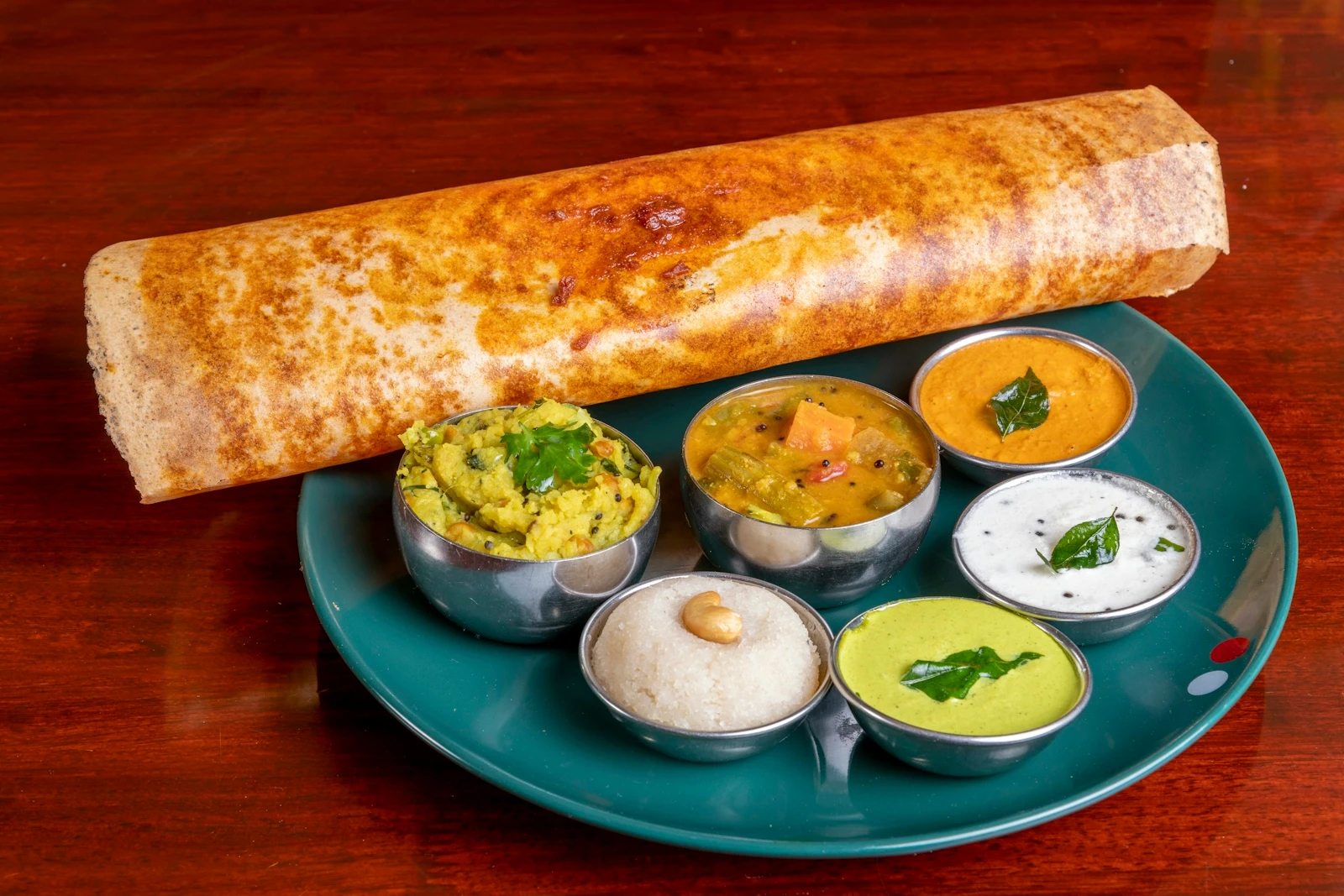
A dosa with sambar and chutneys, the South Indian breakfast most travellers meet first.
How do you eat a banana-leaf meal without getting it wrong?
The short version: eat with your right hand and let staff serve you. A banana-leaf meal arrives as a bare leaf onto which servers spoon rice and a ring of small dishes, then return to refill whatever you finish. Mix a little of one curry into a mound of rice at a time rather than flooding the whole leaf, use your fingers rather than your palm, and keep your left hand for your water glass. When you have had enough, fold the leaf towards you to signal you are done. Asking for a spoon is completely acceptable, but eating by hand is part of how the food is designed to be enjoyed.
Is South Indian food all vegetarian?
No, though the vegetarian reputation is not unearned. Tamil Nadu and inland Karnataka have deep vegetarian traditions, and in temple towns you can eat purely vegetarian for days without noticing. The coasts tell a different story: Kerala eats fish, beef and chicken with enthusiasm, coastal Karnataka lives on seafood, Coorg cooks pork, and the Andhra and Hyderabadi tables are strongly meat-forward. If you are vegetarian, South India is one of the easiest places on earth to eat superbly; if not, you will still eat superb seafood and meat. Either way, the words "pure veg" on a sign mean no meat, fish or eggs are served at all.
How spicy is it, and can you ask for it milder?
Some of it is very spicy, particularly Andhra and Chettinad food, and yes, you can ask for it toned down. The heat is real but uneven, and much South Indian food is fragrant rather than fierce. "Less spicy" is widely understood, as is asking for a dish "not too hot", and coconut-based Kerala curries, most breakfast tiffin and anything with curd are naturally gentler. Keep something starchy or cooling within reach: plain rice, curd rice, or a sweet lassi will calm a mouth faster than water, which just spreads the chilli oil around.
Is South Indian street food safe to eat?
It can be, with the same judgement you would use anywhere: eat where it is busy, freshly cooked and hot. A stall with a queue of local office workers turning over fresh dosa is a good sign; a tray of food sitting warm and uncovered is not.
The practical filters are simple. Favour things cooked to order in front of you over anything pre-assembled, and be more cautious with raw salads, cut fruit and anything washed in tap water than with a hot, fried or steamed item. Drink only sealed bottled or properly filtered water, and check the seal. Give your stomach two or three days to adjust and carry rehydration salts in case it does not. We cover this in depth in our guide to eating street food in India safely, and for medical specifics you should follow official guidance such as the UK's TravelHealthPro India page rather than any article, including this one.
What should you drink, from filter coffee to toddy?
Start with filter coffee, the south's great daily ritual, and branch out to masala chai, fresh lime soda, tender coconut water drunk straight from the shell, and buttermilk spiced with ginger and curry leaf. Two local drinks are worth seeking out: toddy, a mildly alcoholic sap tapped from palm trees, sold fresh in simple licensed shops in Kerala and best drunk the day it is tapped; and, in Madurai, jigarthanda, a cold, milky, almost chewy sweet drink built for the Tamil heat. On water, stick to sealed bottles or a filter throughout, use it for brushing teeth too, and be wary of ice in cheaper places unless you know it is filtered.
How much does eating in South India cost?
South India is one of the best-value places in the world to eat well, and food will rarely be the expensive part of your trip. The figures below are approximate and current in late September 2026, so treat them as a planning range and confirm locally.
A tiffin breakfast of idli or dosa with coffee at a good local place runs from about ₹60 to ₹250, roughly USD 0.60 to 2.60, or GBP 0.50 to 2.00. A banana-leaf lunch, or thali, typically costs ₹150 to ₹500, about USD 1.60 to 5.20, or GBP 1.20 to 3.95, often with unlimited refills. A hands-on cooking class or a guided food walk with a local usually falls between ₹2,000 and ₹6,000 per person, about USD 21 to 63, or GBP 16 to 47. A meal in a smart hotel dining room costs several times a street plate, yet stays modest by London or New York standards.
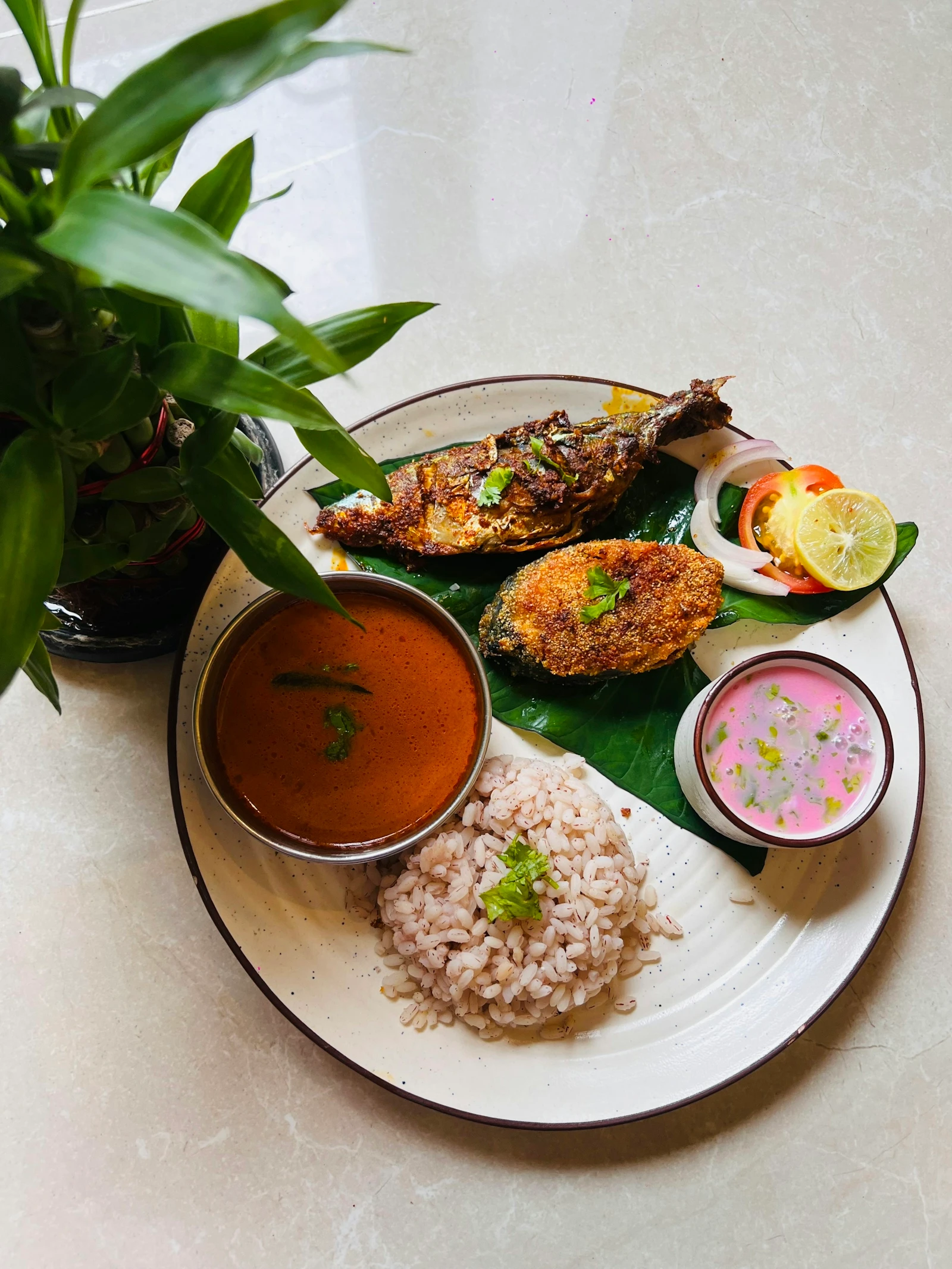
A coastal fish curry, the kind Kerala and the Mangalore coast do best.
Where should you eat, from a mess to a home kitchen?
The honest answer is that the best South Indian food is rarely in the fanciest room. A "mess" or "tiffin room", a plain, busy, often decades-old eatery, will frequently out-cook a hotel restaurant, and a home kitchen will out-cook both.
There is a rough ladder. Tiffin rooms and messes are unbeatable for breakfast and quick meals, and are where locals actually eat. Traditional "meals" restaurants do the full banana-leaf lunch. Hotel dining rooms give you comfort and a softened version of the flavours. Above all of these sits the family table. The single best meal I have had in Kerala was in a home, five or six of us around a counter with our hands in the dough for appam, recipe cards to take away, and a cook who had made that fish curry a thousand times.
Can you learn to cook South Indian food?
Yes, and it is one of the most rewarding half-days you can spend in the south. The classes worth your time are the small, hands-on ones run out of a family kitchen, five or six people around the counter actually grinding, tempering and folding, with recipe cards to take home, not the ones where you watch a demonstration from a chair.
There is a wider version of the same idea: a jaggery farm in the Coimbatore countryside where cane juice is boiled down over a wood fire, a culinary trail through the Muslim food of the northern Malabar coast, a morning spent tapping toddy and eating with a fishing family near the old Muziris coast. These turn a meal into an afternoon, and in my experience they are what people talk about long after the temples blur together. Building a day around the right kitchen at the right hour is much of what we do when we plan a food-led trip, and our guide to immersive cooking classes in India goes further into choosing one.
What do first-time visitors get wrong about South Indian food?
Most errors come from treating the south as one place and one dish, and a little planning fixes all of them.
The common ones: ordering a dosa for dinner when it is really a breakfast and snack item; assuming everything is vegetarian and missing the coast's extraordinary seafood; assuming everything is fiery and avoiding whole regions out of caution; eating only in hotels and never in a mess or a home; and drinking unfiltered water or unverified ice. The other quiet mistake is rushing lunch. A banana-leaf meal is designed to be lingered over and refilled, and eaten slowly it is one of the great meals of India.
Who is a South Indian food trip best suited for?
A food-led trip through the south suits curious eaters above all: people who would rather understand a cuisine than tick off monuments, and who are happy to eat where locals eat. It is a gift for vegetarians, and a revelation for anyone who thought Indian food began and ended with a curry house menu.
It works well for couples and solo travellers, and adapts for families if you build in milder options and shorter days. It suits less those who need familiar Western food at every meal, or who want to move fast between sights, since the south rewards slowing down. If your priority is the Taj Mahal or Rajasthan's forts, those are different trips north.
Frequently asked questions
What is the most famous South Indian food?
The dosa and idli are best known abroad, but within India the region is equally famous for Hyderabadi biryani, Chettinad chicken, Kerala fish curry, the Onam sadhya feast and South Indian filter coffee. Each belongs to a different state.
Is South Indian food healthy?
Much of it is naturally light: fermented rice and lentil batters, steamed dishes like idli and puttu, plenty of vegetables, and coconut and yoghurt rather than heavy cream. Fried items and rich restaurant curries exist too, so it depends what you order, but a typical tiffin breakfast or banana-leaf lunch is among the healthier ways to eat on the road.
Is South Indian food very spicy?
Some of it is, especially Andhra and Chettinad cooking, but plenty is fragrant rather than fiery. Coconut-based Kerala curries, breakfast tiffin and curd-based dishes are gentle, and you can ask for food "less spicy" almost anywhere.
What is the difference between North and South Indian food?
Broadly, the south is more rice-based, using coconut, curry leaves, tamarind and fermented batters, and serves lighter, tangier dishes. The north leans on wheat breads, dairy and richer gravies. Both are vast and regional, so the contrast is a starting point, not a rule.
Do you need to eat with your hands in South India?
No, cutlery is always available and asking for a spoon is fine. That said, banana-leaf meals are designed to be eaten with the right hand, and trying it is part of the experience. Keep your left hand for your glass.
When is the best time for a South Indian food trip?
The cooler, drier months of roughly November to March are the most comfortable for travelling and eating across the south. If you want the Onam sadhya at its fullest, aim for the Onam festival in Kerala in late August or early September, though dates shift each year with the Malayalam calendar.
Planning a food-led journey through the south
South Indian food is not one thing to be sampled but five cuisines to be travelled through, from a Chennai tiffin room at dawn to a Kerala home kitchen at dusk. Eat slowly, eat where locals eat, and let the food set the pace of the trip.
We design private, personalised India journeys for travellers who want to eat their way into a place rather than photograph it from outside. If you would like a South Indian route shaped around your own dates, appetite and pace, Plan my India trip.