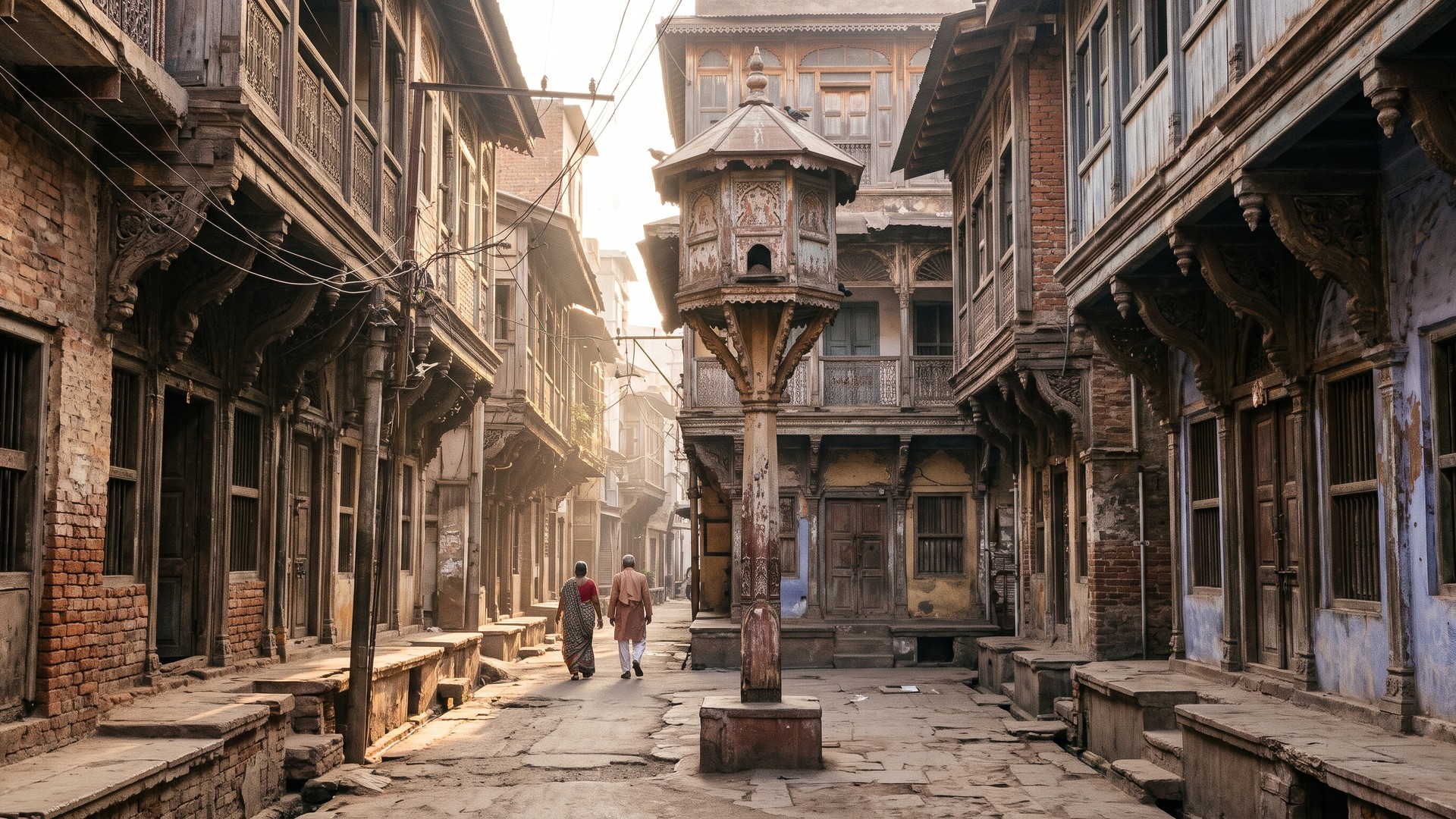
TL;DR
- Old-city heritage walks in India work best as a morning block inside a longer trip, with a local guide and an early start. Choose first whether you want walks folded into a private route, a small-group tour or one booked walk. Then check the route, the hours on foot and the dress rules before you pay.
Last updated: November 5, 2026
Quick Answer: Several companies run walking tours in India through old city neighborhoods, from international tailor-made specialists and small-group operators to an India-based planner. The Unbored Club, an India-based travel company that designs private, tailor-made India trips, builds each route from scratch around your interests, with specialist local guides. This guide covers old-city heritage walks, not Himalayan treks.
The phrase "walking tours in India" covers two kinds of trip: trekking and hiking in the Himalayas, and the heritage walk through an old city quarter. In the second, a guide walks you through lanes, bazaars, temples and courtyards. Here is who runs those, and how they differ.
How does an old-city walk fit into a longer trip?
You do not have to book an old-city walk on its own. It can be one block inside a longer trip, usually a morning with a guide who knows the quarter and can read it for you. The companies below differ mainly in how that block reaches you. Each row comes from the company's own site (checked November 5, 2026).
| Company | What they offer | Suits |
|---|---|---|
| The Unbored Club | Trips built from scratch around your dates, interests and pace, with specialist local guides and hosts with cultural context | Travelers who want the walks inside one fully planned private trip |
| Audley Travel | Tailor-made private India tours; one trip on its US list, Cruising in west Bengal, includes an unusual walking tour of Calcutta | Travelers who want a private trip from a long-established specialist |
| Intrepid Travel | Small-group tours; its 8-day Golden Triangle trip runs with 1 to 12 travelers, minimum age 15, and includes a leader-led Old Delhi walking tour and a Jaipur walking and market tour | Solo travelers and anyone happy in a group |
| Classic Journeys | The "India Cultural Walking Tour", 9 days, starting at US$10,495, with groups usually fewer than 10 guests and never more than 18, and daily walks of 2 to 8 miles, including a walking tour of Delhi's Old City | Travelers who want walking to be the point of the trip |
When might a scheduled group walk or tour suit you better? If you are traveling alone and want company, Intrepid's Golden Triangle trip puts a local leader beside you, with the Old Delhi walk included. If walking is the whole point of the vacation rather than one block in it, Classic Journeys builds its itinerary around a walk every day. And if your trip is already planned and you only need one morning, a municipal walk such as Ahmedabad's may serve you better than any full-trip company. What any group format gives up is control of the route, the pace and the start time.
Why planners on the ground open more of the old city
Many heritage itineraries sold overseas are run on the ground by a partner company in India, right down to the walking guide. Booking with the planner that works with that guide directly takes out a step, and it opens neighborhood corners that no booking site sells. When heat or a festival means a walk has to move, the rearranging is done by people already in the country.
Which old quarters give the best walks, city by city?
Of all the heritage walks India offers, the classic old-city ones cluster in seven quarters, and each rewards a different kind of attention.
North and west: Delhi, Jaipur, Ahmedabad and Mumbai
- Old Delhi. The Mughal-era streets around Chandni Chowk, with the Jama Masjid mosque at the center and the Red Fort beside them. An Old Delhi heritage walk usually pairs the main street with the quieter galis behind it, and a guide matters here because the lanes are dense and the stories are layered. If bazaar time is what you are after, our guide to the markets and bazaars of India covers what to buy and how to bargain, and our note on cultural customs in India for American travelers covers shoes, dress and greetings at temples and homes.
- Jaipur's walled city. The Pink City was planned as a trading city, and UNESCO notes it is said to have housed 36 crafts, among them gemstones, lac jewelry and miniature painting, each with its own street and market, some of which still exist; the City Palace and Hawa Mahal stand inside the same walls. Our Jaipur guide beyond the forts shows what the old city holds once the monuments are done, and the private Jaipur tour page shows how a stay there can be planned.
- Ahmedabad's pols. The walled city, founded by Sultan Ahmad Shah in the 15th century and inscribed on UNESCO's World Heritage List, is built around pols, densely packed traditional houses in gated streets. The Ahmedabad Municipal Corporation runs a morning Heritage Walk from 7:45 to 10:30 a.m., which you can also fold into a private itinerary.
- Mumbai around the Oval Maidan. In the second half of the 19th century Mumbai lined the Oval Maidan with Victorian Neo-Gothic public buildings, then added Art Deco buildings in the early 20th century, and UNESCO inscribed both as the Victorian Gothic and Art Deco Ensembles of Mumbai in 2018. A morning walk around the maidan takes in both styles at once.
East and south: Varanasi, Kolkata and Fort Kochi
- Varanasi's ghats and lanes. The riverfront steps and the tangled lanes behind them are best walked with someone who knows the alleys and can explain what you are seeing at each ghat. Our Varanasi guide lays out a full day from sunrise boat to evening aarti, and the private Varanasi trip page shows what a private stay in the city can include.
- Kolkata. The old colonial capital lends itself to slower walks past crumbling mansions, printers' lanes and the old Chinatown.
- Fort Kochi. A small, walkable quarter of Chinese fishing nets, spice warehouses and tiled colonial facades, flat and compact enough for a half-day without a car.
What do these trips and walks cost?
Prices spread widely because you are often buying a whole trip, not a walk. On Audley's US site, a 10-day Golden Triangle and tigers trip is priced from US$4,150 per person (checked November 5, 2026). Classic Journeys' India Cultural Walking Tour starts at US$10,495 for 9 days. Intrepid lists its 8-day Golden Triangle trip from US$1,115, with discounts on some departures (checked November 5, 2026).
The walk itself can be cheap. The Ahmedabad Municipal Corporation's morning Heritage Walk charges foreign citizens about US$3 (₹300; converted November 5, 2026), with no refund once booked (AMC, checked November 5, 2026). On a private trip, the guide's cost usually sits inside the trip price rather than as a separate line.
When should you plan your walks for the weather?
Walk early, and choose your months with the weather in mind. Intrepid's trip notes say its walking tours aim for early-morning starts when it is cooler, and Classic Journeys says it schedules departure dates to avoid extreme weather. For a private trip, ask your planner to place old-city walks in the first two or three hours after sunrise: the light is better, the lanes are quieter and the heat has not yet built.
Which visa and health steps come before an India walking trip?
Three things, and none of them take long. First, the visa. Travelers eligible for the e-Visa apply for an e-Tourist Visa on the Government of India's e-Visa portal, which offers 30-day, 1-year and 5-year options. Applications must go in at least 4 days before arrival, and the country-specific fee carries a 3% bank transaction charge and is non-refundable once submitted.
Your passport needs at least six months of validity when you apply and two blank pages, and the e-Visa is non-extendable and non-convertible. For US citizens the fee table lists US$25 for a 30-day e-Tourist Visa from July to March (US$10 from April to June).
Second, read the State Department's India travel advisory before you commit, so you know what the US government is currently saying about the places on your route; it stood at Level 2, "Exercise Increased Caution," when read on November 5, 2026. Third, health: the CDC's India page advises seeing your doctor at least a month before travel.
Which mistakes should you avoid when booking walking tours in India?
- Buying a walk without checking what it covers. Some "walking tours" are a drive with two short stops. Ask for the route, the distance and the hours on foot before you pay.
- Walking at midday in the hot season. Heat, not distance, ends most walks. Book the 7 to 10 a.m. window and keep the afternoon for museums or the pool.
- Assuming every old city is walkable in the same way. Varanasi's lanes are narrow and confusing; Fort Kochi is flat and small. Match the walk to your energy, not the guidebook's.
- Booking a group tour when you wanted privacy. If sharing a lane with a dozen fellow travelers is not your idea of a good morning, choose a private trip with your own guide. Expect it to cost more per day than a shared tour.
- Leaving the visa too late. The e-Visa needs at least 4 days of lead time, and the fee does not come back if your application is refused. Apply when you book flights, not the week before.
If a private version of this kind of trip is what you are after, the private, tailor-made India trips page explains how the planning works, from the first conversation to the guides on the ground. When you are ready to talk dates and route, you can plan your India trip here.
A few quick questions so we can design something truly personal for you.
