Varanasi rewards the traveller who stays for a full turn of the day, from the first light on the river to the stillness long after the crowds have gone home.
Varanasi is best experienced across a full day: a boat on the river at sunrise, the old lanes and temples through the late morning, and the Ganga aarti ceremony at sunset. Each hour shows you a different version of the same riverbank and most travellers see only the evening. I think that is a missed chance, the city's quietest and most lasting moods happen before most people are awake. It works best as the closing stretch of a two-week north India itinerary.
Known also as Banaras and Kashi, the city sits on the west bank of the Ganga in Uttar Pradesh in northern India. For Hindus it is among the most sacred places in the country, a city of pilgrimage, prayer and last rites. For a curious outsider it can feel overwhelming at first, then, slowly, deeply moving. The trick is to slow down and let it set the pace.
Why is Varanasi called India's oldest city?
Varanasi has been continuously inhabited for around three thousand years, and it has stood on the same stretch of the Ganga through empires, invasions and centuries of pilgrimage, which is why it is often described as one of the oldest living cities in the world.
In Hindu belief the city is sacred to Shiva, and its older name, Kashi, means the city of light. People travel here from across India to bathe in the Ganga, to pray, and for many, to spend their final days, in the belief that dying in Varanasi brings moksha, release from the cycle of rebirth. That belief shapes everything you see along the water. Varanasi is a working spiritual city where ritual and daily life happen side by side, which is part of what makes it so intense and so unlike anywhere else. It is the city that most changes how travellers talk about the real India.
What is the best time of day to experience Varanasi?
There is no single best hour. Varanasi is really three cities folded into one day: the meditative river at dawn, the everyday bustle of the old city's lanes by late morning, and the fire and sound of the ghats after dark. To understand the place at all, give it at least one sunrise and one sunset. How many nights that needs is part of India in 7, 10 and 14 days.
If you only have one full day, build it around the water at both ends. Start before dawn with a boat ride, spend the late morning in the old lanes, the Kashi Vishwanath temple, one of the most sacred Shiva shrines in India, sits in this maze of alleys and is worth seeking out, then rest through the hottest part of the afternoon before returning to the ghats for the evening ceremony. The city is busiest and most photographed in the evening, so the morning is your reward for setting an early alarm. It is calmer, serene and, for many travellers, a more lasting memory.
If you can time your visit to Dev Deepawali, the full moon of November, the ghats are lit with hundreds of thousands of oil lamps and the riverfront becomes one of the most extraordinary sights in India.
What is a Varanasi sunrise boat ride actually like?
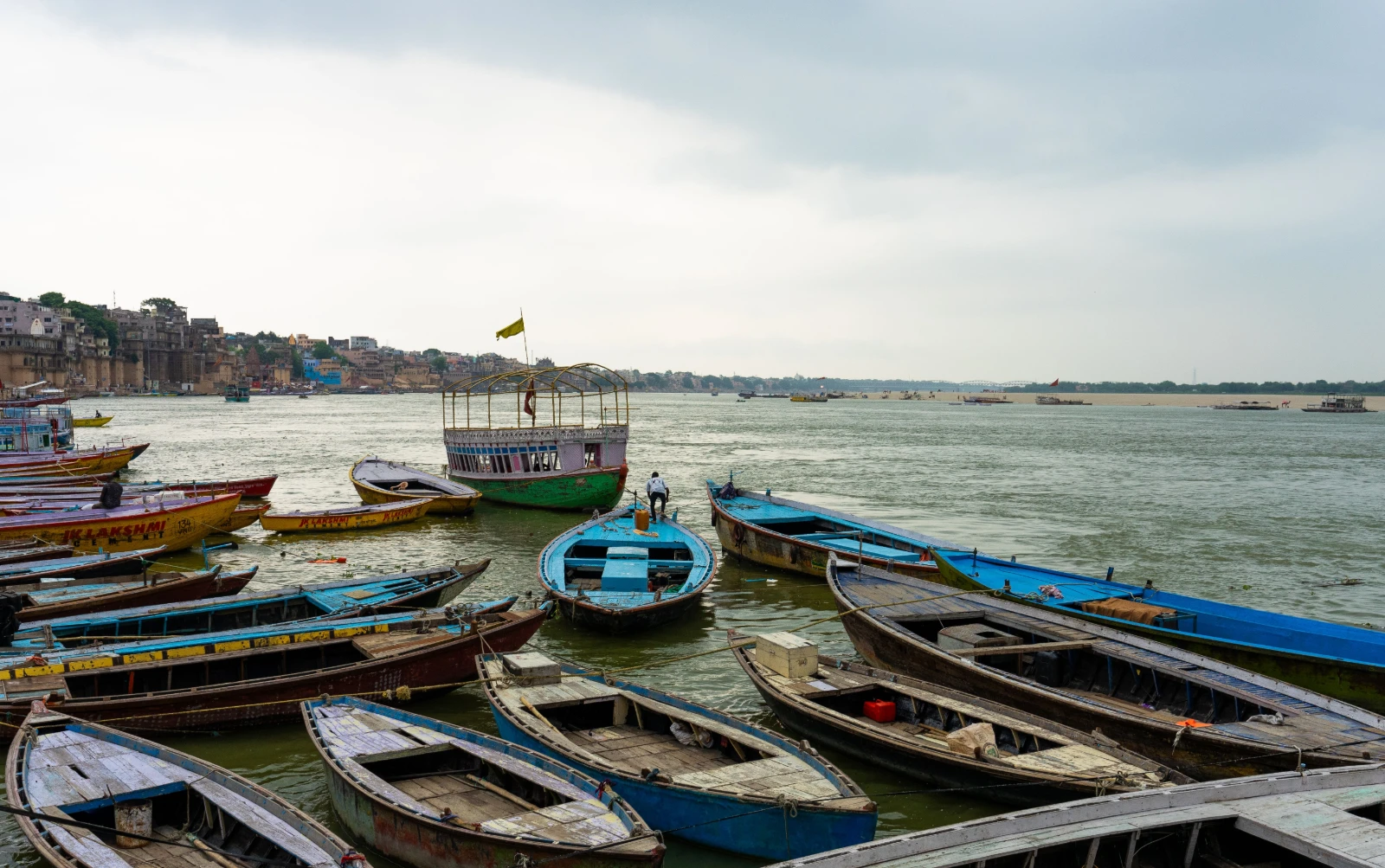
A sunrise boat ride is the calmest and most beautiful way to meet the city. Boats usually push off around 5 to 5.30 am, often from Assi Ghat in the south, and drift north along the riverfront as the sun comes up behind the water. It is slow, quiet and unforgettable.
The first time I watched the ghats wake from a wooden rowboat, I wasn't prepared for how quiet it would be. You hear the water, the bells of an early temple, the sound of laundry hitting stone, and almost nothing else. From the river you watch pilgrims wade in to bathe and offer prayers to the rising sun. Priests sit under wide umbrellas. Small leaf boats carrying marigolds and a single flame float past on the current. A morning mist often hangs over the water in the cooler months, softening the whole skyline of temples and old palaces into something that feels suspended in time.
Down at Assi Ghat, the morning has its own gentle ritual called Subah-e-Banaras, the morning of Banaras, which brings together yoga, Vedic chanting and live classical music at first light, and it is free to watch. If you would rather be on the water, a private wooden rowboat is the most peaceful choice. Prices vary with the season, the duration and how many people share the boat, so agree the price and the route before you step in. I always suggest a hand-rowed boat over a motorboat. It is slower, quieter and far kinder to the calm you came for.
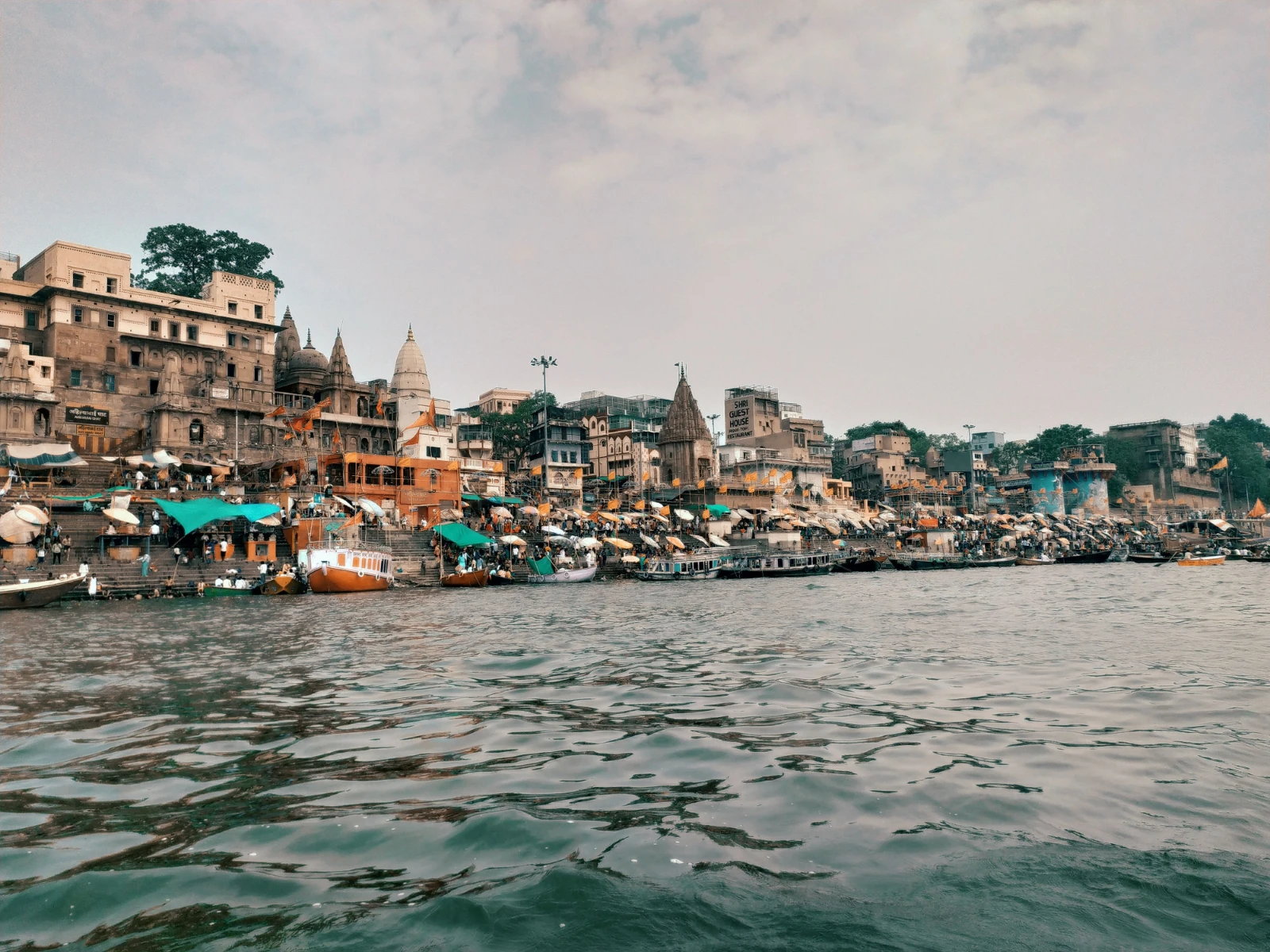
From the water, the ghats reveal themselves slowly as the light grows, pilgrims bathing, priests at their stations, and the city waking all at once.
Winter mornings on the river can be genuinely cold and foggy, so bring a layer, and accept that on some days the sun stays hidden behind the mist.
We plan private Golden Triangle journeys that include Varanasi as an extension, timed to beat the crowds and the heat, with private guides and a dedicated driver throughout. The route is shaped around your dates and pace, not a fixed departure. Plan a private Golden Triangle trip.
What are the Varanasi ghats, and which ones should you know?
The Varanasi ghats are the broad stone steps that run down to the river, around eighty of them in a near-continuous ribbon stretching several kilometres along the bank. Each ghat has its own character, history and daily rhythm. A handful are worth knowing by name before you arrive.
The busiest and most central ghat, and the stage for the main evening Ganga aarti. Lively at almost any hour.
The southernmost of the main ghats, calmer and more spacious, home to the Subah-e-Banaras morning ceremony and a good place to begin a sunrise boat ride.
The principal cremation ghat, where funeral pyres burn day and night. A profoundly sacred place, and one to approach with quiet respect.
The other, smaller cremation ghat, named after a king revered in Hindu legend for his unwavering honesty.
Marked by its red and white striped temple, popular with South Indian pilgrims and one of the more photogenic ghats in soft morning light.
A historic ghat crowned by a large mosque, where by tradition five rivers are said to meet.
The ghats are best explored slowly and on foot in the early morning. A walking route from Assi in the south towards the centre lets you feel how the mood shifts from one ghat to the next.
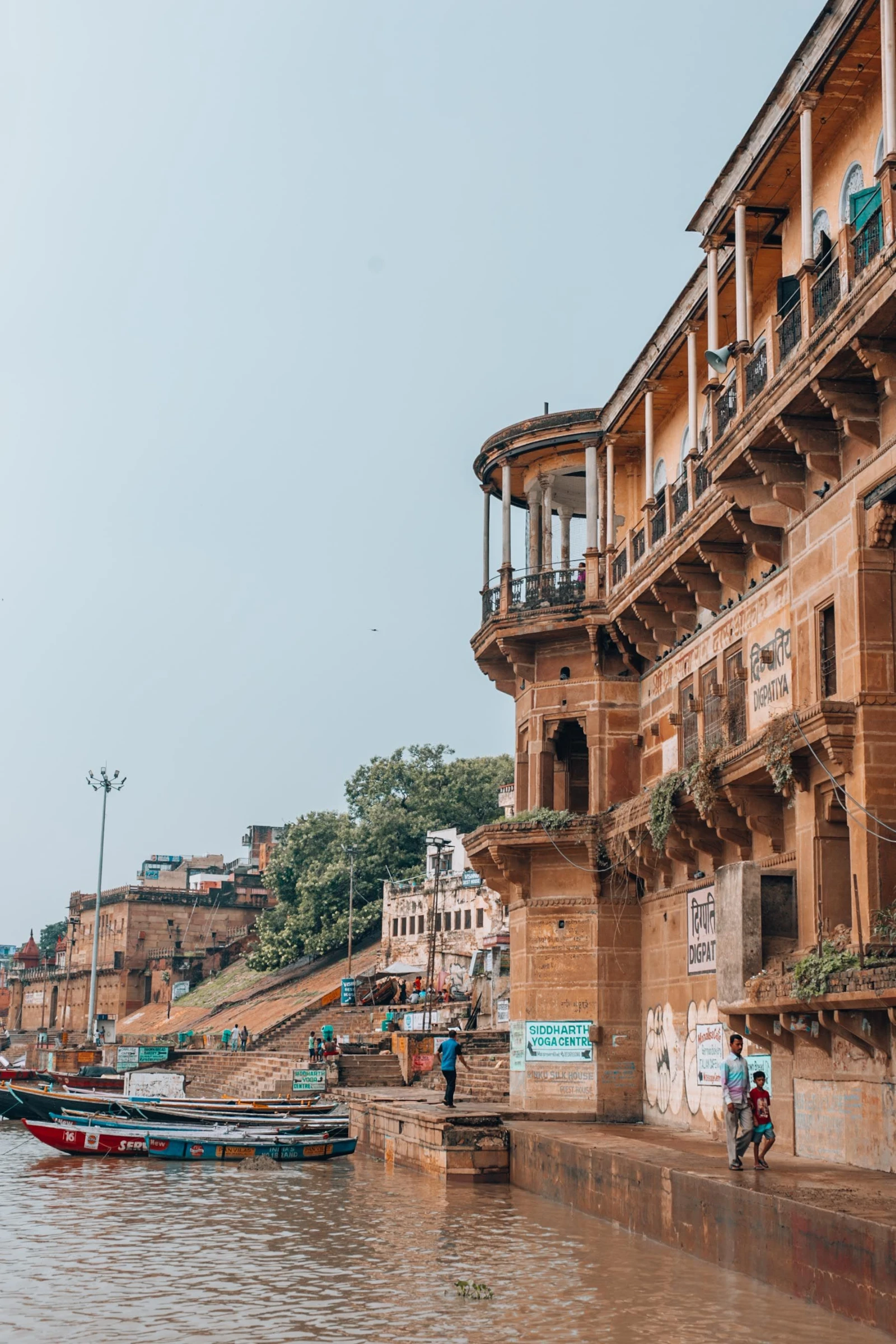
Each ghat has its own daily rhythm, some busy with pilgrims and priests, others quieter and almost contemplative.
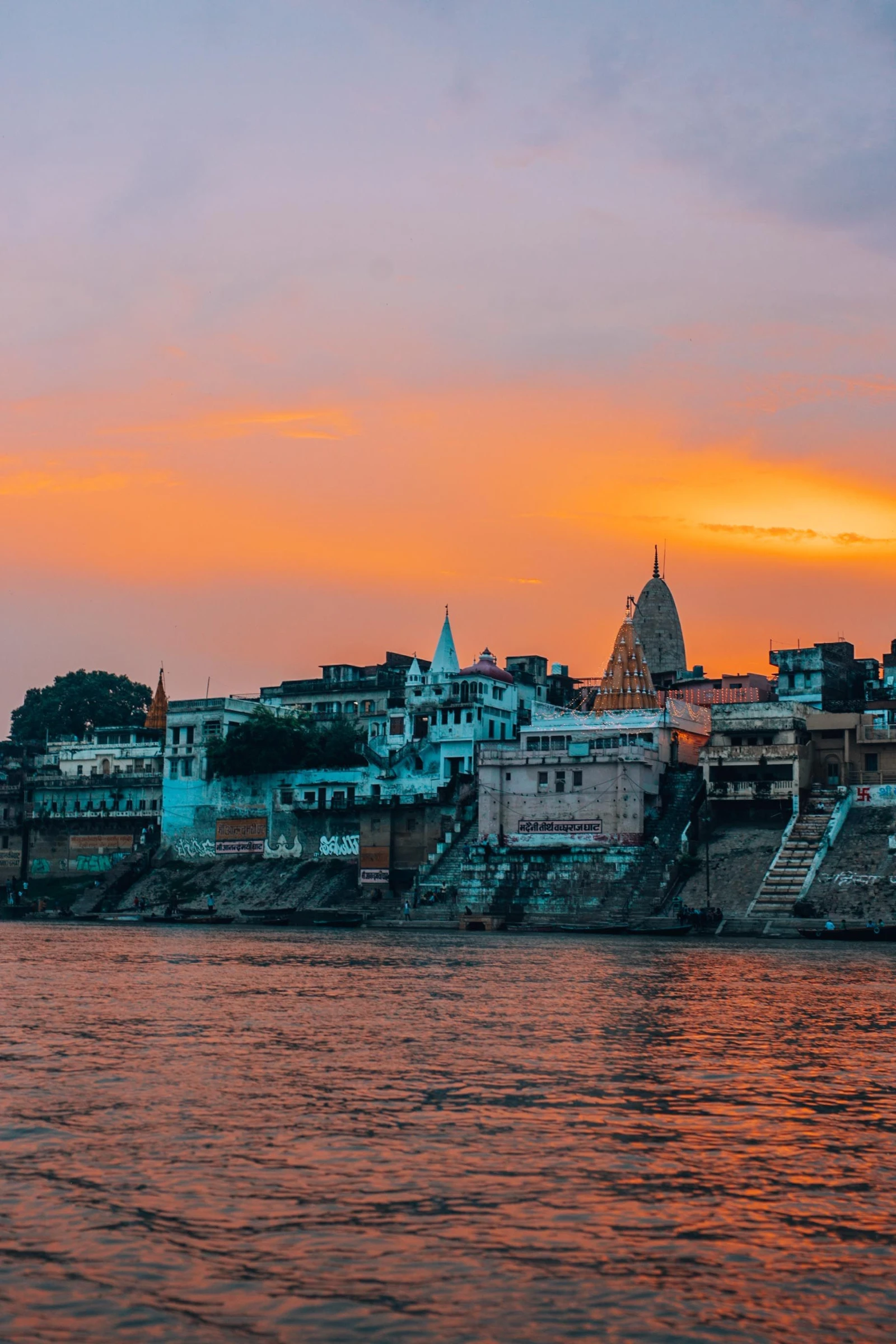
The ghats seen from the river reveal the full length of the riverfront, a continuous line of temples, palaces and stone steps.
What is the Ganga aarti, and where do you watch it?
The Ganga aarti is an evening ceremony of light and thanks offered to the river, performed every day at Dashashwamedh Ghat. In summer it begins around 6.45 pm, and in winter around 5.45 pm, soon after sunset, and lasts about forty-five minutes. It is free to attend and runs every single day of the year.
The ceremony is led by seven priests dressed in matching robes and moving in slow unison. They swing large brass lamps stacked with burning flames, circle smoking incense, ring bells and chant, all timed to drums and devotional song. The smoke, the firelight and the sound build into something genuinely hypnotic, and the river in front of them fills with small floating lamps set adrift by pilgrims and visitors.
I have watched the aarti from the ghat steps and from a boat on the water. From the steps you feel the heat of the lamps and the press of the crowd around you, it is immersive and loud and thrilling. From the boat the whole ceremony opens up: you see the priests in formation, the smoke rising, and the river full of drifting lights all at once. I find the boat calmer and more complete, but both are worth experiencing if you have the nights.
The aarti at Dashashwamedh Ghat, seven priests, brass lamps, incense and devotional music that builds slowly into something unforgettable.
Arrive thirty to forty-five minutes early for a good place on the steps. If the main aarti feels too crowded, the smaller evening ceremony at Assi Ghat is gentler and easier to take in.
What is the food like in Varanasi?
Varanasi is a strictly vegetarian city at its core, and the food is one of its quiet pleasures. The most famous thing to eat here is kachori sabzi, a flaky, deep-fried bread served with a spiced potato and chickpea curry, and you will find it at breakfast stalls near the ghats from around six in the morning. The lassi at Banaras is thick and serious, often topped with malai and served in earthen cups. Thandai, a chilled milk drink spiced with cardamom, saffron and rose, is worth trying at least once. The city’s strictly vegetarian cooking is one of the surprises in our regional guide to Indian food.
The lanes of the old city, particularly around Vishwanath Gali, are lined with small sweet shops selling malaiyyo in winter, a cloud-light milk dessert that exists only in the cold months, and the jalebis here are fried fresh and eaten warm. Most of the good eating happens early, at street stalls rather than restaurants, and the pace is entirely unhurried.
Go hungry before your sunrise walk, and follow the crowds rather than a list, the best food in Varanasi is found by instinct.
What is Varanasi like at midnight?
After the evening crowds thin, Varanasi becomes intensely still. The lanes empty, the shops shutter, and most of the ghats fall dark and quiet. The exceptions are the cremation ghats, Manikarnika and Harishchandra, where fires burn through the night without pause.
This is the city at its most elemental, and it asks for sensitivity. The cremation ghats are active funeral sites, not attractions, and photography there is not appropriate. If you find yourself nearby late at night, the respectful thing is to stand quietly at a distance, keep your camera away, and simply witness. Many travellers describe the experience as sobering rather than frightening, a direct and unhurried encounter with the way this city holds life and death together. It is also the clearest expression of why people call Varanasi the great cremation ground and the city of light in the same breath.
Late at night the lanes are dark and easy to get lost in, so it is sensible to go with a trusted local guide or stay close to your accommodation. The city is generally safe for visitors who move with the same care they would in any unfamiliar place, but it pays to be sensible after dark.
How long should you stay?
Give Varanasi at least two full nights so that you catch both a sunrise and a sunset without rushing between them. Three nights would be much better. A single afternoon, the way many tours schedule it, barely scratches the surface.
- Dress modestly and cover your shoulders and knees, especially near temples and during ceremonies
- Remove your shoes before entering temples, and follow the lead of those around you
- Do not photograph cremations or grieving families at Manikarnika and Harishchandra
- Agree the price and route of any boat ride before you board, and prefer a hand-rowed boat
- The old lanes are a maze, walk slowly, expect to get lost, and treat it as part of the experience
- October to March is the most comfortable season; summers are very hot
- Carry small cash for offerings, boats and chai, and drink bottled or filtered water
Frequently asked questions
Is Varanasi safe for tourists?
Varanasi is generally safe for travellers who take normal precautions. The lanes are crowded and easy to get lost in, so keep an eye on your belongings, be firm but polite with persistent touts, and take extra care after dark. Many visitors, including solo women, travel here comfortably, particularly when they keep to the busier hours and arrange boats and guides through trusted sources.
What is the best time of year to visit Varanasi?
October to February is the most comfortable window, with cooler, drier days that suit early boat rides and long walks along the ghats. April to June is very hot. The monsoon, roughly July to September, brings rain and a higher, faster river, which can limit or shorten boat rides.
How many days do you need in Varanasi?
Two nights is a sensible minimum, enough for one sunrise boat ride, a day among the lanes and temples, and an evening Ganga aarti. Three nights gives you room to slow down, revisit favourite ghats and explore nearby Sarnath, where the Buddha gave his first teaching.
Can you take photographs at the ghats and the Ganga aarti?
You can photograph the Ganga aarti and most of the ghats, and the evening ceremony is a wonderful thing to capture. The firm exception is the cremation ghats, Manikarnika and Harishchandra, where photographing the pyres or mourning families is disrespectful and not allowed.
Is the Ganga aarti free to watch?
Yes. There is no entry charge to watch the Ganga aarti from the ghat, and it takes place every day of the year. If you choose to watch from a boat, you pay only for the boat hire. Arrive early for a good position, as the steps fill quickly.
Is Varanasi worth visiting for non-Hindu travellers?
Absolutely. Varanasi is one of the most compelling places on earth regardless of your background or beliefs. The draw is not religious participation but witnessing a city that holds ritual, daily life, music, death and devotion in the same narrow lanes. Travellers who arrive with curiosity and openness almost always find it profoundly moving.