Indian markets are best treated as places to spend an hour, not places to survive. The short version: pick two or three markets on the route you already have, go early for flowers and produce and late afternoon for cloth and jewellery, check the weekly closing day, carry small rupee notes, and buy craft made near where you are standing rather than gemstones or anything sold as an antique. Do that and the market becomes the best hour of the day.
This guide is for someone flying in from London, Frankfurt, New York or Melbourne who has never haggled and wants to know which markets are worth their time. It covers the three kinds of market, the signature bazaars region by region, bargaining, budgets, timings, what to buy and what to leave, street food and etiquette.
What is the difference between a bazaar, a mandi and a haat?
Knowing the three words helps you read a place before you arrive. A bazaar is a permanent, usually specialised market street or district. A mandi is a wholesale market, often for produce or grain, where traders buy in bulk. A haat is a periodic market, held on a fixed day of the week.
Bazaar is the word you will meet most: Johari Bazaar in Jaipur sells jewellery, Laad Bazaar in Hyderabad sells bangles, each lane given over to one trade. A wholesale market, such as the Khari Baoli spice traders in Delhi, is where shopkeepers stock up, so prices are keen. A haat, like the Wednesday flea market at Anjuna in Goa, runs on one day, so the day matters as much as the address.
Which markets belong on a first trip to India?
The market of wherever you already are, plus two or three signatures worth a detour. Good markets sit in almost every city on a normal itinerary.
- Chandni Chowk, Old Delhi (National Capital Territory of Delhi): the grand old market district, with the spice street of Khari Baoli at its western end.
- Johari Bazaar and Bapu Bazaar, Jaipur (Rajasthan): jewellery, gemstones, block-printed cloth, slippers.
- Laad Bazaar, Hyderabad (Telangana): lac bangles and pearls beside the Charminar monument.
- Devaraja Market, Mysuru (Karnataka): an 1880s flower, fruit and incense market.
- Anjuna flea market (Goa): a Wednesday beach market, roots in the 1960s traveller scene.
- New Market, Kolkata (West Bengal): a covered Victorian market, cheese to luggage.
Pick two or three on your route, and give them time.
Chandni Chowk and the spice lanes of Old Delhi
Chandni Chowk is one of the oldest and best known market districts in India, and the right place to start. Laid out in 1650 for the Mughal emperor Shah Jahan and traditionally credited to his daughter Jahanara, it runs west from the Red Fort through the heart of Old Delhi. Its central spine is now largely pedestrianised, with motor traffic restricted during daylight hours between the Red Fort and the Fatehpuri Masjid since the first phase of redevelopment finished in 2021.
The district is a set of specialist lanes. Dariba Kalan sells gold and silver, Kinari Bazaar sells the trims and garlands used at weddings, and Nai Sarak sells books, paper and stationery. At the western end lies Khari Baoli, trading since the seventeenth century and widely described as Asia’s largest wholesale spice market, where whole streets are stacked with open sacks of red chilli, turmeric and cardamom and the air itself makes you sneeze. Its covered heart, Gadodia Market, dates from the 1920s. Go in the morning as deliveries arrive, and take a cycle-rickshaw, a passenger tricycle pedalled by a rider, to cover the wider lanes. Old Delhi is a maze, so a good local guide is worth a great deal. Shops here keep one weekly closing day, so confirm it locally before a special trip.
The bazaars of Rajasthan: jewels, textiles and slippers
Rajasthan’s walled cities keep their trades on named streets, which makes shopping unusually legible. Jaipur’s pink-washed old city, a UNESCO World Heritage Site since 2019, is organised into bazaars you can navigate by what you want to buy.
Johari Bazaar is the jewellers’ street, with kundan and meenakari work, the setting of uncut stones and the enamelling of gold, alongside the loose gemstones for which the city is known. Gemstone cutting and jewellery manufacture are mainstays of Jaipur’s economy, not a tourist sideline. Bapu Bazaar, nearby, sells block-printed cotton and the pointed leather slippers called mojari or jutti. In Jodhpur, the Blue City, Sardar Market fans out around the Ghanta Ghar, the clock tower, into spices, tie-dye cloth and handicrafts. Prices in tourist-facing shops start high. Buy what you like the look of, not what you are told will appreciate.
Bangles, pearls and produce: the markets of the south
Two southern markets reward a visit, both best early, before the heat builds.
Laad Bazaar in Hyderabad, Telangana, has traded since the Qutb Shahi dynasty founded the city in the late sixteenth century. It runs off the Charminar, the four-arched, four-minaret monument built in 1591 at the city’s heart, and sells lac bangles, the lacquer rings studded with coloured stones that give the market its name, along with saris, wedding goods and imitation jewellery. The pearls for which Hyderabad is known are concentrated on the adjoining Pathargatti street. Devaraja Market in Mysuru, Karnataka, is a covered produce and flower market built in the 1880s, where vendors sit behind pyramids of kumkum powder, marigolds and stacked fruit. Its future has been fought over for years: the Supreme Court halted demolition plans in September 2025 and, on 4 May 2026, ordered the building protected and restored. It is still a working market, but conservation work is expected, so check locally first.

A crowded Indian street market at night.
Ima Keithel and the markets of the east
Ima Keithel in Imphal is the most remarkable market in the country, and is usually described as the largest all-women market in Asia. Its name means Mothers’ Market. Around five to six thousand women trade fish, vegetables, cloth and pottery from low platforms in the Khwairamband Bazaar complex, in the capital of Manipur in the far northeast, passing their trading rights from mother to daughter. The tradition reaches back to the sixteenth century.
I would not plan a first trip around it. As of September 2026 the UK Foreign, Commonwealth and Development Office advises against all but essential travel to Manipur, and the US State Department rates the state Level 4, Do Not Travel, after ethnic violence that began in 2023. Check your own government’s current advice first. Kolkata’s New Market is the easier eastern stop: covered halls formally named the Sir Stuart Hogg Market, opened on 1 January 1874, with roughly two thousand stalls selling cheese, cakes, luggage and sheet music. It trades from about ten in the morning to eight at night on weekdays, closes earlier on Saturdays and shuts on Sundays.
The flea markets of Goa and the coast
Goa’s markets are a world apart, worth knowing if your trip includes the coast. The best known is the Anjuna flea market, held on Wednesdays and running into the early evening, mainly through the tourist season, roughly November to April.
It grew out of the 1960s and 1970s traveller scene, when visitors sold their belongings to fund the next leg, and it is now a sprawling bazaar of clothing, jewellery, spices and souvenirs above the beach. Prices are aimed at visitors and bargaining is good-natured, and the Saturday night markets near Arpora add music and food to the same idea. Scale and season shift from year to year, so confirm locally before building a day around it. It is a low-pressure place to learn the rhythm of buying and selling.
How does bargaining actually work?
Bargaining is expected in markets and small shops, but not everywhere, and the skill is knowing which is which. Fixed-price government emporiums, supermarkets and most restaurants do not haggle. Independent stalls selling crafts, textiles and souvenirs almost always do.
The method is simple and unhurried. Ask the price, offer roughly half to two thirds of it, and settle in between over a minute or two. Stay friendly, because this is a social exchange rather than a fight, and be willing to walk away, which is your only real leverage. Pushing a poor artisan for another fifty rupees, about half a US dollar or forty British pence, does you no credit. Decide beforehand what the item is worth to you.
How much should you budget, and how do you carry money?
Market shopping is cheap by Western standards. The figures below are indicative, not quotations, because market prices are published nowhere and vary by city, season and stall. A set of lac bangles might run ₹200 to ₹1,500, about USD 2 to 16, or GBP 2 to 12. A block-printed cotton bedspread might be ₹800 to ₹4,000, about USD 8 to 42, or GBP 6 to 31. A genuine pashmina shawl, woven from the fine undercoat of the Changthangi goat and protected as a geographical indication under the name Kashmir Pashmina since 2008, is a serious purchase at ₹8,000 to ₹40,000 or more, about USD 84 to 420, or GBP 63 to 313, and imitations sold as the real thing are everywhere.
Carry rupee cash in small denominations: cards and mobile payments now work in many shops, but the stall you want will often take only notes, and vendors rarely have change early in the day. Change money at banks, official counters or ATMs, not with anyone who approaches you. Rates move, so treat every figure here as a guide: these conversions use approximately ₹95 to one US dollar and ₹128 to one British pound, the September 2026 monthly averages.
When are Indian markets open, and when should you go?
Most city bazaars open mid-morning and run into the evening, and many keep one weekly closing day, so the day matters. Fresh produce and flower markets are the exception, coming alive at dawn and winding down by mid-morning.
- Go early for flower, fruit and spice markets, ideally between six and nine, when goods are fresh and the light is good.
- Go late afternoon and evening for textiles, jewellery and general shopping, when bazaars are busiest.
- Check the weekly closing day before a special trip. It varies by city and even by lane, and is not reliably published online. Kolkata’s New Market closes on Sundays.
- Weekly haats and flea markets run on one fixed day. Anjuna is Wednesday.
- Expect markets at their fullest before Diwali, the autumn festival of lights, whose date shifts with the lunar calendar. In 2026 the main day falls on 8 November.
What is worth buying, and what should you leave behind?
Buy things made where you are standing. India’s regional crafts are the real prize, and best bought close to their source.
Good buys include block-printed and hand-woven textiles, especially in Rajasthan and Gujarat, spices bought whole rather than ground, brass and copper kitchenware, leather slippers, tea from the hills, and simple silver jewellery. Several carry geographical indication protection, a useful signal of origin, among them Sanganeri and Bagru hand block printing near Jaipur, Blue Pottery of Jaipur, Bidriware and Darjeeling tea.
Leave behind loose gemstones, which you cannot value without expertise. Leave behind anything sold as an antique: under the Antiquities and Art Treasures Act, 1972, an object at least a hundred years old counts as an antiquity and its export is restricted, so it is not something to buy expecting to carry it home. If you buy a new piece that simply looks old, keep the receipt and ask the Archaeological Survey of India about a non-antiquity certificate. Leave behind anything made from ivory, tortoiseshell, coral or other wildlife, restricted under India’s Wildlife (Protection) Act, 1972 and under CITES, and illegal to import into most countries. Shahtoosh, woven from the wool of the Tibetan antelope, has been banned under CITES since 1979 and is often passed off as pashmina, so if a shawl is described as shahtoosh, walk away. For a rug or furniture too large for your luggage, reputable dealers arrange shipping: ask for a written quotation, including duties at your end, before committing.
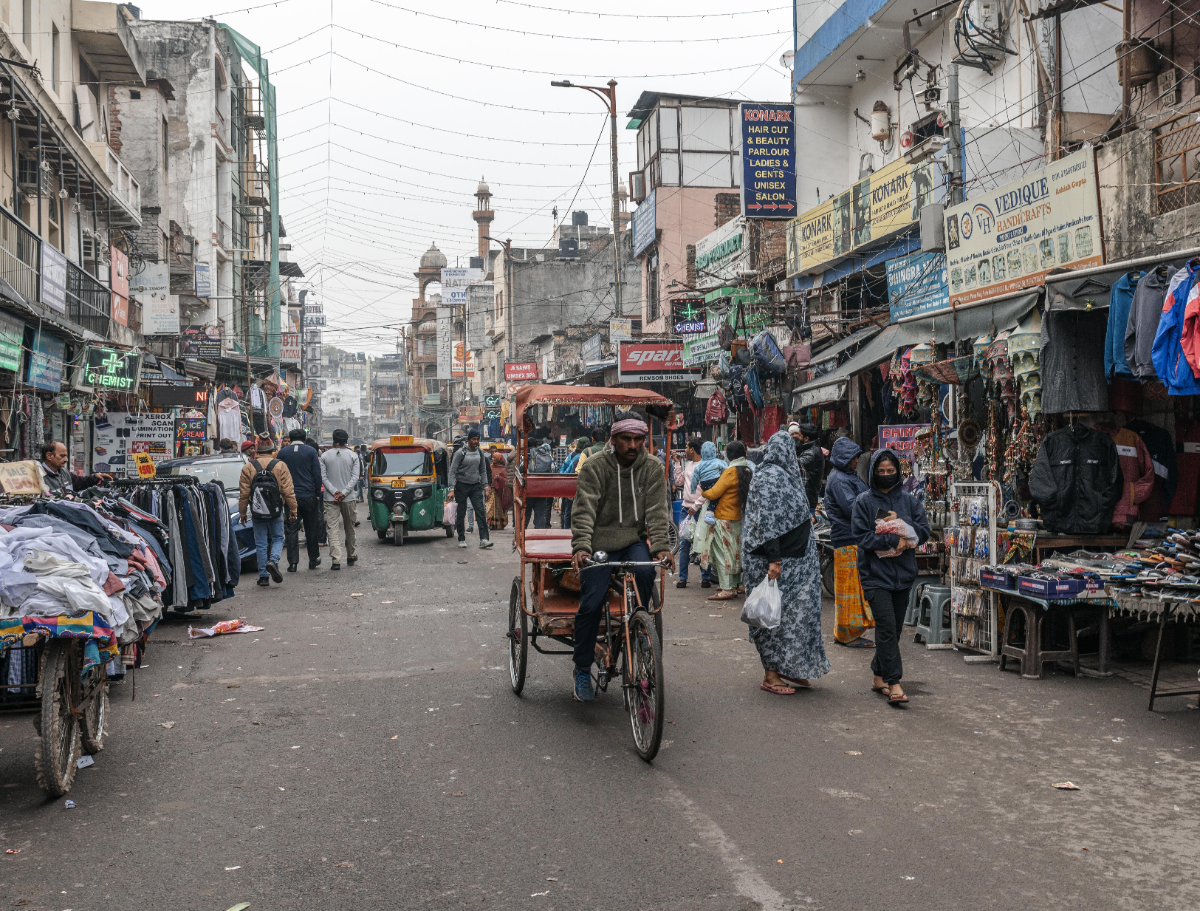
Cycle rickshaws and bicycles on a busy bazaar street.
Can you eat the street food, and is it safe?
Market street food is one of the joys of India and can be eaten safely with a little judgement. The best snacks live here, from the fried flatbreads of Old Delhi to chaat, a family of tangy savoury snacks sold from carts across the north, often something like ₹20 to ₹100 a plate, about USD 0.20 to 1.05, or GBP 0.15 to 0.80. The rule is turnover and heat: a busy stall cooking to order, with a queue of local customers, is safer than a quiet one with food sitting out. Eat things served hot, be careful with cut fruit, drink only sealed bottled or filtered water, and give your stomach a few days to adjust.
How do you stay comfortable and respectful in a crowded bazaar?
Dress modestly, move slowly, and ask before you photograph people, and the crowd becomes friendly rather than daunting. Markets are close, loud and physical, and that is normal. Cover your shoulders and knees, which matters more in traditional and religious quarters, and wear shoes you can stand in for hours. Keep your bag in front of you, as pickpocketing is the main risk and violent crime is rare. Ask before photographing a vendor or their stall, because a market is someone’s workplace, and most say yes warmly. Use your right hand to give and receive money and goods, since the left is traditionally considered unclean. Near tourist sights you will meet touts, and a calm, smiling “no, thank you” is all you need.
What do first-time visitors get wrong in Indian markets?
- Bracing for a battle. Most vendors are hospitable, and treating every exchange as a scam sours a warm experience.
- Buying gemstones or antiques as investments. Without expertise you cannot value them, and this is where real money is lost.
- Grinding a poor trader over a trivial sum. Bargain on big-ticket craft, not on a cup of chai, the spiced milk tea sold everywhere.
- Trying to see every famous market. Two done slowly beat six in a rush.
- Carrying only large notes, and assuming spices and food will clear customs at home.
Who are India’s markets best suited for?
Markets reward the curious and the unhurried. They suit travellers interested in food, craft, textiles and daily life, photographers willing to ask permission, and anyone who would rather understand a place than tick it off.
They are harder for travellers who need calm and predictability, for those with limited mobility, since many old markets are stepped, uneven and crowded, and for families with very young children at peak hours. The fix is timing and choice: go early, pick a covered market, keep the visit short, and pair it with something quiet afterwards. This is the shaping we do when we plan a trip, matching the market to the traveller rather than sending everyone into Chandni Chowk at noon.
Frequently asked questions
Are Indian markets safe for tourists?
Generally yes, with ordinary city precautions. The main risk in a crowded bazaar is pickpocketing, not violence, and solo travellers, including women, shop in India’s markets routinely. Check your government’s advice for the region first: some states, Manipur among them, carry advisories against non-essential travel.
Do you have to bargain in India?
Only in independent stalls and craft shops, not in fixed-price emporiums, supermarkets or restaurants. Where it is expected, offer roughly half to two thirds of the asking price and settle in the middle. Government emporiums are a good no-haggle option if you find bargaining stressful.
What is the most famous market in India?
Chandni Chowk in Old Delhi is the best known, a market district laid out in 1650 that includes Khari Baoli, widely described as Asia’s largest wholesale spice market. Other signatures are Johari Bazaar in Jaipur, Laad Bazaar in Hyderabad and Devaraja Market in Mysuru.
Can I take spices and crafts home from India?
Usually yes for sealed, packaged spices and new crafts, but rules vary, and many countries restrict food, seeds and plant material. India restricts the export of antiquities, meaning objects at least a hundred years old, and bans trade in ivory, shahtoosh and other protected wildlife products. Check India’s export rules and your own country’s import rules before you buy.
When is the best time to visit Indian markets?
Early morning for flower, fruit and spice markets, and late afternoon or evening for textiles and jewellery. Markets are at their most vivid, and most crowded, in the weeks before Diwali, which falls on 8 November in 2026 and 29 October in 2027.
How much should I budget for market shopping?
Very little for everyday items and as much as you like for fine textiles or jewellery. Small crafts and snacks cost a few hundred rupees, a few dollars or pounds, while a genuine pashmina or hand-knotted rug runs into the tens of thousands. Carry rupee cash in small denominations.
Planning a trip that includes the right Indian markets
A market is not a shopping list. It is the fastest way to understand a city, and the difference between enduring one and loving it is usually timing, company and knowing where to stand.
We design private, personalised India journeys for visitors who want depth rather than a checklist, including the markets that suit how you travel and the hours that show them best. If you would like your route shaped around your own dates, pace and interests, Plan my India trip