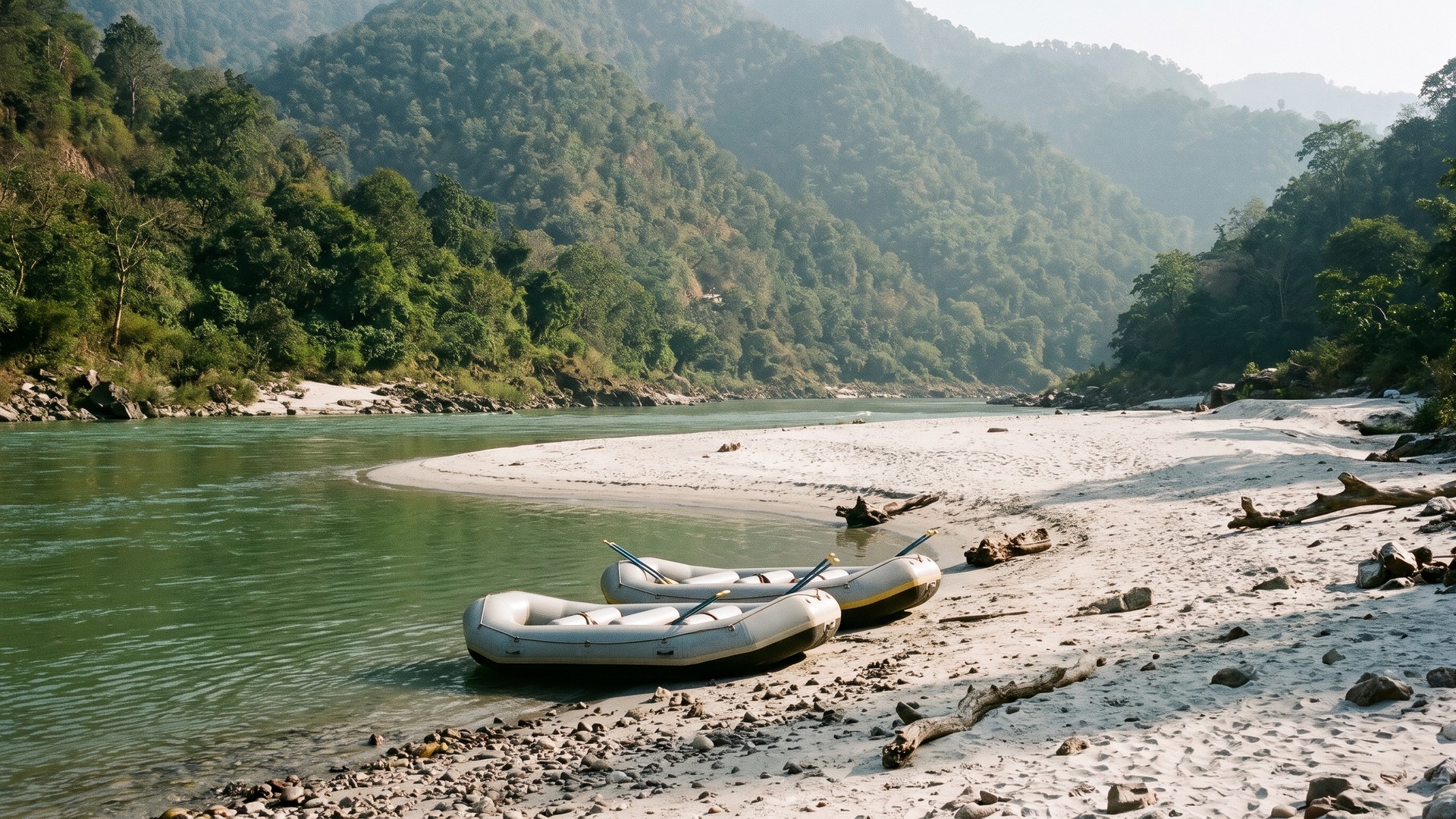
TL;DR
- This guide is for travelers deciding whether a Rishikesh trip is mainly about yoga, rafting or both. Rafters should avoid July and August and book from late September; yoga travelers can choose any cool month, with March bringing the festival crowds. If you want both, autumn is the overlap. Decide your reason first, then the month, then whether to add an evening in Haridwar.
Last updated: November 2, 2026
Quick Answer: The best time to visit Rishikesh for rafting is September to June; the state tourism board advises against the July to August monsoon, when swollen rivers make rafting dangerous. For yoga, October to March gives the coolest practice weather, with October and November the clearest. The Unbored Club plans private Rishikesh trips around either season.
Rishikesh sits in Uttarakhand, where the Ganga leaves the last of the Himalayan foothills and its white-water stretches begin a short drive upstream. It is the town the Uttarakhand Tourism destination guide calls the yoga capital of the world, and the same page lists its white water rafting among the town's headline draws. Which of the two brought you here decides your months, so here is the season-by-season picture.
| Months | Rafting | Yoga and retreats | Weather (WeatherSpark averages) |
|---|---|---|---|
| October to November | Open, post-monsoon water | Comfortable mornings and evenings | Highs around 85°F falling to 80°F; the clearest skies of the year |
| December to February | Open, cold water | Cool and quiet, suited to long courses | January lows around 50°F, highs 71°F |
| March to April | Open | Warm but workable; festival month | Highs climbing from 86°F to 96°F |
| May to June | Open until the authorities close the river, often in late June | Early-morning practice only | Highs around 103°F |
| July to August | Advised against: swollen monsoon rivers | Humid, with heavy rain | August averages 11.7 in of rain |
| September | Reopens once the authorities clear the river, often in late September | Humid but improving | Highs around 88°F |
When does the Ganga open for white water?
Uttarakhand Tourism recommends September to June for rafting in Rishikesh. The Uttarakhand Tourism river rafting guide states it plainly: the best time for river rafting in Uttarakhand is from September to June, and travelers should avoid the monsoon season, July to August, because the rivers swell and rafting becomes dangerous. The state's rafting rules set the Ganga season as 1 September to 30 June, or as the Uttarakhand Tourism Development Board directs by water level, so the exact opening and closing dates move with the river each year.
Within the open season, the experience changes. In October and November the weather is pleasant and the skies at their clearest. The commonest commercial stretch starts at Shivpuri: about 7 miles (11 km) to Lakshman Jhula, per the state's destination page, or about 10 miles (16 km) to Rishikesh. The state's river rafting page grades Uttarakhand's rapids from Grade I to Grade IV, so there is a stretch for first-timers and for experienced rafters. For the full detail on stretches, grades and safety, read the companion guide to running the Rishikesh rapids.
Which months suit a yoga-focused trip?
Yoga in Rishikesh is not tied to the river's calendar. The state's destination page notes that ashrams and resorts both offer yoga sessions and courses, with something for every yoga enthusiast, so your months are decided by comfort rather than by a season. The most comfortable stretch is October through March, when mornings are cool. WeatherSpark's modelled climate summary for Rishikesh puts October as the clearest month of the year, with clear, mostly clear or partly cloudy skies 94% of the time, and January as the coldest, with average lows of 50°F.
March is the festival month. The International Yoga Festival's official site lists its 2027 dates as March 9 to March 15, held only at Parmarth Niketan Ashram on the banks of the Ganga. The state's destination page separately credits the Uttarakhand Tourism Development Board with an annual International Yoga Festival in Rishikesh that attracts thousands of yoga enthusiasts, so check which event a listing means. If you want to be in town for it, book stays well ahead. If you want quiet instead, avoid that week.
A yoga retreat in Rishikesh works around your practice schedule rather than the river's, so a December or January course is very doable; pack warm layers for pre-dawn sessions. For how the town fits India's wider yoga map, see where each yoga style was born. For the slower, non-mat side of the town, the guide to what Rishikesh offers beyond the yoga mat covers the aarti, the sound-healing sessions and the riverside pace.
What is the best time to visit Rishikesh if you want both?
Late September to mid-November is the window where yoga and rafting overlap best. The monsoon has ended, the river is in season, and skies are at their clearest. Daytime highs sit between 80°F and 88°F, warm enough for a morning on the water and cool enough for an evening class. February to mid-April is the second-best window, with rafting in full swing and mornings still pleasant, though afternoons warm up fast.
The trade-off is demand. If quiet matters more to you than warm water, December and January still have in-season rafting and cooler, calmer days, at the cost of cold dawns on the mat. Whenever you go, booking early gives you the widest choice of stays.
What is the weather like month by month?
Rishikesh has a hot summer, a wet monsoon and a short, cool winter. WeatherSpark's modelled averages put the yearly temperature range between 49°F and 105°F. The hottest months are May and June, each averaging a high of 103°F. The coldest is January, with an average low of 50°F and a high of 71°F.
Rain is the real divider. The wetter season runs from June 18 to September 18, and August is the wettest month, averaging 11.7 in of rain across 20.3 wet days. November is the driest, with an average of just 0.2 in and 0.7 wet days. In practical terms, June through mid-September is humid, gray and wet, and everything from late September onward trends drier and clearer.
What are the best things to do in Rishikesh between sessions?
Plenty, and the season shapes it. The state's destination page lists bungee jumping at Mohanchatti from a maximum height of 272 feet (83 m), plus flying fox, mountain swings and paragliding. Trekking routes such as the Waterfall Trek and the Kunjapuri trail, with its views of snow-covered peaks, are at their best in the cooler months.
The town's cultural side runs all year. The evening Ganga aarti at Triveni Ghat is a lamp-and-drums ceremony on the river steps. The Beatles Ashram, where the band stayed in February 1968 and composed nearly 48 songs, is open to walk around, with murals of the band members on the walls. The roughly 2-mile (3 km) walk between Lakshman Jhula and Ram Jhula, lined with small shops, is the town's classic stroll. So the town's activities split neatly: adventure sports follow the rafting calendar, and the rest follows your pace.
How do you get there from the US, and where does Haridwar fit?
You reach Rishikesh in three hops. First, fly into Delhi. Second, take a daily flight to Dehradun's Jolly Grant Airport, which the state's Rishikesh page places 13 miles (21 km) from Rishikesh. Third, drive the last stretch by taxi; alternatively, take a train to Haridwar, which the Uttarakhand Tourism Haridwar guide names as the main railway station for the area, or to Rishikesh's own station, which the state says has frequent trains, and continue by road.
Haridwar is the neighboring holy town downriver, and Jolly Grant Airport serves both: Uttarakhand Tourism puts it 13 miles (21 km) from Rishikesh and 23 miles (37 km) from Haridwar. You can pair the two towns in one trip: Haridwar for the Har Ki Pauri aarti, Rishikesh for the river and the mat. If you are planning around US school breaks, note that the December holidays and March spring break both fall inside the good-weather months named above.
Which timing mistakes trip up Rishikesh visitors?
- Booking July or August for rafting. The state's own rafting page says to avoid these months because swollen rivers make rafting dangerous; plan around them instead.
- Assuming May heat is manageable. With average highs of 103°F, midday sightseeing and afternoon yoga both become hard; shift activities to early morning.
- Ignoring the festival calendar. The International Yoga Festival runs March 9 to March 15, 2027; arrive that week by accident and your quiet retreat becomes a festival town.
- Treating September 1 as reopening day. The state's recommended season starts in September, but the early weeks are still wet, so stay flexible early in the month.
- Underestimating winter mornings. January lows around 50°F feel cold in an unheated ashram room at 5 a.m.; pack for it.
- Planning too few nights. Rafting, yoga and the town's slower rhythms each need a day; two nights barely covers one of them.
How does a private trip handle the seasons?
This is where planning help pays off. The Unbored Club, an India-based travel company that designs private, tailor-made India trips, builds Rishikesh stays around your season and your reason. That could be a rafting week in October, a quiet January yoga course or a trip timed to the March festival, with the timing settled before you fly. Because the team is based in India, it knows the teachers and river operators personally, and there is no overseas middle layer between you and them. You can see how a trip built from scratch around your dates works, or begin by talking through what you want from the town.
If you are weighing seasons and want a Rishikesh trip built around your dates, share what you are hoping for and the team will help you plan it.
A few quick questions so we can design something truly personal for you.
