Most people picture India as temples, spice and heat, not as a place you pull on a helmet and drop into a cold Himalayan river. Yet river rafting in India is some of the most accessible white water anywhere, and the stretch of the Ganga at Rishikesh is where almost everyone starts. The water is snow-fed, the rapids have names, and the whole thing sits a short hop from Delhi.
This guide is for someone flying in from London, Frankfurt, New York or Melbourne who likes the idea of a morning on the river but has never rafted in India and does not know a Grade II from a Grade IV. It answers the practical questions first: when the season runs, which stretch to book, what it costs, whether it is safe, and where else in the country the rafting is good once Rishikesh has given you the taste.
Why is Rishikesh the home of river rafting in India?
Rishikesh is the home of river rafting in India because the Ganga arrives there straight off the mountains, fast, clean and cold, just as the gorge opens onto flatter ground. The town sits in the Himalayan foothills of Uttarakhand, in the north of the country, where the river is still young enough to make rapids but wide enough to run safely.
Rishikesh is also set up for visitors in a way few adventure spots are: a yoga and pilgrimage town with places to stay, places to eat and people used to foreign travellers. You can raft in the morning and sit by the river for the evening aarti, a lamp-and-fire ceremony at the water's edge, on the same day. For many first-timers that mix of adventure and calm within a few hours is the whole appeal.
When is the rafting season in Rishikesh?
The Rishikesh rafting season runs roughly from late September to late June, and it closes through the monsoon. The river is too high and fast to raft safely in July, August and early September, so operators shut down and the equipment comes off the water.
For the 2026 to 2027 season, the Uttarakhand authorities formally opened rafting on 23 September 2026, with commercial runs starting the next day, as of September 2026. Dates shift a little each year with the water level and official clearance, so confirm the current status with Uttarakhand Tourism before you fix travel dates. The sweet spots are the shoulder weeks: late September to November, lively after the monsoon, and March to May, warm on land with a strong flow. Midwinter rafting is possible but cold.
Which rafting stretch should you choose?
Choose your stretch by how much river you want and how hard you want it to hit. Rafting at Rishikesh is sold by fixed stretches down the Ganga, and the longer ones carry bigger rapids.
The four standard options are Brahmpuri, at about 9 kilometres or 5.5 miles, gentle Grade I to II water and the right choice for nervous first-timers and children. Shivpuri, at about 16 kilometres or 10 miles, is the workhorse run, Grade II to III, and the one most visitors book. Marine Drive, at about 25 kilometres or 16 miles, is Grade III with a couple of stretches touching IV. Kaudiyala, at about 36 kilometres or 22 miles, is the serious one, Grade IV, for experienced rafters. The famous named rapids, Golf Course, Roller Coaster, Club House and Double Trouble among them, fall across the longer runs.
If in doubt, book Shivpuri. It gives you real rapids and a stretch of calm water to swim in, without the commitment of the full Kaudiyala day.
We plan private Rishikesh trips that pair the river with the town's quieter side: licensed rafting operators we have vetted, yoga or ashram time, and a stay above the noise. Every route starts with your dates and pace, and our team stays on hand while you travel. See how our private India trips work.
How do the river grades actually work?
River rapids are rated on an international scale from Grade I to Grade VI, and Rishikesh runs from I to IV. Grade I is barely a ripple. Grade II is small, obvious waves. Grade III is proper white water with waves that can fill the boat and soak everyone, which is where most people find the fun. Grade IV is powerful and technical, demanding fast paddling to order. Grades V and VI are expert and extreme, and you will not meet them on a standard Rishikesh trip.
The grade of any rapid changes with the water level, so a stretch feels bigger in May, when snowmelt is high, than in winter. A guide reads the river on the day and briefs you before each named rapid. You need none of it memorised: only that Grade III is exciting and within reach of a fit beginner, and Grade IV is a step up you can save for later.
What does river rafting in Rishikesh cost?
River rafting in Rishikesh is inexpensive by international standards. Uttarakhand sets official rates each season, and for 2026 to 2027 these run from about ₹1,000 to ₹3,500 per person depending on the stretch, roughly USD 10 to 36, or GBP 8 to 28, at rates current in late September 2026. Short runs can be found from around ₹600, about USD 6 or GBP 5.
As a rule, the longer the stretch the higher the price, because it is more river and more of the guide's day. Those figures are for the rafting alone; add transport to the put-in point, often included, and a tip for the crew. Prices move with the season and with weekend demand, so treat these as a planning range rather than a quotation, and check the official rate for the stretch you want. For how rafting fits into a wider budget, our guide to how much a trip to India costs sets out the bigger picture.
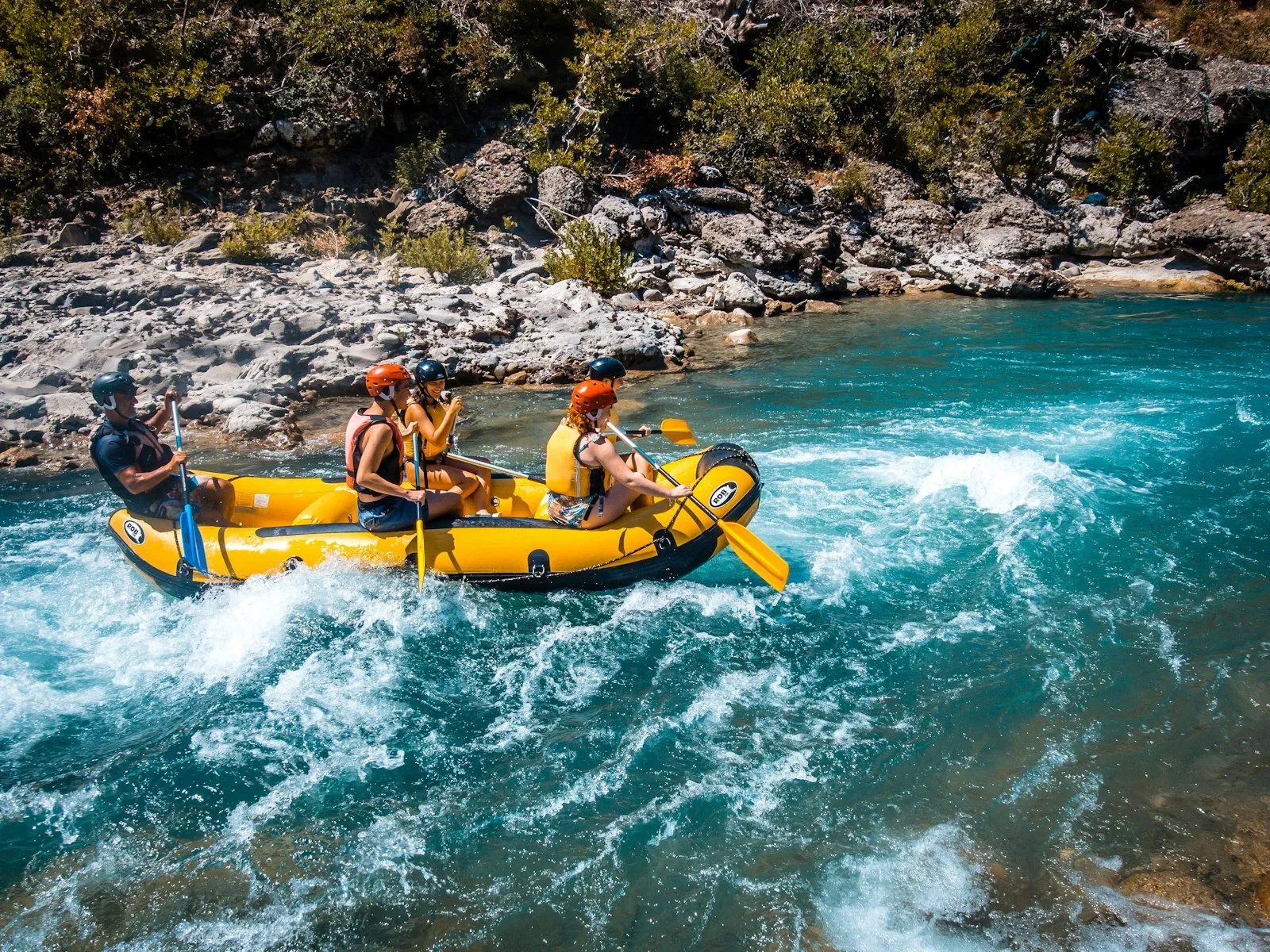
A rafting crew works through a rapid on a Himalayan river.
Is river rafting in Rishikesh safe?
Rafting in Rishikesh is safe for beginners on the lower stretches when you go with a licensed operator, and far less safe when you do not. The activity is regulated by the Uttarakhand Tourism Development Board, which licenses rafting firms each season and has been putting several hundred guides through wilderness first aid and CPR training.
A properly fitted life jacket and a helmet are mandatory and must stay buckled on the water. Every raft carries a trained guide, and on busier stretches a safety kayaker shadows the boats. The sensible precautions are the obvious ones: book a licensed operator, listen to the briefing, keep hold of your paddle, and do not raft after heavy upstream rain. Neither the US State Department, which places India at its Level 2 "exercise increased caution" tier, nor the UK Foreign Office advises against travel to Uttarakhand, though you should always check your own government's current advice. For the broader picture, our honest guide to whether India is safe for first-time travellers covers it in full.
Do you need to swim, and who can raft?
You do not need to swim to raft the gentler Rishikesh stretches, because your life jacket does the floating, but you do need to be reasonably fit and comfortable in cold water. The Ganga here is snowmelt, bracingly cold even when the air is warm, and you will get thoroughly wet.
Minimum ages vary by stretch and operator, commonly around 14 for the longer runs and lower for the gentle Brahmpuri water, with a working weight range of roughly 40 to 100 kilograms. Rafting is not advised if you are pregnant, have a heart condition or a recent injury, or cannot manage sudden cold and exertion. Families with younger children can still enjoy the river by choosing the short, calm stretch and asking about age limits in advance.
How do you get to Rishikesh?
Rishikesh is easy to reach from Delhi, where most international visitors land. The nearest airport is Dehradun's Jolly Grant (airport code DED), about 21 kilometres or 13 miles away, roughly 45 minutes by road, with daily domestic flights from Delhi and other Indian cities.
By train, the nearest major railhead is Haridwar, about 25 kilometres or 16 miles away, around 45 minutes by car, and well connected to Delhi. By road, Rishikesh is about 240 kilometres or 150 miles from Delhi, a drive of six to seven hours on a good day. Within Rishikesh you get around on foot across the famous footbridges and by auto-rickshaw, the three-wheeled open taxis known locally as autos. A private car with a driver, the usual way visitors cover ground in India, runs roughly ₹5,000 to ₹7,000 a day, about USD 52 to 73 or GBP 39 to 55, and is worth it if you are combining the river with trips out of town.
What should you wear and bring for rafting?
Wear quick-drying clothes you do not mind soaking, and bring a dry change for afterwards. Synthetic shorts and a T-shirt, or a swimsuit under a rash vest, work well, with secured sandals or old trainers that will not come off in the water. Leave the cotton, which stays cold and wet, for later.
Bring sunscreen, because the glare off the water is strong, and a strap for your glasses. Leave your phone, camera and valuables at the hotel or in the operator's locker, as anything loose in the raft tends to end up in the Ganga. A warm layer for the drive back is welcome in the cooler months, when foothill mornings can sit around 10 to 15 degrees Celsius, the mid fifties Fahrenheit.
What else is worth doing in Rishikesh?
Rishikesh rewards two or three days rather than a rushed day trip, because the river is only part of it. In my experience, the best version of a rafting visit wraps the adventure inside the town's quieter rituals.
The standout pairing is an early run on the water, then a dawn trek the next morning to the Kunjapuri temple, which looks out over the Himalayan ranges as the sun comes up. Evenings belong to the Ganga aarti at the ghats, the stepped riverbanks where the lamp ceremony is performed, and to the sound-healing and flute sessions the town is quietly good at. There is also the old ashram made famous by the Beatles. Our piece on Rishikesh beyond yoga goes deeper into the spiritual side of the town, and for the surrounding mountains our guide to trekking in the Himalayas picks up where the river leaves off.
River rafting in India beyond Rishikesh
Rishikesh is the easiest white water in India, not the only white water. Once you have the taste, the country has rivers that are wilder, more remote and run in different seasons, which is useful because they fill the gaps when the Ganga is closed.
The Zanskar in Ladakh is the famous expedition run, Grade III to IV through a deep Himalayan gorge, best in July and August when Rishikesh is shut. The Teesta in Sikkim, in the northeast, offers Grade I to IV and runs best from October to April. The Kundalika in Maharashtra, near Mumbai, is a short, punchy Grade III to IV river fed by a dam release, and one of the few that runs reliably in the monsoon. The Barapole in Coorg, in the southern hills of Karnataka, is a monsoon river of steep Grade III to V drops from July to September. The Beas near Kullu and Manali, in Himachal Pradesh, is a friendly Grade I to IV run from spring into early summer. Each is a different trip in a different part of the country, and part of the pleasure of rafting your way around India.
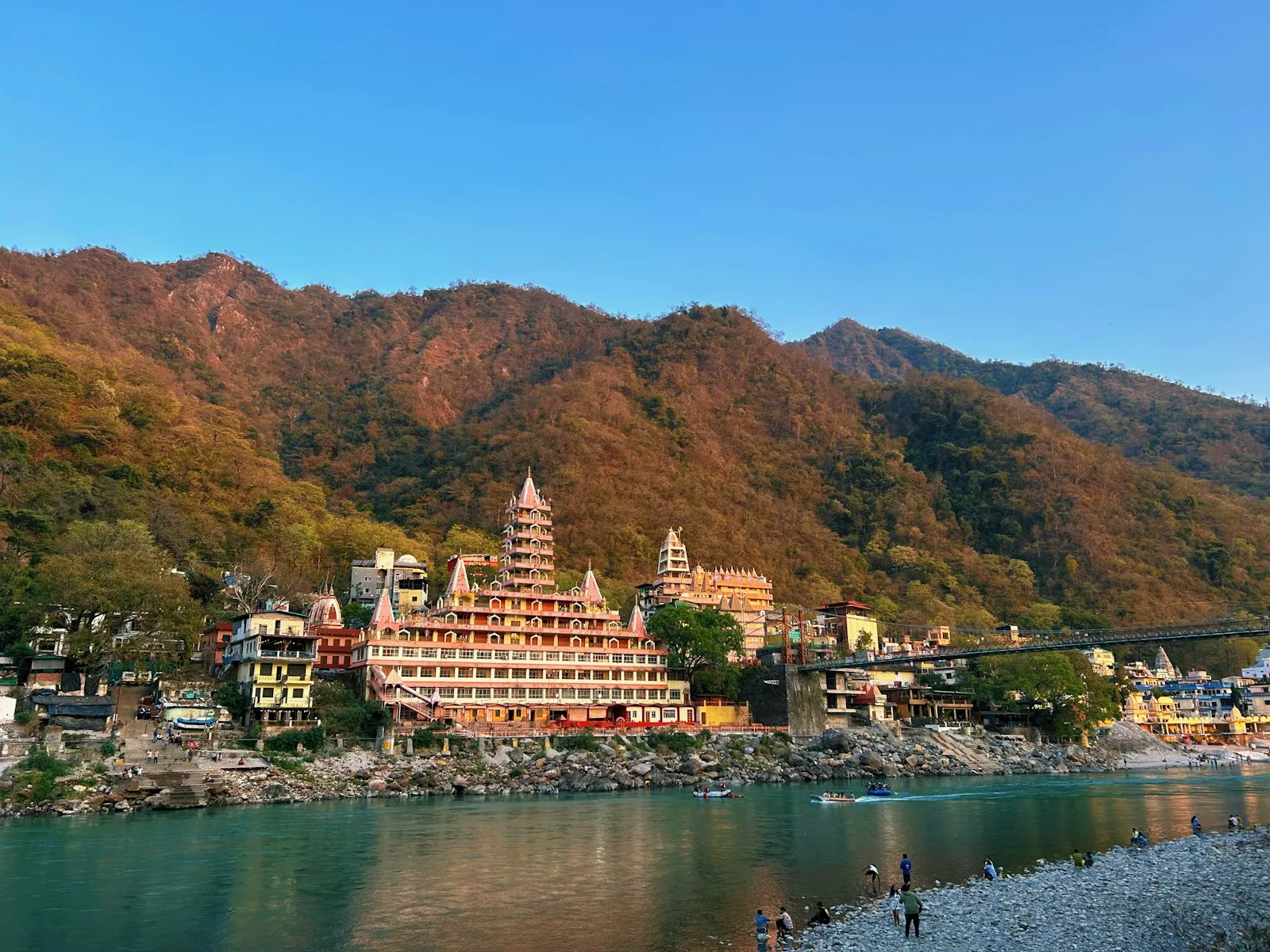
The Ganga runs out of the Himalayan foothills past Rishikesh.
How many days do you need?
For rafting alone, one day is enough: fly into Dehradun or train in from Haridwar, raft a stretch, and be back the same evening. It is how many people fold Rishikesh into a longer north India trip.
To do it properly, give Rishikesh two or three nights: enough to raft without rushing, add a dawn trek or a sound-healing evening, and keep a buffer day in case the river is high after rain. If rafting is the centre of your trip, a week lets you pair Rishikesh with a second river such as the Beas or, in high summer, the Zanskar. Our month-by-month guide to the best time to visit India helps you line the rafting season up with the rest of your plans.
What do first-time visitors get wrong?
The common mistakes are easy to avoid once you know them.
Booking the hardest stretch first is the big one, when Shivpuri gives most people all the thrill they want. Turning up in the monsoon is another, expecting to raft when the river is closed from July into September. Some bring a phone into the raft and lose it, or wear cotton and shiver the whole drive back. The quietest error is booking the cheapest tout on the riverbank rather than a licensed operator, exactly the wrong place to economise when the safety kit and the guide's training are the whole point.
Who is river rafting in Rishikesh best suited for?
Rafting in Rishikesh suits active travellers who want a jolt of adventure without a technical learning curve. It works well for couples, solo travellers, groups of friends, and families willing to pick the gentle stretch for younger children. It also suits anyone already coming for yoga, or to north India for the Golden Triangle, because the river is such a short detour.
It suits you less well if you dislike cold water, cannot manage sudden exertion, or want a calm scenic float rather than genuine white water. And if your heart is set on the biggest rapids, keep Rishikesh as the warm-up and point yourself at the Zanskar.
Frequently asked questions
Is river rafting in Rishikesh safe for beginners?
Yes, on the gentler stretches and with a licensed operator. Brahmpuri and Shivpuri suit fit beginners, life jackets and helmets are mandatory, and a trained guide steers every raft. The risk rises sharply if you book an unlicensed operator or raft when the river is high after rain.
When is the best time for river rafting in India at Rishikesh?
Late September to November and March to May are the best windows, when the water is lively and the weather comfortable. The season closes through the monsoon, roughly July to mid-September, when the Ganga is too high to raft.
How much does rafting in Rishikesh cost?
Official 2026 to 2027 rates run from about ₹1,000 to ₹3,500 per person, roughly USD 10 to 36 or GBP 8 to 28, depending on the stretch, with short runs from around ₹600, about USD 6. Prices move with the season and the length of the run.
Do I need to know how to swim to go rafting?
No, not for the gentler stretches, because your life jacket keeps you afloat. You do need to be reasonably fit and comfortable in cold water, and you should tell your operator in advance if you cannot swim.
Where else can you go white water rafting in India?
Beyond Rishikesh, the best-known rivers are the Zanskar in Ladakh, the Teesta in Sikkim, the Kundalika in Maharashtra, the Barapole in Coorg and the Beas in Himachal Pradesh. They run in different seasons and range from gentle to expert.
How do I get to Rishikesh for rafting?
Fly to Dehradun's Jolly Grant airport, about 21 kilometres or 13 miles away, or take a train to Haridwar, about 25 kilometres away, both close to Delhi. By road Rishikesh is around 240 kilometres or 150 miles from Delhi, a six to seven hour drive.
Planning a rafting trip into a wider India journey
River rafting in India is at its best as one strong note in a fuller trip, not the only reason you flew halfway round the world. A morning on the Ganga, a dawn walk to a hilltop temple, an evening by the river as the lamps go down: that is a better memory than three stretches rafted back to back.
We design private, personalised India journeys for visitors who want depth rather than a checklist, and who like earning their calm with a little adventure first. If you would like a trip shaped around your own dates, pace and appetite for white water, Plan my India trip.