Last updated: 30 October 2026
Quick Answer: The best beaches in Kerala depend on your day: Varkala for red cliffs, Kovalam for a sheltered bay and Marari for quiet village sand. Plan sea swimming for the drier months; the FCDO puts India's usual monsoon, and south India's cyclone risk, at June to November. The Unbored Club can build any of the three into a private Kerala route.
Kerala's coast runs along India's southwestern shore, and the good beaches in Kerala range from cliff-backed coves to quiet fishing-village strands. The comparisons below draw on Kerala Tourism's own beach pages and the FCDO's India travel advice as it stood on 30 October 2026 (last updated 7 October 2026). Use them to match a beach to your trip rather than to a headline.
How do the three main beaches compare?
| Beach | Setting | Suits | Watch out for |
|---|---|---|---|
| Varkala | Red laterite cliffs, around 50 km (about 31 miles) northwest of Thiruvananthapuram | Cliff walks, sunsets, yoga and Ayurveda centres, surfing | Steps down to the sand; exposed sea |
| Kovalam | Three crescent beaches, 16 km (about 10 miles) from Thiruvananthapuram | Easier swimming in a shallow bay, lighthouse, restaurants, nightlife | World-famous and busy; nightlife into the early hours |
| Marari | Fishing-village coast at Mararikulam, Alappuzha district | Long quiet walks, cycling, Ayurveda wellness, doing very little | No water sports or beach shacks; limited facilities |
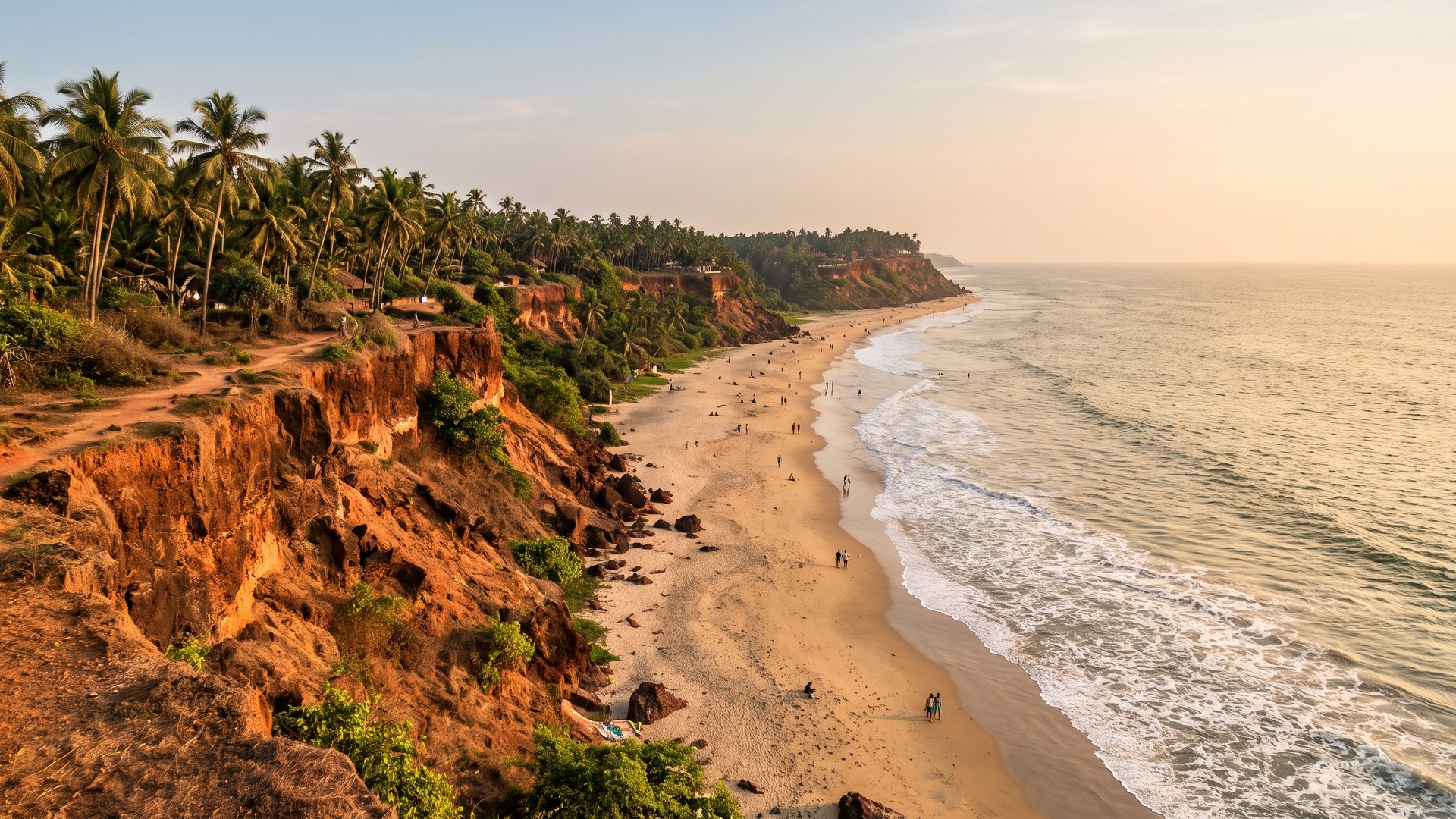
Kerala Tourism describes Kovalam as a shallow beach whose rocky headland creates a calm bay, and Varkala as famous for its red laterite cliffs. Marari, in turn, is described as a peaceful fishing village with long stretches of golden sand. None of them is objectively the best; each suits a different kind of day.
Why is Varkala Beach unlike anywhere else on this coast?
Varkala's beach sits below a remarkable stretch of red laterite cliffs, and it is the only place in southern Kerala where cliffs run directly beside the sea, according to the state tourism board. The Geological Survey of India has declared the cliffs a national geological monument, and geologists call the exposure the Varkala Formation. For a traveller, that means your view is from the cliff top: cafes and yoga terraces look down on the Arabian Sea, and a long stairway drops to the sand.
The beach is also called Papanasam, and it sits beside the ancient Janardhana Swamy temple, which the tourism board calls probably one of the oldest Hindu temples in Kerala. The state board lists surfing, parasailing, paragliding and stand-up paddle-boarding here, along with massage, yoga and meditation centres. Kerala Tourism also calls Varkala a hub for Ayurvedic treatments. It feels quieter and more spread out than Kovalam, but the swimming is more exposed, so treat the sea with respect and follow any lifeguard instructions.
What is Kovalam Beach really like?
Kovalam is a world-famous beach town, and that is both its appeal and its drawback. Kerala Tourism describes it as a destination of three crescent-shaped beaches, where a rocky headland creates a serene bay suited to sea bathing. That calm bay is the draw for swimmers, and the state board lists sunbathing, swimming, Ayurvedic massages and catamaran rides among the activities on offer.
Lighthouse Beach is one of Kovalam's highlights, and climbing the Vizhinjam Lighthouse gives you a view down the whole coastline. The seafront is lined with accommodation from five-star hotels to budget cottages, and the tourism board notes that nightlife continues well into the early hours. If you want a beach with restaurants, shops and an easy swim within reach of a city, Kovalam works. If you came to India for quiet, it will feel busy.
What does Marari Beach offer besides sand?
Marari Beach, in the Alappuzha district, is named after Mararikulam, the fishing village it sits beside, and the state tourism board presents it as a place for people who want golden sand and coconut palms away from city life. The beach lacks water sports and beach shacks. Instead you rent a beach chair and umbrella, walk for kilometres, or cycle through the neighbouring villages to watch the fisherfolk at work. The board notes that conversations with fishermen can even lead to an impromptu boat ride, if they deem it safe.
Marari is also a base for Ayurvedic wellness, with resorts offering treatments, so it is worth knowing how to tell authentic Ayurveda from a spa menu before you book one. It sits within easy reach of the Alappuzha backwaters, Alappuzha Beach, the lighthouse and the Kumarakom Bird Sanctuary. The weather is warm and humid year round. Of Kerala's beaches, Marari is the one built for the last few nights of a trip, when the point of the holiday is to stop moving, and it pairs naturally with a night on the backwaters.
Which other Kerala beaches are worth a detour?
Kerala's coast runs well beyond the southern three, and the state tourism board's own list of popular beaches adds a few that suit particular routes:
- Cherai, near Kochi: golden sand and coconut palms that the board calls ideal for swimming, sunbathing and relaxation, an easy addition to a Fort Kochi stay.
- Bekal, Kasaragod district: a tranquil beach in the far north, famous for its pristine sands and the 17th-century Bekal Fort.
- Muzhappilangad, Kannur: a 4 km (about 2.5 miles) stretch of sand 7 km (about 4 miles) from Thalassery that Kerala Tourism calls the longest drive-in beach in Asia, with black rocks that shield it from strong currents.
The northern beaches sit well away from the usual Kochi-to-Thiruvananthapuram route, so they suit a longer trip or a second visit rather than a first fortnight.
Which are the best beaches in Kerala for swimming and families?
If you are weighing up the best beaches in Kerala for family swimming, start with Kovalam's sheltered, shallow bay and Cherai near Kochi, two beaches the state tourism board describes as good for swimming. Kovalam's rocky headland dampens the swell, and the beach has restaurants and accommodation within a few minutes' walk. Varkala and Marari are better for walking and scenery than for long swims.
A few honest cautions apply anywhere on this coast. The FCDO's India travel advice warns that there are strong currents off many coasts and people drown every year. It also notes that most beaches in India do not have warning signs, flags or lifesaving equipment. In its advice for women travellers, the same page says to avoid isolated areas, including beaches, when alone at any time of day, which is worth remembering on long, empty strands like Marari's.
Take local advice, follow warnings and instructions issued by lifeguards, and remember that emergency service standards may differ from those in the UK. Those are the FCDO's points; on top of them, watch for local beach closures in the monsoon months, and if in doubt stay out of the water.
When should you not swim at a Kerala beach?
The monsoon season in India usually runs from June to November, according to the FCDO, which warns of flash flooding and landslides, particularly in mountainous areas, and lists the same months for cyclone risk in south India, when storm surges can flood coastal areas. That is a weather warning, not a swimming rule, but it is reason enough to treat the sea with extra caution in these months: take local advice and plan your beach days for the drier part of the year.
The FCDO's swimming advice applies all year: strong currents exist, most beaches lack flags and lifesaving equipment, and emergency service standards may differ from those in the UK. Beyond what the FCDO says, a few habits help: swim where a lifeguard is on duty, ask locally about the day's conditions, and keep children within arm's reach in the water. None of this is a reason to skip Kerala's coast; it is a coast to enjoy with the same respect you would give any open sea.
Where do first-time visitors go wrong on Kerala's coast?
- Treating all Kerala beaches as interchangeable. The cliff walk at Varkala, the bay at Kovalam and the village strand at Marari are three different holidays; pick the one that matches your energy.
- Booking only beach nights. Kerala's coast pairs with the backwaters, the tea hills and Fort Kochi; a beach-only trip misses the state's range.
- Swimming without reading the sea. The FCDO warns most beaches have no flags or lifesaving equipment, so local advice is your main safety net.
- Expecting facilities at Marari. The state board says it lacks water sports and shacks; come for quiet, not services.
- Swimming in the monsoon. The FCDO puts India's monsoon at roughly June to November and lists the same months for cyclone risk in south India, when storm surges can flood the coast. That is reason enough to follow lifeguards and local warnings, and keep long swims for the drier months.
- Underestimating Kovalam's busyness. If you want seclusion, its nightlife and seafront crowds will disappoint; Marari is the quieter choice.
How do the beaches fit into a wider Kerala trip?
One route that works well is to fly into Kochi and loop south through three stays of three nights each: the Munnar tea hills, the backwaters around Alleppey (one of those nights can be on a houseboat), and then the coast. Marari is the natural fit beside the backwaters, while Varkala or Kovalam sit at the southern end near Thiruvananthapuram. A first-timer's guide to a night on a Kerala houseboat covers the backwater leg, and a full ten-day Kerala itinerary shows how the days and drives fit together.
The Unbored Club, an India-based travel company that designs private, tailor-made India trips, plans these coastal routes around what you actually want from the sea, whether that is Varkala's cliff-top cafes or a hammock at Marari. Booking directly with a team in India skips the overseas middle layer, so more of your budget goes into the trip and help stays reachable on the ground. The Kerala trip planning page is the place to start. When another option suits you better, it is worth saying plainly: if you want a resort-only beach holiday with no inland travel, a destination built purely around beach resorts will serve you better than Kerala. Kerala's real pull is the combination of coast, backwaters and hills, and a beach-only trip undersells it.
What should you sort out before booking beach nights?
Once you have chosen between cliffs, bay and village, the practical sequence is short. Check the FCDO's India travel advice and your visa requirements, book your beach nights outside the monsoon months, and decide how the coast connects to the rest of your route. Marari pairs with Alleppey and Varkala with Thiruvananthapuram, so the beach choice shapes your final drives. If you would rather hand the logistics over, share your dates, interests and budget and the trip will be designed around them.
A few quick questions so we can design something truly personal for you.
