An Ayurvedic diet is not a list of superfoods, and it is not a cleanse you can buy in a packet. It is a way of eating built on one idea: the right food for you depends on who you are, the season, and how your digestion is behaving that week. The same meal that steadies one person can unsettle another, which is what makes it feel so unlike a Western diet plan.
If you are flying in from London, Frankfurt, New York, Melbourne or Toronto and keep seeing the word Ayurveda beside the places you plan to stay, this guide is for you. It explains what an Ayurvedic diet is, what a day of eating looks like, how to tell a genuine kitchen from a wellness buffet, and where in India to try it. Ayurveda is India's traditional system of medicine, and in Kerala especially it remains a living, everyday practice rather than a spa add-on.
What is an Ayurvedic diet, really?
An Ayurvedic diet is an approach that treats food as medicine, matched to your body and the season rather than to a fixed menu. Nothing is universally good or bad. What matters is whether a food suits your constitution and your digestion right now.
That is why a genuine Ayurvedic cook will ask how you have been sleeping and digesting before deciding what to serve you. The goal is balance and easy digestion, not calorie counting. This is a recognised system in India, overseen by the government's Ministry of AYUSH, and in 2022 the World Health Organization opened a global traditional-medicine centre in Gujarat to study traditions like it.
What are the doshas, and do you need to know yours?
The doshas are the three working energies Ayurveda uses to describe your body and mind: vata, pitta and kapha. Most people have one that leads, and your prakriti, your natural constitution, is the particular mix you were born with.
In plain terms, vata is movement and tends towards dryness and cold, pitta is heat and digestion, and kapha is structure and steadiness. You do not need to self-diagnose before you travel. A qualified Ayurvedic physician reads your pulse, tongue and history and tells you where you sit, and the food follows from that.
What does a day of Ayurvedic eating look like?
A typical Ayurvedic day is three warm, mostly cooked meals, with lunch as the largest. Ayurveda holds that your digestive fire, called agni, is strongest in the middle of the day, so lunch is treated as the main meal and dinner is kept lighter and earlier.
Food is usually freshly cooked, warm, and eaten sitting down without distraction. Raw salads, iced drinks and heavy late dinners are gently discouraged, not forbidden, simply because they are considered harder to digest. In my experience, just moving the big meal to the middle of the day and keeping supper small and early is the change most visitors feel first.
What are the six tastes, and why does every meal include them?
Ayurveda recognises six tastes, called rasa: sweet, sour, salty, pungent, bitter and astringent. A well-built Ayurvedic meal tries to include all six, because each is thought to do something different for the body and leaving one out leaves you reaching for it later.
This is quietly clever. The bitter of a green leaf, the astringent of a lentil, the pungent of ginger, a little sour tamarind, salt, and the sweet of rice or ghee, which is clarified butter, all appear on one plate. You finish satisfied rather than craving, which is the practical reason the approach curbs snacking.
Is an Ayurvedic diet vegetarian, and what is sattvic food?
Most Ayurvedic cooking is vegetarian, though the system is not strictly meatless everywhere. The food you will meet at wellness centres is usually sattvic, one of three categories Ayurveda uses to describe how food affects the mind.
Sattvic food is fresh, light and calming: rice, lentils, seasonal vegetables, fruit, ghee and mild spices. Rajasic food is stimulating, think very spicy, salty or fried dishes, and tamasic food is heavy or stale, including leftovers and most alcohol. A sattvic diet leans hard towards the first group, which is why a week of it often leaves people feeling lighter and clearer.
How is an Ayurvedic meal different from a normal Indian thali?
An Ayurvedic meal looks like a thali, a platter of small dishes around rice, but it is composed for balance and digestibility rather than abundance. A restaurant thali aims to impress with variety and richness. An Ayurvedic plate aims to sit lightly.
So the oil is lighter, the spicing gentler, the portions smaller, and nothing is deep-fried into submission. If you have eaten a Kerala sadya, the grand vegetarian feast served on a banana leaf, you have already seen the ancestor of this idea: many tastes, one leaf, eaten slowly with the right hand.
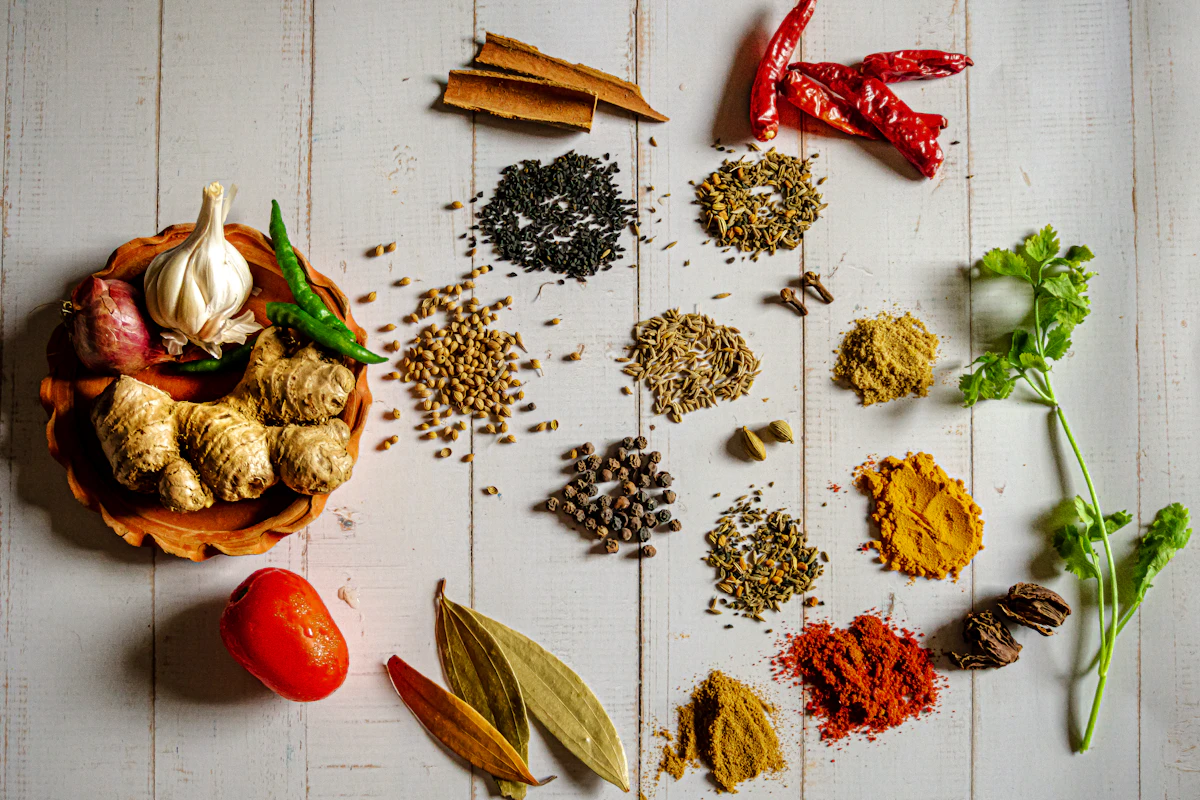
Spices carry the six tastes that an Ayurvedic meal tries to balance on one plate.
Where in India should you go to eat this way?
Kerala, on the southwest coast, is the place most associated with living Ayurveda, which is why most serious Ayurvedic eating happens there. The tradition is woven into ordinary life, and the state is where you will find the deepest concentration of genuine centres and physicians.
That does not mean it is the only option. Rishikesh and the Himalayan foothills lean towards sattvic, yogic eating, and good Ayurvedic kitchens exist across the country. But if your main reason for the trip is to eat and rest this way, Kerala is the honest first answer. You can read more in our guide to Kerala on a Plate: Coconut, Spice and the Sea.
How do you tell a genuine Ayurvedic kitchen from a spa menu?
The clearest test is whether anyone asks about you before they feed you. At a genuine centre, a physician does a consultation and a prakriti reading first, and the kitchen then cooks to your constitution. A spa simply hands you a menu with the word Ayurvedic printed at the top.
This is the difference I care about most on the trips we plan. The places worth your time are the ones where the food is part of a consultation with a doctor on site, not a themed buffet. If no one has asked how you digest, you are eating wellness branding, not Ayurveda. We go deeper on this in Authentic Ayurveda in Kerala: How to Tell Real Treatment From a Spa Menu.
When is the best time of year for an Ayurvedic reset?
The monsoon, roughly July and August, is traditionally considered the ideal season for Ayurvedic treatment in Kerala. The Malayalam month of Karkidakam falls in this window, and Kerala's own tourism board describes the period as the time when the body is most receptive to therapy.
It is also the season of karkidaka kanji, a medicinal gruel of njavara rice and a dozen to two dozen herbs, eaten to reset the system after the rains. This runs against the instinct to visit India only in dry winter, so weigh it against the weather. If a genuine reset is the point of the trip, the wet months reward you.
What is kitchari, and why do Ayurvedic cooks keep returning to it?
Kitchari, sometimes written khichdi, is a soft one-pot dish of rice and split lentils cooked with mild spices and ghee. It is the comfort food and the reset meal of Ayurveda at once, gentle enough to give a tired digestion a rest.
You will meet it on cleanse days, when someone is unwell, and whenever the body needs something easy. It is worth learning to make, because it travels home better than almost anything else on an Ayurvedic table. Ask at a cooking session and most cooks will happily walk you through their version.
What should you actually eat across the day?
Keep it warm, cooked and simple: a light spiced breakfast, a full and varied lunch, and an early, modest dinner. That rhythm alone carries most of the benefit, even before you learn a single recipe.
A workable template: for breakfast, warm spiced porridge, stewed fruit or soft idli, which are steamed rice cakes. For lunch, rice with dal, meaning cooked lentils, two or three vegetable dishes, a little pickle and curd. For dinner, a soup, a kitchari or a light vegetable and rice, eaten before it gets late. Drink warm water through the day rather than iced.
What does an Ayurvedic diet ask you to avoid?
Less a banned list than a short set of habits: very cold, very heavy, very processed, and very late. These are considered the hardest things for your digestion, so they are reduced rather than outlawed.
In practice that means going easy on iced drinks, deep-fried food, heavy dairy such as cheese, leftovers, and large meals close to bedtime. Alcohol is treated as tamasic and kept to a minimum. None of this is absolute, and a good practitioner will tailor it to you rather than hand you a rulebook.
How much does eating this way cost as a traveller?
Eating Ayurvedically in India is inexpensive by Western standards, with the cost sitting in the consultation and the stay rather than the food itself. Treat the figures below as planning ranges that move with season and place, and confirm them with the provider before you book.
As an indication, a one-on-one consultation with an Ayurvedic physician, including a prakriti reading, is often around ₹800 to ₹2,000, about USD 8 to 21, or GBP 6 to 16. A day of full-board Ayurvedic vegetarian meals at a wellness centre typically runs ₹1,200 to ₹3,000 per person, roughly USD 13 to 32, or GBP 9 to 24. A hands-on cooking or farm-to-table session is commonly ₹2,000 to ₹5,000 per person, about USD 21 to 53, or GBP 16 to 40. For how the wider trip adds up, see A Wellness Route Through India: Ayurveda, Yoga, Sound and Forest.

Warm, freshly cooked rice and vegetables: the everyday shape of Ayurvedic eating.
Can you keep an Ayurvedic diet when you get home?
Yes, and the parts that travel best are habits rather than ingredients. Keep the big-lunch, light-early-dinner rhythm, cook simple warm meals, favour the six tastes across a day, go easy on iced and processed food, and keep kitchari in your repertoire for the days you have overdone it. A short course of consultations before you leave India gives you something concrete to carry home rather than a vague intention.
Is an Ayurvedic diet actually good for you? An honest answer
The everyday eating habits are sensible and low-risk, but Ayurveda's wider medical claims are not all backed by strong evidence, so hold the two apart. Warm, fresh, mostly plant-based food, a big midday meal and a light dinner are reasonable by any standard.
Be more careful with Ayurvedic herbal supplements than with the food. The Merck Manual and the US National Center for Complementary and Integrative Health both note that some Ayurvedic herbal products have been found contaminated with heavy metals such as lead, mercury and arsenic, and that high-quality research on the system as a whole is hard to conduct. Enjoy the diet, be cautious with pills, and if you have a medical condition, are pregnant, or take regular medication, speak to your own doctor before changing how you eat or starting any supplement. For a fuller, even-handed look, read The Science (and Soul) of Ayurveda for the Modern Sceptic.
What do first-time visitors get wrong about Ayurvedic eating?
- Treating it as a quick detox. It is a rhythm, not a three-day fix, and the benefit comes from consistency.
- Confusing a spa buffet with Ayurveda. If no physician has assessed you, the food is themed, not prescribed.
- Trusting supplements more than meals. The food is the safe part, the unregulated herbal pills less so.
- Expecting it to be bland. Done well it is full of flavour, just lighter and gentler than a restaurant curry.
- Skipping the consultation. The diet only becomes personal once someone has read your constitution.
Who is an Ayurvedic diet best suited for?
It suits travellers who want rest and reset rather than sightseeing, people curious about food and wellbeing, and anyone who already senses that how they eat affects how they feel. It works beautifully alongside yoga, slow travel and a quiet stretch of coast or hills.
It is a weaker fit if you want a packed, fast-moving itinerary, or if you are hoping for a medical cure rather than a way of eating and living. Families can absolutely enjoy the food, though young children rarely want a full programme. If any of this sounds like you, it pairs naturally with the kind of unhurried, personalised trip we design.
Frequently asked questions
Is an Ayurvedic diet vegetarian?
Mostly, yes. Most Ayurvedic cooking, and almost all of what you will be served at wellness centres, is vegetarian and sattvic. The system is not strictly meatless in every tradition, but plant-based, freshly cooked food is the norm you should expect.
Do I need to know my dosha before I travel?
No. It is more accurate to have a qualified Ayurvedic physician assess your prakriti in person through pulse, tongue and lifestyle than to rely on an online quiz. Treat any app or website result as a rough curiosity, not a diagnosis.
Is an Ayurvedic diet safe?
The food itself is low-risk and sensible for most people. The caution is with Ayurvedic herbal supplements, some of which have been found to contain heavy metals. If you have a health condition, are pregnant or take medication, check with your own doctor before changing your diet or taking any remedy.
What is the difference between Ayurvedic food and ordinary Indian food?
Ordinary Indian restaurant food aims for richness and variety. Ayurvedic food uses many of the same ingredients but keeps the oil lighter, the spicing gentler and the portions smaller, and it is composed for easy digestion and balance rather than indulgence.
When is the best time to do an Ayurvedic programme in India?
The monsoon, around July and August, is traditionally seen as the ideal season in Kerala, when the body is considered most receptive to treatment. Dry winter months are more comfortable for general travel, so the right answer depends on whether rest or sightseeing leads your trip.
Can I follow an Ayurvedic diet at home?
Yes. The habits travel better than the ingredients. Keep a large lunch and a light early dinner, cook warm and simple, aim for the six tastes across the day, and lean on kitchari when you need to reset.
Eating as the Ayurvedic tradition intends
An Ayurvedic diet is less a set of rules than a change of rhythm: warm food, a proper lunch, a light evening, and meals that suit the person eating them. You can feel the difference within a few days, long before you understand the theory.
The best place to learn it is at the source, with a physician who reads your constitution and a kitchen that cooks to it. We design private, personalised India journeys built around exactly this kind of slow, restorative eating. If you would like a trip shaped around your own pace and interests, Plan my India trip.