Most people picture India as heat, colour and crowds. Spiti Valley is the opposite of all three. It is a cold, high desert in the far north-east of Himachal Pradesh, where the rain never reaches, the hills are the colour of bone, and whitewashed monasteries sit on cliffs above a thin grey river. It looks more like Tibet than the subcontinent you expect, which is more or less what it is: a slice of the Tibetan plateau inside India.
If you are flying in from London, Frankfurt, New York or Melbourne and picturing a side trip to the Himalayas, this guide is for you. It answers the questions that decide whether Spiti works for your trip: how to get there, permits, altitude, timing, cost and who it suits.
Where is Spiti Valley, and why does it feel like nowhere else in India?
Spiti is a remote valley in the north-east of Himachal Pradesh, between the greener Kullu and Lahaul valleys and the Tibetan border. Its main town, Kaza, sits at about 3,650 metres, roughly 11,980 feet. The valley is a rain shadow desert: the Himalayan ranges wring the monsoon dry before it arrives, so Spiti stays brown, bare and startlingly clear most of the year.
What sets it apart is the quiet and the Buddhism, a Tibetan Buddhist culture rather than a Hindu one, so the soundtrack is wind and prayer wheels, not horns and bells. A gompa, the local word for a Buddhist monastery, is usually the oldest building in a village of flat-roofed mud-brick houses with firewood stacked on the roofs for winter.
How do you actually get to Spiti Valley?
There is no airport or railway in Spiti, so every visit ends with a long road journey, the first thing to grasp before you plan. The nearest small airports are Bhuntar, near Manali, and Shimla, both weather-dependent. Chandigarh, about a day's drive south, is the better-connected gateway, with frequent flights from Delhi.
From the roadhead, two routes climb into Spiti, and they are not interchangeable. One comes up from Shimla through the Kinnaur valley; the other over the mountains from Manali. Which you use shapes the whole trip, and either way the approach is measured in days, not hours.
Which route should you take: Shimla or Manali?
Take the Shimla side in and the Manali side out, if the season allows, because that order is both safer and more beautiful. The Shimla route runs about 410 kilometres, roughly 255 miles, usually over two days with a night in Kinnaur. It climbs gradually, giving your body time to adjust, and stays open all year. The Manali route is shorter at around 200 kilometres, roughly 125 miles, but it is a single hard driving day of nine to ten hours over the Kunzum Pass at about 4,550 metres, roughly 14,900 feet, and open only in the warmer months.
I would always route the gradual climb from Shimla first, so you acclimatise on the gentle side, and I would urge any first-timer to do the same.
We plan private Spiti trips with acclimatisation built into the route, experienced mountain drivers, monastery visits and homestays we trust. Every route starts with your dates and the season, and our team stays on hand while you travel. See how our private India trips work.
Do you need a permit for Spiti Valley?
Indian citizens need no permit for Spiti itself, but foreign nationals do need an Inner Line Permit for the stretches close to the Tibetan border, which include Tabo, Dhankar, Komic and the Kinnaur border villages such as Nako and Chango. The permit is inexpensive, with an official fee of around INR 200, about USD 2 or GBP 1.60, and is normally issued to foreign tourists travelling in a group of two or more through a recognised Indian travel agent.
The rules change from season to season. As of October 2026 the position is as described, but treat it as orientation, not gospel: confirm the current requirement through the official Himachal district administration, such as the Kinnaur district authorities, or have your operator arrange it before you travel.
When is the best time to visit Spiti Valley?
The main season is roughly June to early October, when both roads are open, the days are mild and the full circuit is drivable. Daytime temperatures in Kaza then sit around 15 to 25 degrees Celsius, roughly 59 to 77 Fahrenheit, while nights stay cold even in July.
Winter is a different proposition. From about November to April the Manali road closes under snow and Spiti is reachable only by the long Kinnaur route, often on ice. Nights can fall well below minus 20 degrees Celsius, below minus 4 Fahrenheit, and many homestays shut. People still go, because winter is the snow leopard season around Kibber, but it is a specialist trip, not a first visit. For how India's seasons move region by region, see our guide to the best time to visit India.
How many days do you need for a Spiti Valley road trip?
Plan on at least seven to nine days, and resist the urge to go faster. The distances look modest on the map, but mountain roads are slow, and the altitude means your first day or two should be gentle. A four-day dash from Manali and back is possible, and it is also the quickest way to give yourself altitude sickness and see very little.
A sensible shape is two days climbing in from Shimla, three or four days based around Kaza, a night at the lake if the season allows, and a day out over Kunzum to Manali.
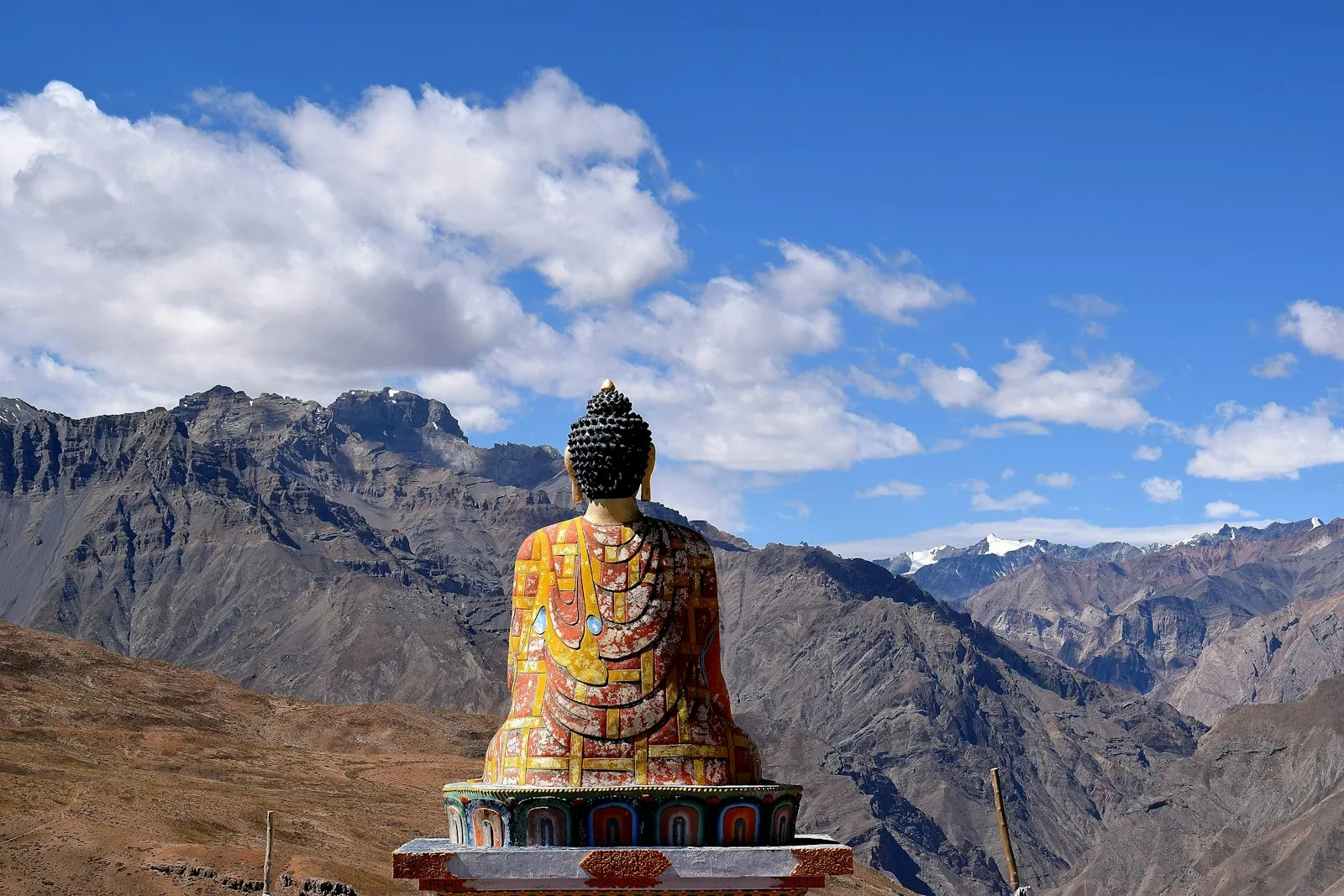
The hillside Buddha above Langza, one of Spiti's highest villages.
A suggested Spiti Valley itinerary, stop by stop
The classic loop runs Shimla, Kinnaur, Spiti and out via Manali. Nights are listed rather than days, because nights are what you book.
- Kinnaur valley: 1 to 2 nights, climbing from Shimla, acclimatising around Kalpa or Nako.
- Tabo: 1 night, for its thousand-year-old monastery.
- Kaza: 3 nights, your base for Key, Kibber, Langza, Hikkim and Komic.
- Dhankar: a half day, for the old fort-monastery above the river.
- Chandratal: 1 night near the lake if the road and your stamina allow.
- Manali: arrive over the Kunzum Pass, for a warm bed and a long shower.
Drop Chandratal if the camping season is over, add a day in Pin Valley for a walk, and go slowly at first.
The monasteries: Key, Tabo, Dhankar and Komic
Spiti's monasteries are why most people come, and four stand out. Key Monastery, the one in the photographs, is the largest in the valley, a warren of white rooms stacked up a conical hill at about 4,166 metres, roughly 13,668 feet, around 12 kilometres, 7.5 miles, north of Kaza. Monks still live and study there, and you can usually sit in on a morning prayer if you are quiet and ask first.
Tabo is the oldest and, for many, the most moving. Founded in 996 CE, it has been in continuous use for more than a thousand years, and its mud-walled halls hold murals so fine that it is nicknamed the Ajanta of the Himalayas, after India's famous cave paintings; the Archaeological Survey of India has proposed it for World Heritage status. Dhankar, a former fort-monastery, clings to a crag above the river. A monastery can feel opaque; half an hour with someone who can explain the paintings and the chanting turns looking into understanding, the same lesson travellers learn in India's temples.
The high villages: Kibber, Langza, Hikkim and Komic
Above Kaza sits a cluster of villages among the highest you can drive to, and visiting them is the best half-day in Spiti. Langza, at around 4,400 metres, is known for a large hillside Buddha statue and for the marine fossils still found in its soil, a reminder that this desert was once the floor of an ancient sea. Hikkim, nearby, is widely described as the world's highest post office, at about 4,400 metres, roughly 14,500 feet, and you can post a card home from it.
Komic, higher still at roughly 4,580 metres, about 15,050 feet, is often called one of the highest villages connected by a motorable road anywhere. Kibber, a little lower, is the base for winter snow leopard tracking. Go up slowly and expect a short uphill walk to leave you breathless.
How do you handle the altitude in Spiti?
Altitude is the real difficulty in Spiti, and the fix is simple: ascend slowly and give your body time. Kaza is higher than many people have ever slept, and the villages above it higher again, so climbing in gradually from Shimla rather than vaulting over the Kunzum Pass from Manali is the single best thing you can do. Spend your first day or two doing very little, drink water constantly, go easy on alcohol, and do not rush uphill the day you arrive.
Mild breathlessness and a headache are common and usually pass. Anything worse, such as persistent vomiting, confusion or breathlessness at rest, means you must descend rather than push on. Ask your own doctor about altitude medication before you fly, as that is a medical question this article cannot answer. On our high-altitude departures we build in acclimatisation nights as a matter of course and keep bottled oxygen in the vehicle.
What does a Spiti Valley trip cost?
Spiti is one of the more affordable corners of the Indian Himalayas. As a planning range, a well-organised seven-to-nine-day private trip with car, driver and homestays typically lands between INR 60,000 and 120,000 per person, excluding flights to India: roughly USD 625 to 1,250, GBP 470 to 940, or EUR 555 to 1,110 at rates in October 2026.
The main components, all moving with season and demand:
- A village homestay with dinner and breakfast: roughly INR 1,000 to 2,500 per person per night, about USD 10 to 26, or GBP 8 to 20.
- A private vehicle with driver for mountain roads: roughly INR 5,000 to 9,000 per day, about USD 52 to 94, or GBP 39 to 70.
- A bowl of thukpa, the local noodle soup, at a roadside dhaba: around INR 150 to 400, about USD 1.50 to 4.
For how costs vary by travel style, see our transparent breakdown of what a trip to India costs. Your biggest expense is reaching the hills; once you are up there, the valley is cheap.
Where do you stay and eat in Spiti?
Accommodation is mostly family homestays and small guesthouses, which is part of the appeal. A typical room is clean and plain, with heavy blankets and, in smaller villages, a shared bathroom, and your hosts usually cook dinner and breakfast. Kaza and Tabo have a few boutique guesthouses, some with a sun deck or a quiet room for morning yoga, but all are modest by design. Book ahead in peak summer, and carry cash, because card machines and signal are scarce beyond Kaza.
The food is simple, warming and largely safe if you eat where there is turnover. Staples are Tibetan: thukpa, the noodle soup; momos, which are steamed or fried dumplings; and plenty of dal, rice and vegetables. Homestay kitchens are the safest places to eat, because the food is made to order. Drink only bottled or filtered water, and go gently on the local barley spirit, chhang, while you are still acclimatising.
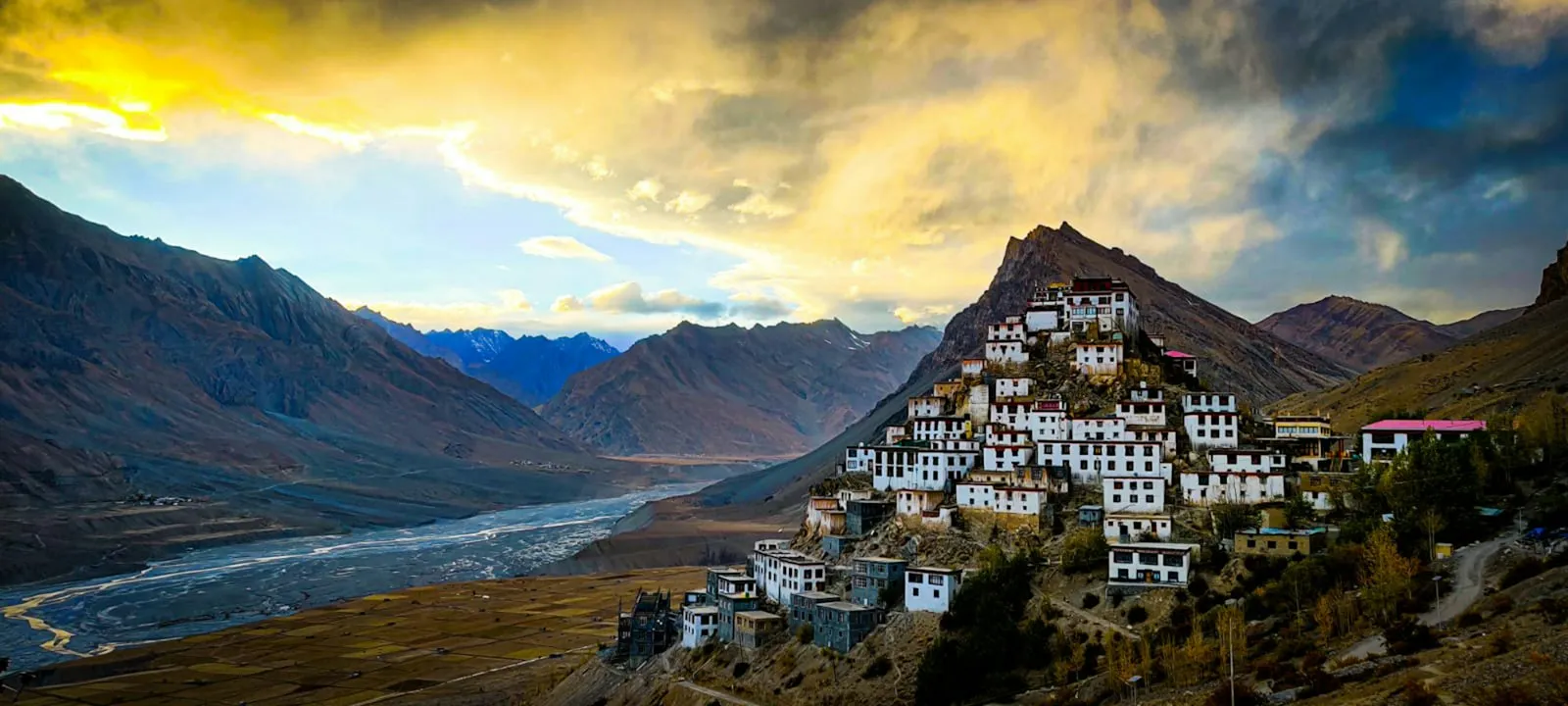
A Spiti village of flat-roofed homes above the river, where most stays are family homestays.
What should you pack for Spiti Valley?
Pack for genuine cold at night even in summer, strong sun by day, and no shops to rescue you. The essentials are warm layers including an insulated jacket, hat and gloves, thermal base layers for the nights, sturdy shoes, high-factor sun cream and good sunglasses, because ultraviolet light is fierce at this height. A refillable water bottle, a first-aid kit with rehydration salts and any personal medication, and a power bank all earn their place.
Bring enough rupee cash for the whole trip, because ATMs are unreliable beyond Kaza, and a head-torch for the power cuts. Our guide to what to pack for India covers the wider trip; for Spiti, think less tropical India and more high-mountain cold.
Is Spiti Valley safe?
Spiti is one of the safer places you can travel in India, though the risks here are physical rather than personal. Crime against visitors is very rare, and solo travellers, including women, generally report feeling comfortable. The real hazards are altitude, long days on narrow mountain roads with steep drops, sudden weather, and the nearest serious hospital a long way off.
As of October 2026 the UK Foreign, Commonwealth and Development Office does not advise against travel to Himachal Pradesh, including Spiti, though it does advise against travel to parts of nearby Jammu and Kashmir, a separate region. Always check your own government's current advice before you go, through a source such as the FCDO travel advice for India, and take out insurance that covers high altitude. For a similar landscape, see our account of a high-altitude road trip in Ladakh.
What do first-time visitors get wrong in Spiti?
- Going too fast. A four-day dash from Manali buys altitude sickness and a blur of a valley you barely saw.
- Entering over the Kunzum Pass on day one. Climbing in gradually from Shimla is gentler and far safer.
- Underestimating the cold. Summer nights are freezing, and travellers who packed for tropical India shiver through them.
- Expecting hotels, signal and ATMs. Spiti runs on homestays, cash and patience, and that is the point.
- Treating the monasteries as photo stops. They are living places of worship: dress modestly, ask before photographing anyone, and walk clockwise around a stupa, a domed Buddhist shrine.
Who is a Spiti Valley trip best suited for?
Spiti suits travellers who want wild, quiet, high-altitude landscape and are happy to trade comfort for it. It is wonderful for second-time visitors who have done the Golden Triangle and want something different, and for photographers, trekkers and anyone drawn to Buddhist culture who would rather spend a day driving to an empty monastery than in a city.
It is a poor fit for anyone needing predictable comfort, for anyone with a heart or respiratory condition that makes altitude risky without medical sign-off, and for families with very young children. If you want green hills rather than a cold desert, the Himalayan foothills are kinder; our guide to trekking in the Himalayas lays out the options from easy to serious.
Frequently asked questions
Is Spiti Valley worth visiting?
Yes, if you want raw, high-altitude Himalayan landscape and ancient Buddhist culture rather than comfort and crowds. It is one of India's most distinctive places, a cold desert of bare mountains and cliff-top monasteries.
Do foreigners need a permit for Spiti Valley?
Foreign nationals need an Inner Line Permit for the border-area sections of Spiti and Kinnaur, while Indian citizens do not. It is inexpensive and usually arranged through a travel agent or district office, but the rules change, so confirm the current requirement with the official Himachal district administration or your operator before you travel.
How high is Spiti Valley, and will I get altitude sickness?
Kaza sits at about 3,650 metres, roughly 11,980 feet, and the high villages above it reach around 4,500 metres, about 14,800 feet. Altitude sickness is a real risk if you ascend quickly. Climbing gradually from the Shimla side, resting on arrival and drinking plenty of water all reduce it; ask a doctor about medication before you go.
What is the best time to visit Spiti Valley?
June to early October is the main season, when both roads are open and the full circuit is drivable. Winter, from about November to April, is for committed travellers chasing the snow leopard, with the Manali road closed and only the long Kinnaur route open, often on ice.
Is Spiti better than Ladakh?
Neither is objectively better; they are similar in spirit but different in scale. Ladakh is larger, higher, busier and easier to fly into, while Spiti is smaller, quieter, cheaper and more intimate. For fewer tourists and a village-scale feel, choose Spiti.
Planning a slower Spiti Valley journey
A good Spiti trip is not a race over the passes. It is a gradual climb, a monastery at first light, a homestay dinner under more stars than you have ever seen, and the patience to let the altitude and the silence do their work.
We design private, personalised India journeys for visitors who want the high Himalayas done properly: acclimatised, well guided and in no hurry. If you would like a Spiti Valley route shaped around your own dates and pace, Plan my India trip.