People assume a sound healing session is a spa treatment with a soundtrack, something you half-listen to while your mind keeps running its usual errands. That is not quite what happens. The first time I lay on a thin mat in a room above the Ganges and a man struck a metal bowl the size of a mixing basin, the sound did not stay in my ears. I felt it arrive in my chest, then behind my eyes, and my to-do list went quiet in a way I had not asked it to.
This guide is for you if you are flying into India from London, Frankfurt, New York, Toronto or Melbourne, you have seen sound healing in India on retreat pages and Instagram, and you want an honest account before you give an hour of your trip to it. I will tell you what a session feels like, where to do it, what it costs in your own currency, and who walks out glad they tried it.
What actually happens in a sound healing session?
You lie on your back on a mat, usually under a light blanket, and close your eyes while a practitioner plays a series of instruments around and sometimes over your body. Nobody touches you and you do nothing. There is no chanting to join in and no posture to hold.
A session opens with a few minutes of settling, perhaps a single bowl played slowly so your ears adjust, builds into longer washes of overlapping sound, and closes with silence before the practitioner gently calls you back. The whole thing runs about an hour.
What does a sound bath feel like in the body?
This is the part that surprises people. A sound bath, which simply means lying still while sustained tones wash over you, is felt as much as heard. Low notes from a large bowl or a gong carry a physical vibration you sense in the breastbone, the belly and the jaw. Higher tones from crystal bowls sit near the crown of the head.
Most people report drifting into a state between waking and sleep, where thoughts loosen and time stops behaving normally. Some fall asleep. A few feel a wave of unexpected emotion. In my experience the strangest moment is the silence at the end, which feels enormous after an hour of sound.
What instruments are used, and what is nada yoga?
The core instrument is the singing bowl. You will meet two kinds: Himalayan metal bowls, struck or circled with a mallet for a deep, grainy tone, and clear crystal quartz bowls, which ring higher and longer. Practitioners add gongs, small hand cymbals, a flute and sometimes the human voice.
The tradition behind this is called nada yoga, which translates roughly as the yoga of sound: an old strand of Indian thought holding that sound and vibration are a path to a settled mind, summed up in the phrase nada brahma, sound as the ground of everything. You do not need to believe any of it for the hour to work on you.
We plan private wellness trips that include sound healing with practitioners we know personally, alongside yoga, Ayurveda and quiet time in nature. Stays and transfers are handled for you, and our team stays on hand while you travel. See how our private India trips work.
Does sound healing actually work, or is it just deep relaxation?
Honestly, the strong evidence points to deep relaxation rather than anything more medical, and that is worth having on its own. The most cited study, published in 2017 by Goldsby and colleagues with 62 participants, found significant drops in tension, anger, fatigue and low mood after an hour of singing bowl meditation, and a rise in reported wellbeing. People new to it felt the biggest drop in tension.
The honest caveat is that the authors flagged the design: no control group and not randomised, so it shows association, not proof of a healing mechanism. Treat sound healing as a reliable way to reach a rest state quickly, not as a treatment for a medical condition. For context on India's gentler therapies, see our guide to wellness travel across India.
Where in India should you go for sound healing?
Rishikesh is the obvious home for it, but it is not the only good option. Four places stand out for visitors, each with a different feel.
Rishikesh, in the Himalayan foothills on the Ganges, has the deepest concentration of practitioners and the strongest atmosphere. Varkala, a clifftop beach town in Kerala, offers dawn sessions with the sea as a backdrop. North Goa has a busy alternative-wellness scene around the Arambol and Ashwem beaches. Mysore, long a yoga town, has a quieter, more studious version.
Why is Rishikesh the natural home for sound healing in India?
Rishikesh calls itself the yoga capital of the world, and whether or not you accept the title, the infrastructure for practices like this is simply denser here than anywhere else. The town sits where the Ganges leaves the mountains, and both banks are lined with ashrams, which are residential centres for spiritual study and practice, alongside yoga schools and riverside cafes.
That density means choice. You can find a session within a short walk most days, though the best practitioners are worth booking ahead. For a fuller picture of the town, read Rishikesh beyond yoga.
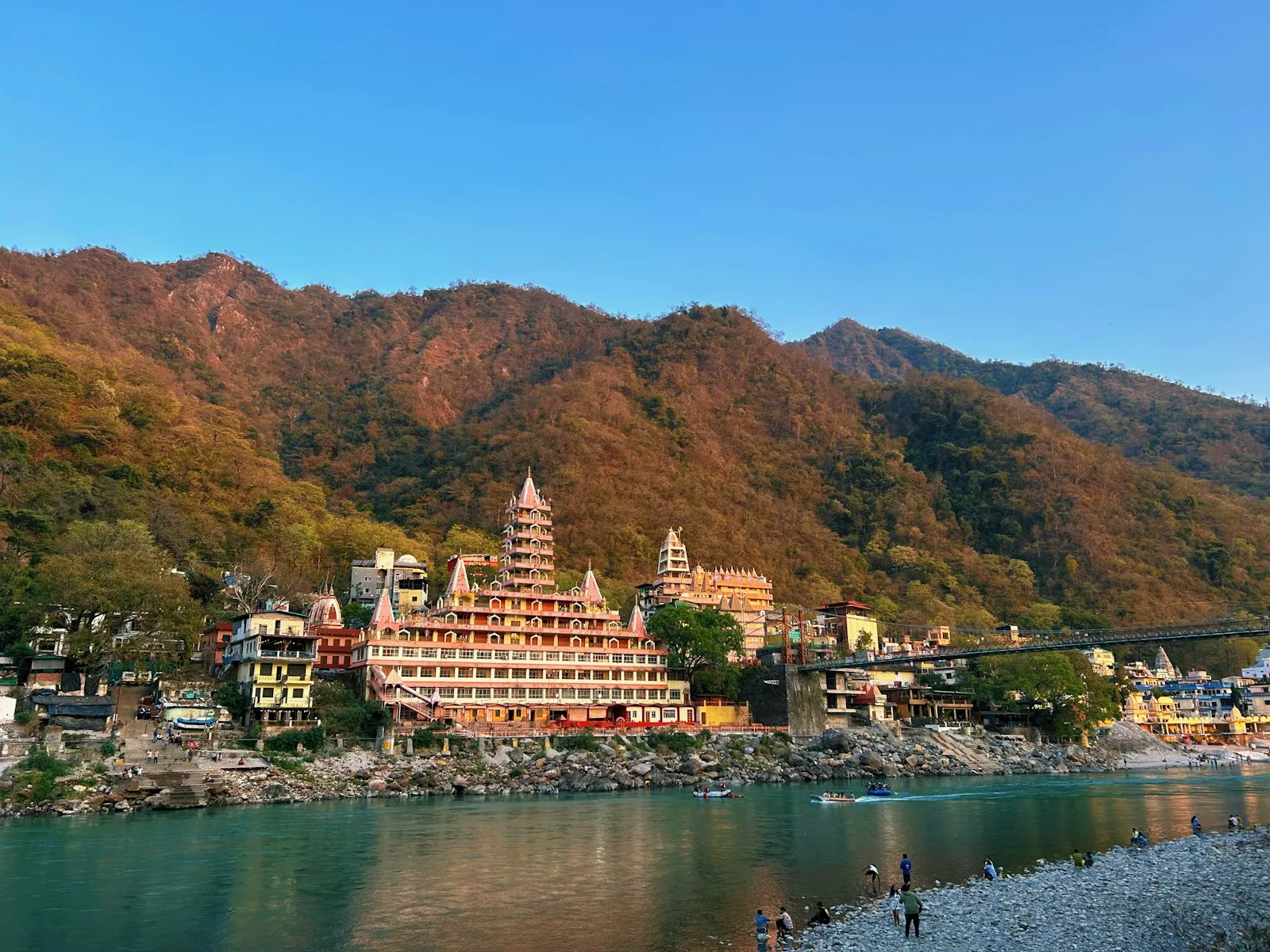
Rishikesh, where the Ganges leaves the mountains, has India's deepest concentration of sound healing practitioners.
How much does a sound healing session cost?
A group session in Rishikesh typically runs somewhere around INR 500 to 2,000 per person, which at rates in early October 2026 of roughly INR 96 to the US dollar and INR 127 to the pound is about USD 5 to 21, or GBP 4 to 16. A private one-to-one session costs more, often two to four times that.
Prices move with the practitioner's reputation, the setting and whether it is a drop-in or part of a retreat, so confirm the current rate directly rather than relying on any figure here, including mine. By the standards of a wellness treatment back home, it is inexpensive.
Group session or private: which should you book?
For a first try, a small group session is usually the better choice, and not only on cost. Lying in a room with five or six other people, each wrapped in a blanket, has a quiet companionability a solo session lacks, and the practitioner still works the sound around the whole room.
A private session earns its higher price when you want the tones tailored to you, when travelling as a couple, or when you simply want the practitioner's full attention. A sensible approach is to start in a dawn group setting and keep a private session in reserve for those who come back wanting more.
Is a flute or voice session different from bowls?
Yes, and in Rishikesh you can find both. A flute sound healing uses the bamboo bansuri rather than metal, producing something more melodic and less vibrational, closer to a live, improvised lullaby than a bath of overtones.
Voice-led sessions, sometimes overlapping with kirtan, which is devotional call-and-response singing, are warmer and more communal. If pure sustained tones sound clinical to you, a flute or voice session is a gentler door in. I would still do a bowl session once, because the physical vibration is the part you cannot get any other way.
When is the best time to go?
For Rishikesh and the Himalayan foothills, the comfortable windows are roughly September to November and February to April, when days are mild and the river is calm. Avoid the peak of the summer monsoon, July into early September, when the Ganges runs high and heavy rain disrupts travel.
If you want the practice at its most charged, the International Yoga Festival takes over Rishikesh for a week each March, dated 9 to 15 March in 2026, and the town fills with teachers from around the world. It is wonderful, and crowded. For the wider picture, see our month-by-month guide to visiting India.
How long is a session, and how will you feel afterwards?
Plan for an hour inside the room, plus fifteen minutes either side to settle and come round slowly. Do not schedule anything sharp straight afterwards.
Most people come out soft-edged and a little dreamy, the way you feel waking from an afternoon nap, and that state can last a few hours. A few feel briefly tearful as something unwinds. Drink water, walk by the river, and give yourself a gentle evening. Going straight from a session into a long drive is a poor idea.
What should you wear and bring?
Wear loose, warm, comfortable clothing you can lie still in for an hour, because your body temperature drops when you are motionless. In Rishikesh mornings and evenings are cool even in the warmer months, so bring a layer and thick socks.
Most practitioners provide mats, bolsters and blankets. Leave your phone off, not merely silent, as a single buzz carries in a quiet room. Eat lightly beforehand: a full stomach makes lying flat for an hour less pleasant.
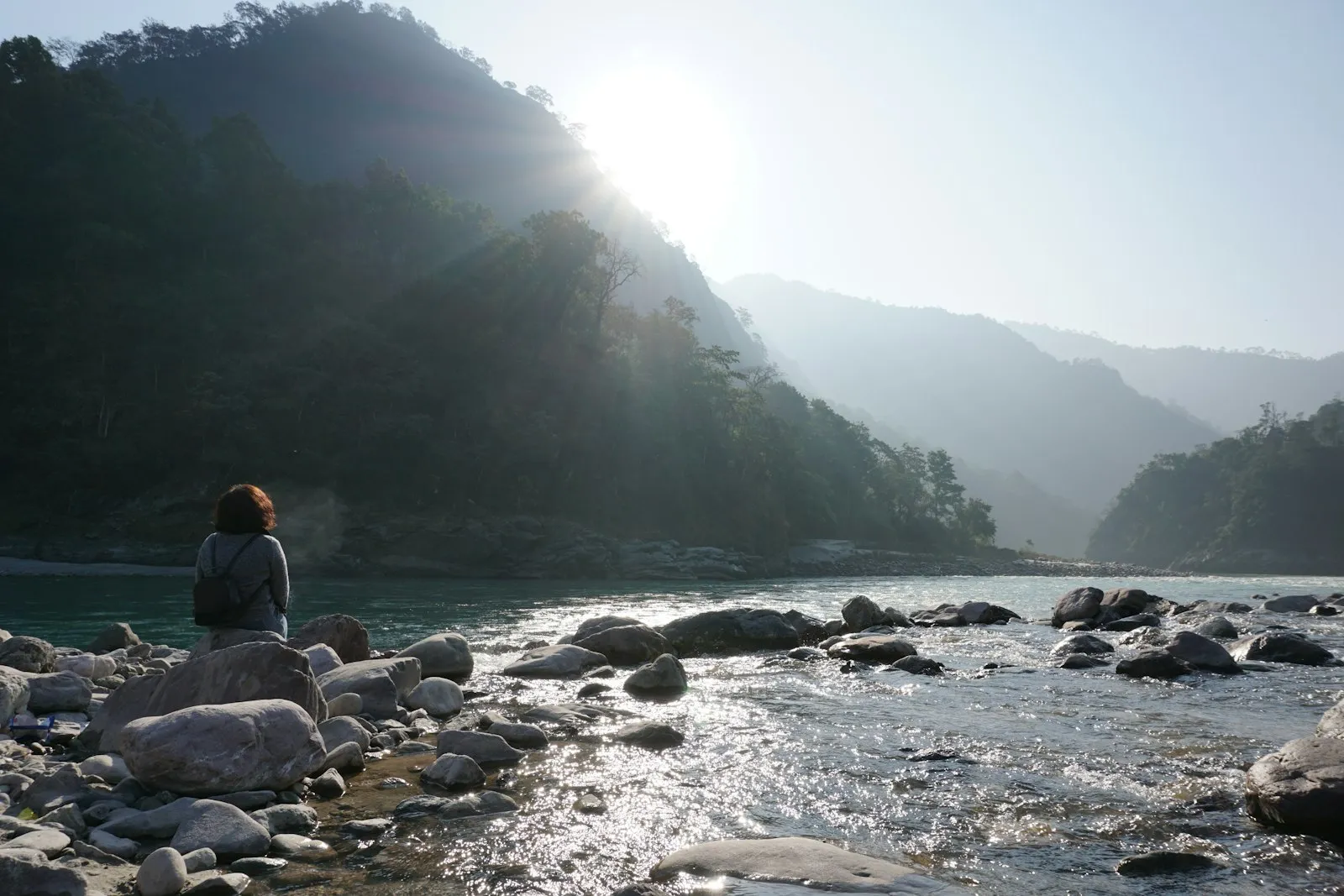
Leave time to come round slowly afterwards; most people stay soft-edged for a few hours.
What do first-time visitors get wrong about sound healing?
The commonest mistake is expecting a dramatic, mystical event and feeling short-changed when what arrives is simply deep rest. The value is in the rest. Judge it by how you feel the next morning, not by whether you levitated.
Two other errors recur. People book a famous practitioner for a crowd of forty when a small session would have moved them more, and people treat it as a one-off novelty when the effect deepens with a second or third try as the body stops bracing against the unfamiliar. If sound is the thread you want to follow, our piece on India's subtle therapies goes further into breathwork and forest bathing.
Is it safe, and is it culturally appropriate?
The practice itself is physically gentle and carries no real risk for most people, though anyone with a serious ear condition, epilepsy or a pacemaker should check with a doctor first, as sustained low-frequency vibration is not advised in a few specific cases.
On travelling in the region, Rishikesh and the state of Uttarakhand carry no special advisory. As of October 2026 the UK Foreign Office advises against travel only to parts of Jammu and Kashmir, Manipur, and the immediate India-Pakistan border, none of which touch this trip. Always check your own government's current advice before you book, through the UK FCDO or the US State Department.
Who is a sound healing session best suited for?
It suits anyone who finds it hard to switch off, who travels wound up, or who is curious about India's wellness traditions but not ready for a silent meditation retreat. It is a low-commitment, hour-long way in, good for couples wanting a shared quiet hour and for solo travellers glad of a gentle group setting.
It suits you less well if you are restless lying still, dislike enclosed quiet with strangers, or want measurable medical results. There is no failure in trying it once and deciding it is not for you.
How do you fit sound healing into a wider India trip?
Slot it in as a morning on a Rishikesh day, or pair it with yoga and a riverside walk for a restful half-day between busier stretches of a northern itinerary. It also sits naturally inside a wellness-led route taking in Ayurveda and meditation.
A session lands better when you are not rushing to it from a six-hour drive. We plan the day around the hour, not the hour around the day.
Frequently asked questions
Is sound healing in India worth doing?
For most visitors, yes, as an hour of genuine deep rest that is inexpensive and easy to arrange. Keep expectations grounded: it is a fast route to a calm state, not a cure, and it rewards an unhurried frame of mind more than scepticism or hype.
Do I need any experience or to be able to meditate?
No. You lie down and do nothing, which is the appeal. The research suggests newcomers often feel the strongest drop in tension, perhaps because the experience is so unfamiliar that the mind gives up trying to manage it.
How much does a sound healing session cost in India?
A group session in Rishikesh is commonly around INR 500 to 2,000 per person, about USD 5 to 21 or GBP 4 to 16 at early October 2026 rates, with private sessions costing more. Confirm the current price directly, as rates vary widely.
Where is the best place for sound healing in India?
Rishikesh has the greatest depth and the strongest atmosphere, with Varkala in Kerala, north Goa and Mysore as good alternatives. Choose by the rest of your route rather than travelling specially.
How long does a sound healing session last?
The session itself runs about an hour, and you should allow a quarter of an hour either side to settle and to come round gently afterwards. Avoid scheduling anything demanding immediately after.
Is sound healing safe?
For most people it is entirely safe and physically passive. Those with a pacemaker, epilepsy or a significant ear condition should check with a doctor first, as sustained low-frequency vibration is cautioned against in a few specific cases.
Planning a quieter kind of India trip
Sound healing in India works best not as a box ticked but as one unhurried hour inside a trip built to leave room for it. The country rewards travellers who slow down, and an hour on a mat by the Ganges is a fine place to practise that.
We design private, personalised India journeys for travellers who want depth and calm rather than a checklist, and we are glad to build a session, or a whole wellness thread, into yours. If you would like a trip shaped around your own pace and interests, Plan my India trip