Most couples planning India start with a list of the country's most photographed places and try to string them together. The trip that brings you closer usually does the opposite. It picks two regions, moves slowly between them, and leaves room in the day for the long dinner and the unplanned hour that you will actually remember. India for couples is less about how much you see and more about how much you slow down.
This guide is written for two people flying in from London, Frankfurt, New York, Toronto or Melbourne, planning a honeymoon, an anniversary or simply a first big trip together, who have never travelled in India and reasonably want to know where to go, when, what it costs in their own money, and how to design it so it feels like time together rather than a logistics exercise. I run a company that plans exactly these trips, so what follows is the advice I give couples before they book anything.
Why does India reward couples who travel it slowly?
India rewards a slow pace because its best moments are not sights, they are situations. A temple at dawn, a houseboat moored for the night, a meal cooked in someone's home: none of these are improved by rushing to the next thing. A romantic trip to India works when the itinerary protects space rather than filling it.
The common mistake is to treat two weeks as a chance to cover the whole country. You cannot, and the attempt costs you the very thing you came for. Fewer places, more nights in each, and genuine gaps in the day is the shape of a trip that feels intimate rather than exhausting. The couples who come home saying it changed something between them are almost always the ones who did less.
How long do you need for a couples trip to India?
Ten days to two weeks is the practical sweet spot for a first couples trip. Ten days lets you settle into one region properly. Fourteen days lets you pair two, for example culture and coast, or hills and backwaters, without living out of a suitcase.
If you only have a week, resist the urge to see three cities and instead go deep on one place, such as Kerala or a slice of Rajasthan. If you have three weeks, do not simply add more stops. Add more nights per stop and one contrasting region, so the trip breathes. The rhythm matters more than the mileage, and a couple moving every night rarely relaxes into each other's company.
Which parts of India are most romantic for couples?
There is no single most romantic place in India, but a handful of regions do the job especially well, and they split neatly by the mood you are after. Choose one or two, not all of them.
Rajasthan is the classic choice for grandeur: lake palaces at Udaipur, desert forts, and heritage hotels that were genuinely once the homes of royalty. Kerala, in the south, is the choice for softness: backwaters, tea hills, Ayurveda and a slower, greener pace. Goa and the Konkan coast give you beaches and long lunches without much effort. The Andaman Islands, further out in the Bay of Bengal, offer the clear-water beach honeymoon that mainland India cannot quite match. And the Himalayan foothills around Rishikesh or the tea country of Darjeeling suit couples who relax by walking rather than lying still.
A trip that pairs one heritage region with one restful one tends to please both halves of a couple, which is often the real planning problem to solve.
Every trip we plan is private and starts with a conversation about how you want to travel, not a pre-written itinerary. For a couples trip or honeymoon, that means specialist local guides, handpicked stays, and food, hygiene and safety checks built into each decision. See how our private India trips work.
Is it safe to honeymoon in Kashmir right now?
This deserves a plain answer, because Kashmir appears on almost every romantic India list and the picture on the ground is more complicated than those lists admit. The houseboats of Srinagar's Dal Lake and the meadows of Gulmarg are beautiful. They are also, as of September 2026, covered by an advisory against all travel from the UK's Foreign, Commonwealth and Development Office, which names Srinagar, Gulmarg, Sonamarg and Pahalgam specifically.
I do not recommend building a honeymoon around a destination your own government advises against, both for your safety and because travel insurance often will not cover travel taken against official advice. Advisories change, sometimes quickly, so check your own government's current guidance before you decide. If it is the Himalayan landscape you want, Ladakh, Himachal Pradesh and Uttarakhand offer high mountains without the same warnings, and I would point a couple there instead.
What experiences are worth designing a couples trip around?
Design the trip around a few private, unhurried experiences rather than a checklist of monuments. The difference between a nice trip and a close one is usually two or three of these, spaced out so they do not blur together.
A few that consistently land for couples, drawn from trips we have planned and run:
A private sunset boat on a palace lake in Udaipur, timed so you are on the water as the light goes and the city walls turn gold, with the boat to yourselves rather than shared with a tour.
A night on a private houseboat in the Kerala backwaters, on a converted rice barge known as a kettuvallam, with a small crew who cook for the two of you and moor the boat by late afternoon so the evening is spent tied to a quiet bank listening to water and birds rather than an engine.
A cooking lesson at a family table rather than a demonstration stage, standing in a real kitchen learning a regional dish, three or four courses, then eating what you made with the family who taught you. In a Rajasthani heritage home this might be slow-cooked laal maas, a fiery Rajasthani meat curry, and it is as much an evening together as a class.
A genuine Ayurvedic consultation and treatment on the Kerala coast, the kind run with a consulting physician who assesses you first, not a spa menu you pick from. Couples treatments are possible, but the value is in the assessment and the rhythm, not the candles.
A night in the Thar Desert near Jaisalmer, in Rajasthan's far west, with dinner under a sky full of stars and nothing between you and the horizon. It is the simplest of these and often the one couples talk about most.
None of these needs to be expensive to be intimate. What makes them work is that they are private and unhurried, and that the day around them is not crammed.
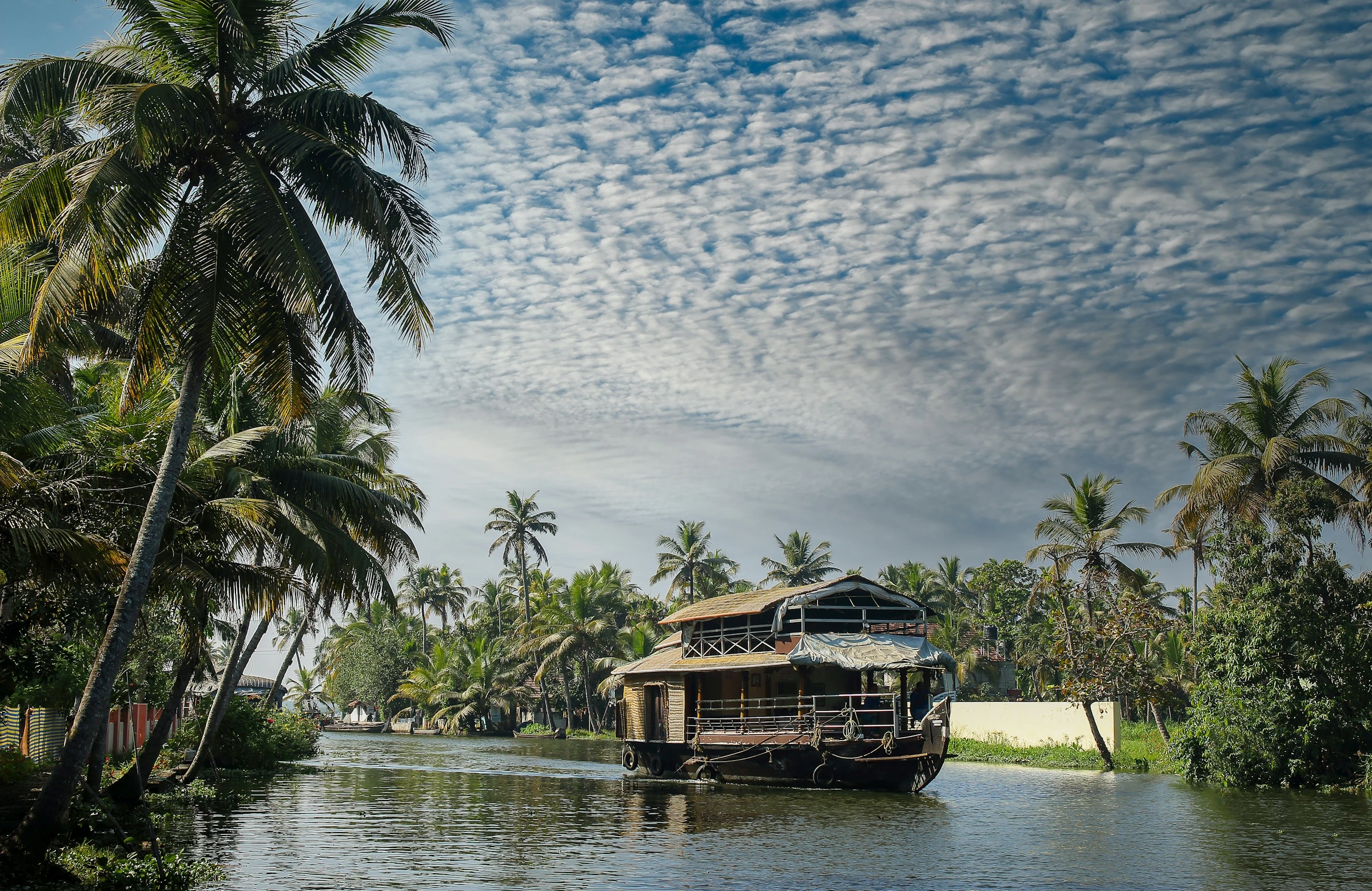
A traditional Kerala houseboat, or kettuvallam, moored by the palms on the backwaters near Alleppey.
Where should couples stay in India?
Your choice of stay shapes the mood of the whole trip more than any single sight, so spend your budget here with intent. India gives couples three broadly different experiences, and mixing them keeps a trip interesting.
Heritage hotels, meaning former palaces, forts and havelis, the grand old townhouses of Rajasthan and beyond, let you sleep inside the history rather than beside it. Boutique homestays and small owner-run properties trade grandeur for warmth and give you the family table and local knowledge that turn a trip personal. And a small number of standout beach and backwater properties are worth planning a couple of nights around in their own right.
A useful pattern is to alternate: a night or two of quiet luxury, then something simpler and more personal, so the trip has texture. For a fuller look at the palace-and-haveli end, see our guide to heritage stays in India.
How much does a trip to India for couples cost?
As a working figure, a well-organised private trip of ten to fourteen nights in comfortable boutique and heritage hotels typically lands between INR 150,000 and INR 400,000 per couple, excluding international flights. That is about USD 1,560 to 4,170, GBP 1,180 to 3,150, or EUR 1,375 to 3,670 at rates in late September 2026, when one US dollar bought roughly 96 rupees, one pound about 127 rupees and one euro about 109 rupees. Rates and local prices move, so treat every figure here as a planning range rather than a quotation.
Indicative components, all of which shift with season, region and demand:
Boutique or heritage double room: roughly INR 8,000 to 25,000 per night, about USD 83 to 260, GBP 63 to 197, or EUR 73 to 229. Palace suites run far higher.
Private car with a driver: roughly INR 4,000 to 8,000 per day including fuel, about USD 42 to 83, GBP 31 to 63, or EUR 37 to 73. This is the normal way couples cover ground in India, not a luxury extravagance.
A private overnight houseboat for two, all meals included: commonly INR 15,000 to 35,000, about USD 156 to 365, GBP 118 to 276, or EUR 138 to 321.
A good dinner for two: from INR 800 in a well-run local restaurant to INR 5,000 in a hotel dining room, about USD 8 to 52, GBP 6 to 39, or EUR 7 to 46.
The single largest variable is not the country, it is your choice of accommodation. The same route can run at half these figures in simple homestays or several times more in palace hotels, and the sunset on the lake looks the same from both. For a fuller breakdown by travel style, see our guide to how much a trip to India costs.
When is the best time to visit India as a couple?
For most of the country, October to March is the reliable window, and it is when the majority of couples should aim to travel. The weather is dry and comfortable across the classic romantic regions, the light is good, and the evenings are pleasant enough to sit outside.
The picture shifts by region. Rajasthan and North India are at their best from November to February, though December and January nights can be genuinely cold in the desert, so pack a warm layer. Kerala and the south are pleasant from October to March and turn green and quiet, and cheaper, during the June to September monsoon, which some travellers actively enjoy and which Ayurvedic practitioners consider a good season for treatment. Goa's beach season runs November to February. The Himalayan foothills are loveliest from March to June and again in September and October. For a month-by-month view, see our guide to the best time to visit India.
Booking three to six months ahead matters more than couples expect, because the best small properties have very few rooms, and the good ones for a honeymoon sell out first.
How do couples get around India?
For most romantic itineraries, a private car with a driver is the practical backbone, with trains and the occasional domestic flight filling the gaps. This is not about status. Indian roads take local knowledge, and handing that over frees the two of you to look out of the window rather than at a map.
A driver is not a chauffeur in the formal sense. It is an air-conditioned sedan or small SUV with a professional who handles the traffic, waits while you wander a fort, and knows where to stop for a good lunch. On longer hops between regions, a short domestic flight saves a day. On a few scenic stretches, a train in an air-conditioned class is part of the trip rather than a chore. Within towns you will use auto-rickshaws, the three-wheeled open taxis known locally as autos, or app-based cabs in the bigger cities. Agree the fare before you set off if the meter is not running.
Do you need a visa for a couples trip to India?
Yes. Most visitors, including those from the UK, the European Union, the United States, Canada, Australia and New Zealand, need a tourist visa, and an electronic tourist visa, or e-visa, is available to nationals of more than 175 countries. As of September 2026 the e-tourist visa comes in thirty-day, one-year and five-year multiple-entry versions, with a separate longer option in between, and you apply from a minimum of four days up to 120 days before you travel.
Fees are specific to your nationality and a small bank charge applies, so both partners should apply separately and early. Rules, fees, validity and eligible entry points change, so apply only through the official Indian government portal at indianvisaonline.gov.in and confirm the current requirements before you book flights. Beware the many look-alike visa websites that charge a markup for the same service.
What about safety, health and the practical worries?
India is broadly comfortable and rewarding for couples who take ordinary precautions, and most romantic regions, Rajasthan, Kerala, Goa, the Golden Triangle and the Andamans, carry no special travel warnings. The sensible habits are familiar: use booked transport at night, keep valuables discreet, dress with local norms in mind, and check your own government's current advice for the areas you plan to visit.
On health, speak to a travel clinic or your own doctor about vaccinations and anti-malarial advice well before you fly, since requirements vary by nationality and region. Drink bottled or filtered water, give your stomachs two or three days to adjust, and carry rehydration salts. For the fuller safety picture, our honest guide to whether India is safe for first-time international travellers goes further, and the UK's FCDO and the US State Department both publish current, country-specific advice worth reading before you commit.
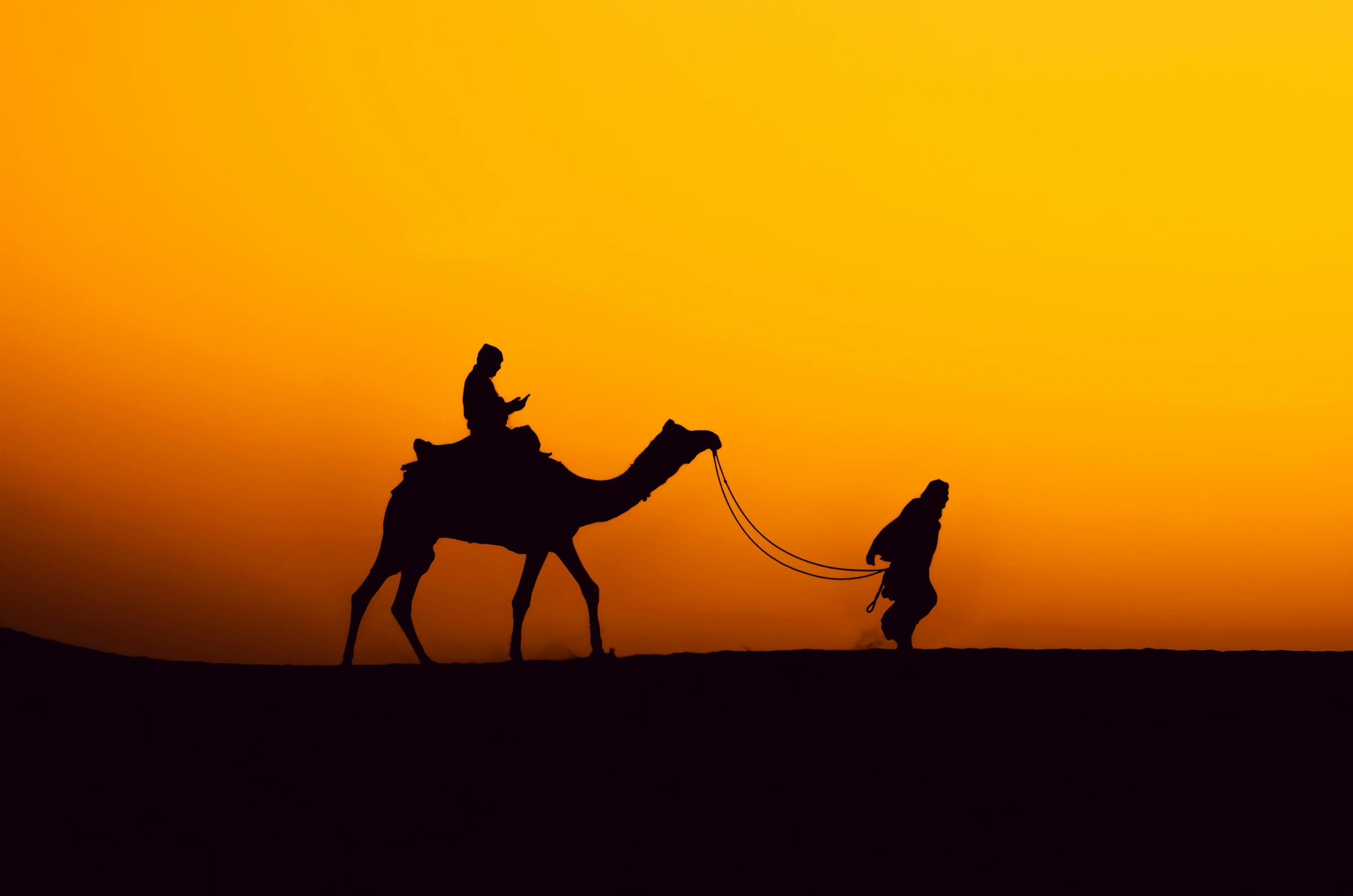
Sunset over the Thar Desert near Jaisalmer, one of the simplest and most memorable nights a couple can plan in Rajasthan.
What should couples know about public affection and etiquette?
India is more conservative about public affection than most Western countries, and a little awareness saves you awkwardness. Holding hands is fine almost everywhere. Kissing and more overt displays draw attention and, in temples and smaller towns, can cause genuine offence.
The etiquette that matters is small and easy. Dress modestly at religious sites, with shoulders and knees covered, and carry shoes you can slip off, because you will remove them often. Ask before photographing people, especially at worship. Eat and pass things with your right hand. Non-Hindu visitors are not admitted to the innermost sanctums of some temples, which is worth knowing in advance so it does not feel like a rebuff. None of this is heavy going, and couples who travel with a little cultural care are met with a great deal of warmth.
How do you avoid the honeymoon-package trap?
The standard honeymoon package sells you a rushed circuit dressed up with rose petals and a cake, and rarely leaves room for the slow hours that make a trip feel close. The fix is to design around fewer places and private experiences, not a discount and a checklist.
Watch for three things. First, itineraries with a stop every single night, which means you are always packing rather than settling. Second, the substitution of add-ons, the petals and the candlelit dinner photograph, for genuine time and space. Third, group departures marketed as romantic, which put you on someone else's schedule. A trip that brings you closer is usually private, unhurried, and built around your pace rather than a template. This is the whole reason we plan couples' trips one at a time rather than from a brochure.
Should you tell hotels you are celebrating?
Yes, tell them, well ahead and in writing. Good Indian hotels take a honeymoon or anniversary seriously and will often do something thoughtful, a room upgrade if one is free, flowers, a quiet table, a private breakfast, without turning it into a performance.
Say what you would actually like and, just as usefully, what you would not. If a surprise band at dinner is your idea of a nightmare, tell them. The warmth is real and generous, and it lands best when the hotel knows the couple rather than just the occasion.
What do first-time couples get wrong in India?
Booking too much is the near-universal error. Eight stops in fourteen days feels ambitious on a spreadsheet and exhausting in real life, the fastest way to spend a trip tired and short with each other.
The others follow from it. Sightseeing at midday, when temples and forts are hot and crowded, rather than early and late when they are cool and quiet. Treating one signature experience, a houseboat night, as if it were a whole region. Underestimating road time, and planning as if India moves at motorway speeds when much of it moves at half that. And packing for a single climate when a good couples trip often crosses several, from desert nights to hill mornings to coastal humidity in one fortnight.
Who is an India couples trip best suited for?
This kind of trip suits couples whose idea of romance is shared discovery rather than a resort and a sunlounger. It works beautifully for honeymooners who want their first trip as a married couple to mean something, for anniversaries that call for more than a weekend, and for two people who travel well together and are curious about a culture very different from their own.
It suits couples who can handle a little friction, the occasional long drive, the heat, the unfamiliarity, as the price of something memorable. It is less suited to travellers who want everything smooth and identical to home, or who mainly want to switch off on a beach, though even they can carve out a restful Kerala or Goa version. If you would rather be moved than merely comfortable, India is one of the great trips to take as a couple.
Frequently asked questions
Which is the most romantic place in India for couples?
There is no single answer, but Udaipur in Rajasthan, with its lake palaces, and the Kerala backwaters, with their houseboats and slow water, are the two most consistent choices. Udaipur suits grandeur, Kerala suits softness, and many couples pair a few nights of each. The Andaman Islands are the pick for a clear-water beach honeymoon.
How much should a couple budget for a trip to India?
A well-organised private trip of ten to fourteen nights in comfortable boutique and heritage hotels typically costs between INR 150,000 and INR 400,000 per couple, roughly USD 1,560 to 4,170 or GBP 1,180 to 3,150, excluding international flights and at rates in late September 2026. Simple homestays cost much less and palace hotels much more.
When is the best time for a honeymoon in India?
October to March is the reliable window across most romantic regions, with November to February ideal for Rajasthan and the north, and October to March best for Kerala and the south. Book three to six months ahead, because the best small properties sell out first.
Is India safe for couples and honeymooners?
Most romantic regions, including Rajasthan, Kerala, Goa and the Andamans, are comfortable for couples taking ordinary precautions. A notable exception is Jammu and Kashmir, including Srinagar and Gulmarg, which carried an official advisory against all travel as of September 2026. Always check your own government's current advice before booking.
Do we both need separate visas for India?
Yes. Each traveller applies for their own tourist visa, usually the e-tourist visa, through the official Indian government portal. Apply early, from a minimum of four days up to 120 days before travel, and use only the official site rather than the look-alike agencies that charge a markup.
Is it acceptable to show affection in public in India?
Holding hands is fine almost everywhere. Kissing and more overt displays draw attention and can cause offence in temples and smaller towns, so keep them for private moments. A little discretion goes a long way and is met with warmth.
Planning a couples trip to India that actually brings you closer
A good couples trip to India is not a list of famous places ticked off in sequence. It is a sequence with the right rhythm: a lake at dusk, a long unhurried dinner, a morning with nothing booked, and one or two private experiences you will still be describing years later.
We design private, personalised India journeys for couples who want depth and time together rather than a packaged circuit. If you would like a trip shaped around your own dates, pace and idea of romance, Plan my India trip.