The first thing that surprises many visitors to India is not what they see but what they hear. Devotional music in India is the sound of worship itself: hymns, drums, bells and chanting that are not staged performances but daily acts of faith, carried through temples, along riverbanks and inside shrines from the Himalayas to the southern coast. It runs before dawn and after dark, and much of it has been sung, more or less unchanged, for a very long time.
This guide is written for someone flying in from London, Frankfurt, New York, Melbourne or Toronto who is drawn to that sound and wants to understand it. It explains what the main ceremonies are, where the genuine article happens rather than the version arranged for an audience, when in the year to go, what it costs, and how to be present at something sacred without turning it into a show.
What is devotional music in India, and why does it matter to travellers?
Devotional music in India is music made as an offering rather than as entertainment. It spans many faiths and forms: Hindu temple chanting and bhajans, which are simple congregational hymns; Sikh shabad kirtan; Sufi qawwali at Muslim shrines; and ritual drumming that summons a deity. For a traveller, it is the most direct way into how the country feels about the sacred. You can read about a temple, but you understand it the moment a drum starts and everyone around you knows what comes next.
What is the Ganga aarti in Varanasi, and what are you watching?
The Ganga aarti is an evening fire ceremony offered to the river Ganga, and Varanasi stages the most famous version at Dashashwamedh Ghat, one of the stone stairways, called ghats, that run down to the water. Priests move large tiered brass lamps in slow circles while bells, a conch shell and chanting build over roughly forty-five minutes. It begins around sunset: near 6pm in winter (October to March), closer to 6.45pm in summer; times shift seasonally, so confirm on the day. A quieter dawn version, Subah-e-Banaras, takes place upriver at Assi Ghat at about 5.30am.
What is Theyyam, and where do you find it?
Theyyam is a ritual in which a performer becomes a god. In the temples and family shrines of northern Kerala, chiefly the Kannur and Kasaragod districts, an elaborately painted and costumed dancer is believed to be possessed by the deity, and worshippers come to ask the god questions directly. The chenda, a tall cylindrical drum, drives the whole thing, and the rhythm is not accompaniment, it is the summons. Many Theyyams run through the night and peak before dawn. This is worship, not theatre. When I take travellers to one, I choose a village performance arranged by the community rather than a show, and a local guide explains what is being asked of the god, so the intensity makes sense instead of washing over you.
Every trip we plan is private and starts with a conversation about how you want to travel, not a pre-written itinerary. For a trip built around ceremonies and sacred music, that means specialist local guides, handpicked stays, and food, hygiene and safety checks built into each decision. See how our private India trips work.
What is kirtan, and how does it differ from a concert?
Kirtan is call-and-response devotional singing: a leader sings a line, everyone answers, and the whole room becomes the instrument. It has no audience in the usual sense, because there is no separation between performer and listener. You will meet it in Hindu temples and ashrams, in the kirtan halls of towns like Rishikesh, and in the Krishna temples of places like Hampi and Vrindavan. The music is repetitive on purpose, built to loosen the grip of the thinking mind, and an hour passes without your noticing. You are welcome to sit at the back and listen.
What temple music will you hear in South India?
South India holds some of the oldest continuous sacred sound anywhere. Outside a Tamil Nadu temple you will hear the nadaswaram, a long and piercing oboe, paired with the tavil drum: this is mangala vadyam, auspicious music, played at temple rituals and weddings. Inside Kerala shrines, sopanam music is sung beside the sacred steps that give it its name. Carnatic music, the classical tradition of the South, grew from this devotional root, and each January the five-day Thyagaraja Aradhana at Thiruvaiyaru near Thanjavur draws musicians from across India to honour the composer-saint Thyagaraja. Kerala is also home to Kutiyattam, described by Kerala Tourism as the oldest living theatre tradition and recognised by UNESCO, where Sanskrit verse is chanted in a form roughly two thousand years old. Our guide to the classical arts of India traces the dance and music that grew from temple worship.
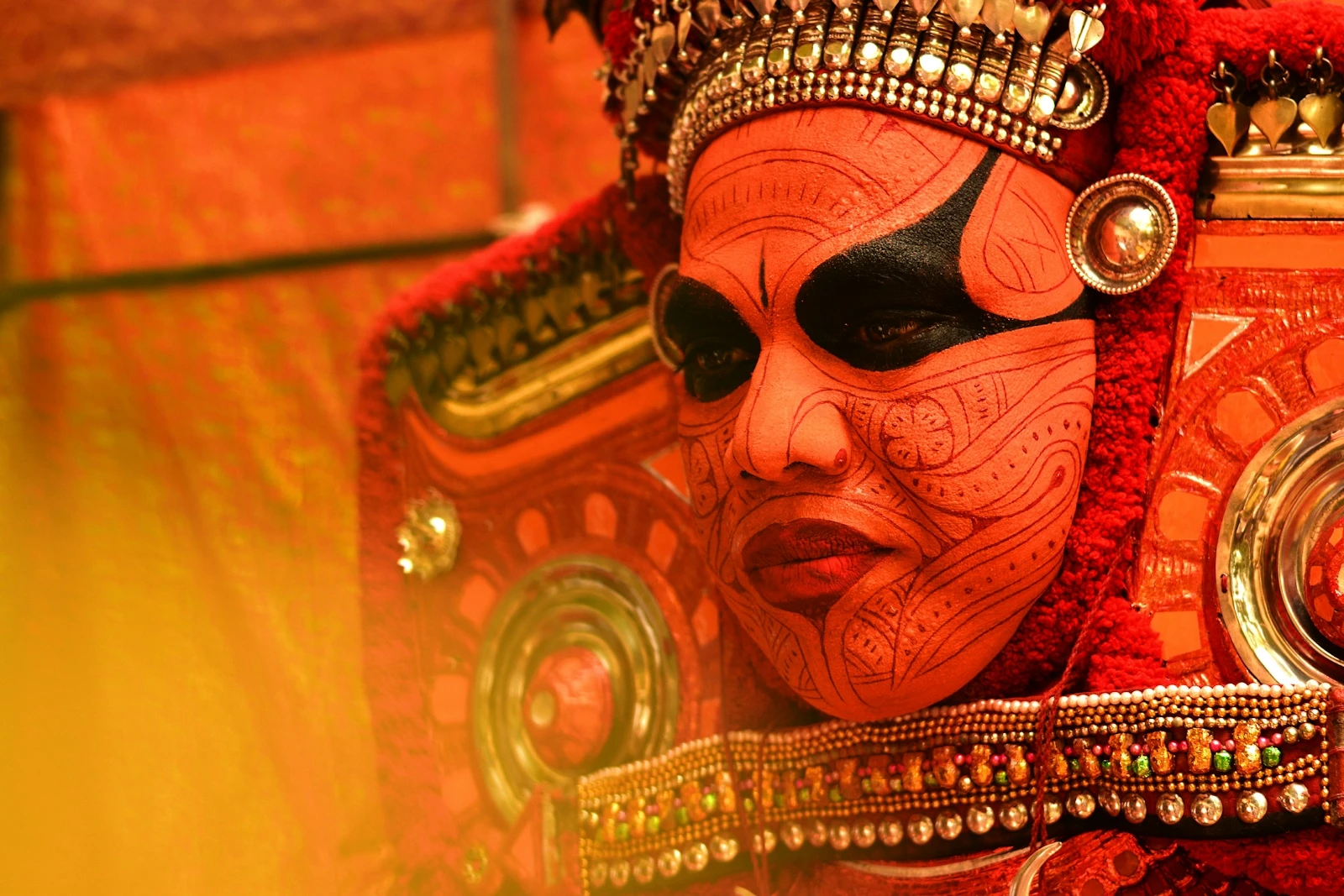
A Theyyam performer in northern Kerala, where the drum is the summons and the dancer becomes the deity.
What makes the sound of the Golden Temple different?
At the Golden Temple, or Harmandir Sahib, in Amritsar, shabad kirtan is sung almost continuously and relayed live across the whole complex, so the hymns reach you before you reach the shrine. The temple is open around the clock, and the most moving hour is Amrit Vela, the pre-dawn window from about 4am, when the recitation carries across the water and the marble is still cold underfoot. You do not need to understand the words; the sound does the work, and first light by the pool with the kirtan flowing over you is, for many visitors, the strongest memory of a trip to the north.
When is the best time of year to catch these ceremonies?
The winter months of roughly November to March are the strongest window overall, and they line up with several ceremonies at once. The Theyyam season in northern Kerala runs broadly from December to April, with some shrines starting earlier, so check the Kerala Tourism Theyyam calendar for confirmed dates before you plan around it. The Thyagaraja Aradhana falls each January. The Ganga aarti in Varanasi, by contrast, runs every single evening of the year, as does the kirtan at the Golden Temple. India's wider festival calendar, from Diwali onward, layers extra ceremonies on top, so it is worth checking what falls within your dates.
How do you find a real ceremony rather than a staged show?
In my experience, the honest ceremonies are the ones that would happen whether or not you turned up. A priest lighting the evening lamp, a village Theyyam funded by the community, kirtan in a working temple: these are worship first and a spectacle never. Staged shows exist too, and some are excellent, particularly the nightly Kathakali and cultural performances in Fort Kochi, which are put on for visitors and clearly presented as such. The distinction worth making before you go is which one you are attending, because arriving at a tourist show expecting raw ritual, or a genuine rite expecting a comfortable seat, leads to the same quiet disappointment.
Do you need to book, and what does it cost?
Most genuine ceremonies are free, being acts of worship open to all. The Ganga aarti costs nothing to watch from the ghat steps, though a place on a shared boat to see it from the water is usually ₹100 to ₹300 per person, about USD 1 to 3, or under GBP 3. A staged Kathakali performance in Fort Kochi runs at roughly ₹350 to ₹700, about USD 4 to 7, or GBP 3 to 5. Where booking helps is guidance: a half-day with a specialist who can read the music and ritual for you costs around ₹3,000 to ₹8,000, about USD 31 to 83, or GBP 24 to 63, and it is the difference between hearing sound and understanding it.
What should you wear, and how should you behave?
Dress modestly: shoulders and knees covered, and shoes you can slip off easily, because you will remove them at every temple. Cover your head at Sikh and some Hindu and Muslim sites, and carry a scarf for it. Move quietly, do not walk in front of people at worship, and receive anything offered, such as prasad, the blessed food handed out after a ceremony, with your right hand. At the Ganga aarti and at kirtan you are welcome to sit and take part or simply witness, but follow the room. If everyone is seated and still, be seated and still.
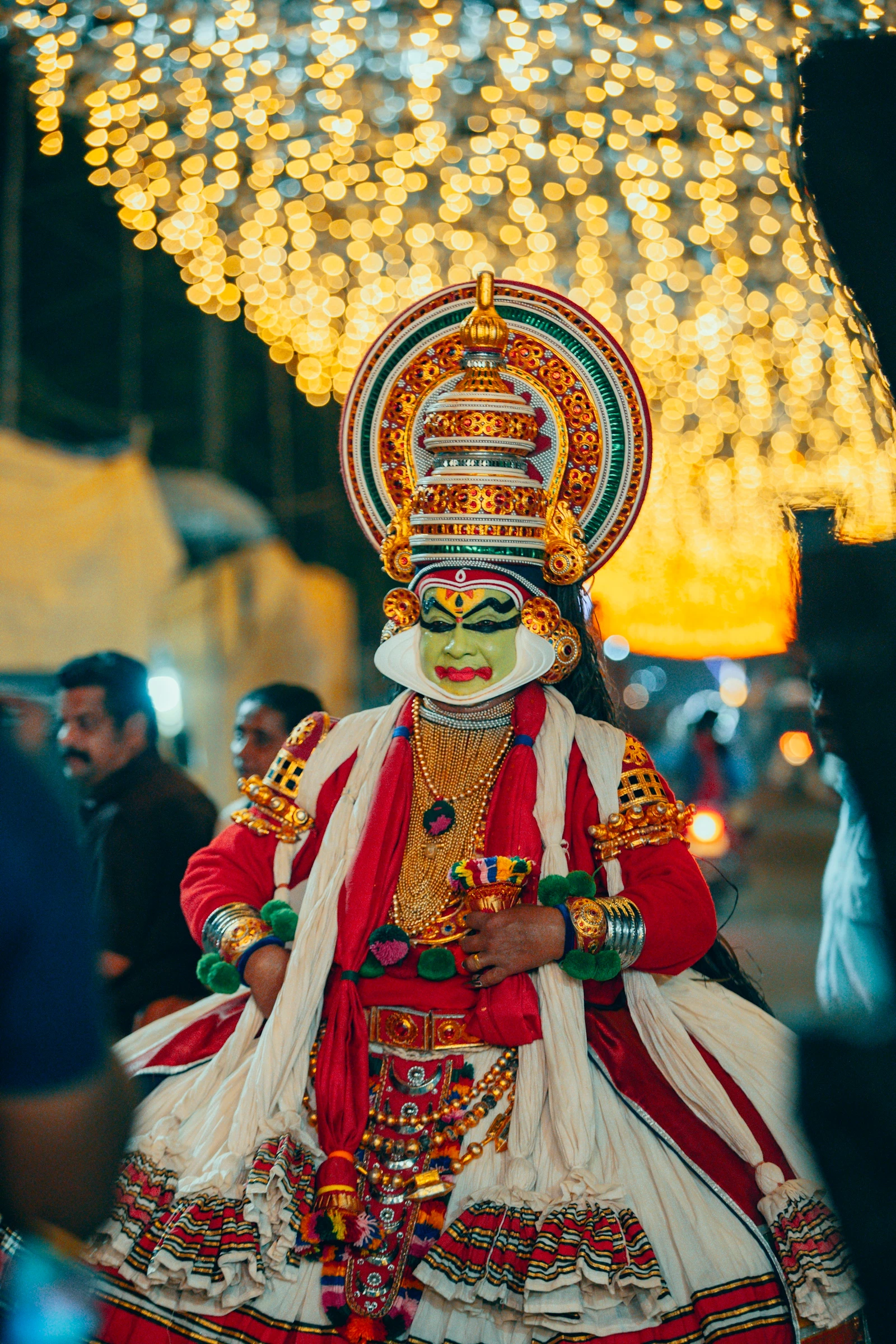
A Kathakali dancer in Fort Kochi, one of the staged performances put on for visitors in the south.
Can non-Hindus attend temple ceremonies?
Usually yes, but not everywhere, and it pays to know before you arrive. Many of the great temples welcome visitors of all faiths into their outer courtyards, which is where most of the music and ceremony happens anyway. A number of temples, however, admit only Hindus, or bar non-Hindus from the innermost sanctum, and this is a firm rule rather than a slight; our guide to Indian temple etiquette has more. The Golden Temple, by contrast, welcomes everyone without exception. Because policies differ from temple to temple and change over time, check the specific shrine before you build a visit around entering it, so a closed door does not feel like a rebuff.
Is it safe, and are there places to avoid right now?
The main destinations for devotional music, Varanasi, Amritsar, and Kerala and Tamil Nadu in the south, are generally comfortable and straightforward for visitors, with ordinary city precautions. One exception is the northeast: Manipur is home to Sankirtana, a UNESCO-listed tradition of ritual singing and drumming, but as of September 2026 the FCDO advises against all but essential travel there following ethnic violence, so it is not one to plan around at present. Kashmir also carries restrictions. Always check your own government's current travel advice before you commit, as advisories change.
Which places should you build a sacred-sound trip around?
Four places give you the fullest range. Varanasi is unmatched for the daily rhythm of riverside ceremony. Amritsar delivers the continuous kirtan of the Golden Temple. Kerala offers Theyyam in the north and sopanam and temple music, along with staged Kathakali in the south. Tamil Nadu's temple towns, from Madurai to Thanjavur and Chidambaram, give you nadaswaram, Carnatic music and rituals a thousand years old. You do not need all four on one trip. Two, done slowly, is plenty.
Who is this kind of travel best suited for?
This suits travellers who are curious about faith and music rather than ticking off monuments, who are comfortable with early starts and late nights, and who would rather sit still in one powerful place than race between five. It works well for couples, solo travellers and musicians, and for anyone who has been to India before and wants to go deeper. It is less suited to those who need a fixed schedule and a guaranteed seat, since ritual timings move, and to families with very young children during the long overnight ceremonies. If your priority is wildlife or the Taj Mahal, those are different trips.
What do first-time visitors get wrong?
The commonest mistake is watching a ceremony through a phone screen and missing the thing itself, closely followed by photographing people at prayer without asking. The third is assuming a staged show and a living ritual are the same, and being let down by whichever one they did not expect. A quieter error is over-scheduling: sacred music rewards stillness, and three ceremonies in a day cancel each other out. The last is arriving without context, so a Theyyam becomes only noise and colour rather than a village asking its god for the year ahead.
Frequently asked questions
What is the most famous devotional ceremony in India?
The evening Ganga aarti at Dashashwamedh Ghat in Varanasi is the best known, a fire ceremony offered to the river each night at dusk with lamps, bells and chanting. The continuous shabad kirtan at the Golden Temple in Amritsar is a close second and, for many, more moving.
Can tourists attend the Ganga aarti in Varanasi?
Yes. The Ganga aarti is free and open to everyone, every evening of the year. You can watch from the ghat steps or from a boat on the river. Arrive thirty to forty-five minutes early in the busy winter months, as the ghat fills quickly.
What is the difference between bhajan and kirtan?
Both are Hindu devotional songs. A bhajan is a hymn that can be sung by one person or a group, often with a fixed melody. Kirtan is specifically call-and-response, where a leader sings a line and the gathering answers, so the whole room takes part.
When is the Theyyam season in Kerala?
The Theyyam ritual season in northern Kerala runs broadly from December to April, with some shrines beginning earlier, and performances are concentrated in the Kannur and Kasaragod districts. Dates are set by individual temples, so check the Kerala Tourism Theyyam calendar before planning around a specific performance.
Do I need to cover my head in Indian temples?
At Sikh gurdwaras, including the Golden Temple, covering your head is required for everyone. At some Hindu and Muslim shrines it is expected, and at others it is not. Carry a light scarf to cover your head and shoulders when needed.
Is Carnatic music religious?
Largely, yes. Carnatic music, the classical tradition of South India, grew from temple worship, and most of its core repertoire is devotional compositions addressed to Hindu deities. It is performed in temples and concert halls alike.
Planning your own journey into India's sacred sound
Devotional music in India is not something you schedule so much as something you place yourself in the path of: a lamp lifted at dusk, a drum before dawn, a hymn that reaches you across still water. The art is in choosing the right few places and giving each one enough time to work on you.
We design private, personalised India journeys for travellers who want that depth rather than a checklist. If you would like a trip built around India's living sacred sound, shaped to your own dates and pace, Plan my India trip.