Most people picture an Indian desert as sand, camels and ochre dunes. The Rann of Kutch is none of those. It is a flat sheet of cracked white salt that runs to an empty horizon, so level and so bright that on a clear day the ground and the sky seem made of the same material. For part of the year it is not even dry land. It is a drowned marsh.
If you are flying in from London, New York, Toronto or Sydney, this guide answers the questions that decide whether the Rann belongs on your trip: when it is open, how you reach it, what permits you need near the Pakistan border, what it costs in your own currency, and who it suits.
What is the Rann of Kutch, and why is it white?
The Rann of Kutch is a seasonal salt marsh in the Kutch district of Gujarat, in India's far west, and the Great Rann is one of the largest salt deserts in the world at around 7,500 square kilometres, roughly 2,900 square miles. "Rann" means salt marsh. For about four monsoon months, June to September, rain and seawater flood flats that lie barely above sea level; as the water evaporates through winter it leaves the white salt crust that visitors walk on. With no landmarks, distance stops making sense: at sunset the salt turns pink and gold, and on a bright night it reflects the moon like a frozen lake. The Rann is also a refuge for large flocks of greater and lesser flamingos.
When is the best time to visit the Rann of Kutch?
Visit between November and February, the only months the Rann is reliably dry, cool and accessible, and when the tourism season is built around it. Winter days are warm, often in the mid-twenties Celsius, the mid-seventies Fahrenheit, while the open desert can drop close to single figures at night, the low-to-mid forties Fahrenheit, so pack a warm layer. The monsoon leaves the flats under water, and from March the heat climbs fast. For how the seasons move across the country, our guide to the best time to visit India sets the Rann in context with the rest of your route.
What is Rann Utsav, and do you have to stay in the tent city?
Rann Utsav is the Gujarat tourism festival that runs all winter at a purpose-built tent city near Dhordo village, and for the 2026 to 2027 season the official dates are 1 November 2026 to 7 March 2027. You do not have to stay there to see the Rann. It is a comfortable, slightly theatrical operation of furnished tents, performances and organised sunset transfers, priced by tent category and night, with rates published each season, so check the official Rann Utsav site for pricing. Many independent travellers skip it, stay in Bhuj or a village homestay, and drive out for sunset. The tent city is easier and more managed; the villages are quieter and closer to real Kutch.
We plan private trips to Kutch timed around the white desert and the full moon, with village craft visits, comfortable stays and a driver who knows the roads. Every route starts with your dates and pace, and our team stays on hand while you travel. See how our private India trips work.
Should you plan your visit around a full moon?
Plan around the full moon if you can, because that is when the white desert is most extraordinary: the salt crust behaves like a vast mirror, and under a full moon the flats glow silver with no artificial light at all. The first time I walked out onto the salt under a full moon, I understood why people fall quiet out there, with nothing to look at and only the scale of the place to feel. In the 2026 to 2027 season the full moons fall on 24 November 2026 and 24 December 2026, with the following full moons in late January and around 20 February 2027. Rann Utsav extends its viewing hours around these nights and publishes its own dates each season, so confirm them officially before booking flights. The full-moon weekends, especially the one over Christmas and New Year, are also the busiest and dearest, so a night a few days either side still catches most of the glow with fewer crowds.
How do you get to the Rann of Kutch?
The gateway is the town of Bhuj: fly or take a train there, then drive the last stretch to the White Rann, around 85 kilometres, about 53 miles, roughly one and a half to two hours by road. Bhuj has its own airport (code BHJ) with seasonal domestic flights from Mumbai, Delhi and Ahmedabad, so many visitors route through Ahmedabad, which has far wider connections. Bhuj is also on the rail network, with overnight trains from Ahmedabad and Mumbai. If you would rather drive the whole way, Ahmedabad to the Rann is around 400 kilometres, roughly 250 miles, about eight hours. Most international arrivals connect through Mumbai or Delhi first, so budget a domestic leg.
Do you need a permit to enter the White Rann?
Yes. Because the White Rann sits close to the India-Pakistan border, every visitor needs a permit to pass the final checkpost, though it is quick and inexpensive. Buy it in advance through the official portal, rannpermit.com, or in person at the Bhirandiyara checkpost on the way out to the flats. As of October 2026 the published charge is modest: around 100 rupees per adult, about one US dollar or just under a pound, roughly half that for children aged six to twelve, free for under-fives, plus small charges for vehicles. Carry a passport or photo identification, since you show identity proof when the permit is issued. Border-area rules and fees can change, so confirm the current position officially before you travel.
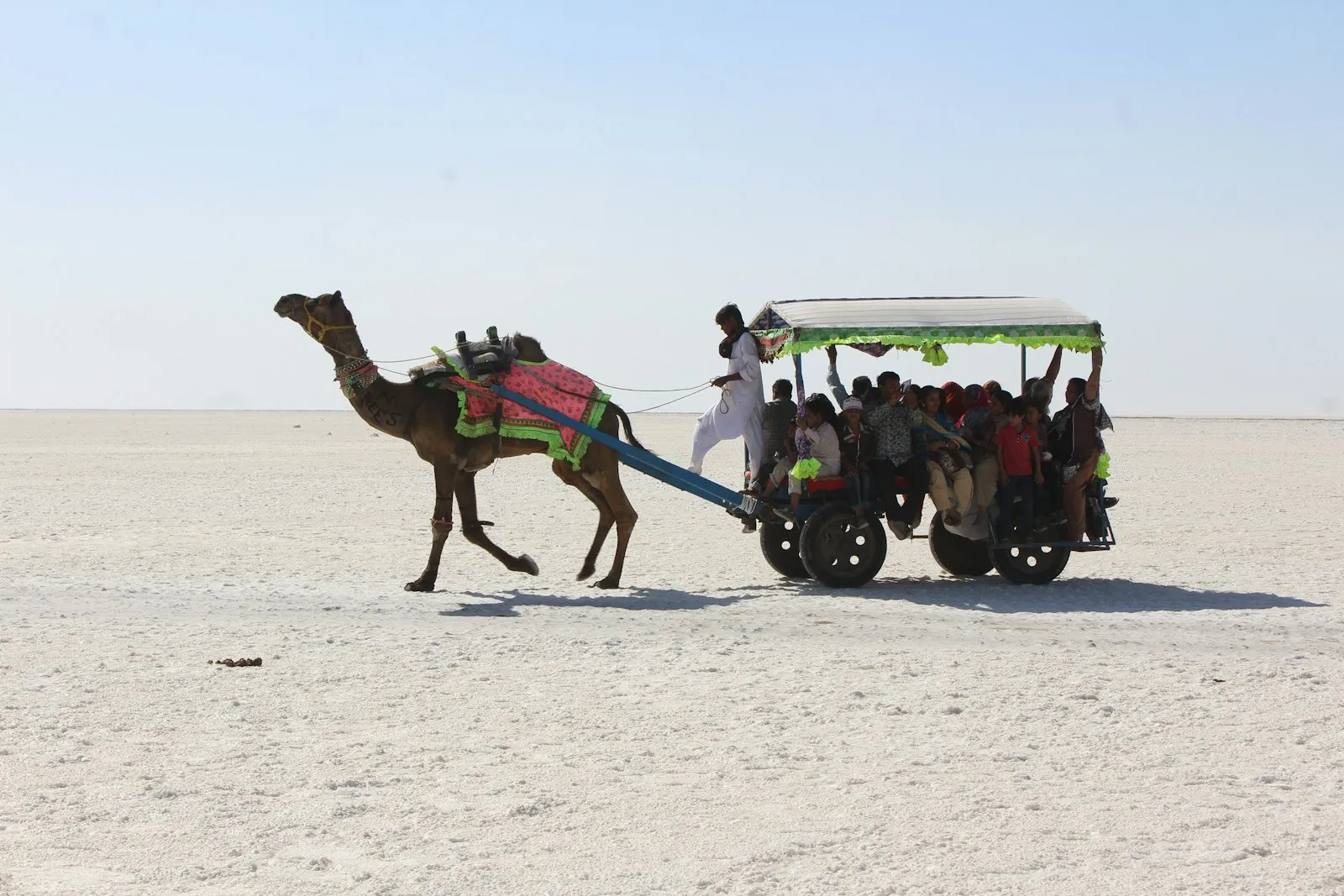
A camel cart crossing the salt, a classic Rann Utsav arrival at Dhordo.
Where do you actually stay near the Rann?
There are three honest options: the Rann Utsav tent city at Dhordo, easiest and most comfortable; the town of Bhuj, a practical base with the widest choice of hotels; and the Kutchi villages, whose homestays put you closest to the land and its people. The village stays are the quiet pleasure. Some are built as clusters of bhungas, the traditional circular Kutchi mud houses with conical thatched roofs, cool by day and warm at night, and far more memorable than a chain hotel. Whichever you choose, book early for the festival season and especially for full-moon weekends, when beds across the district fill months ahead.
How many days do you need in Kutch?
Give Kutch three to four nights. One night sees only the White Rann at sunset and moonrise, a long way to come for a single evening. A sensible rhythm is a night or two in or near Bhuj for the crafts and the town, then a night out at the Rann, with a day for Kala Dungar and the drive to Dholavira. This is offbeat territory by Indian standards, the kind of place we gather in our guide to offbeat India, and it works best when it is not squeezed into a single stop.
What does a trip to the Rann of Kutch cost?
The desert itself is almost free to enter; the real spend is transport and accommodation. A private car with driver, the practical way to cover Kutch's long, empty roads, runs roughly 4,000 to 8,000 rupees a day including fuel, about 42 to 83 US dollars, or 32 to 64 pounds, at early-October 2026 rates of around 96 rupees to the US dollar and 126 to the pound. Meals are cheap away from the resorts, from a few hundred rupees for a Gujarati or Kutchi thali, a round steel plate of small dishes, to a couple of thousand in a hotel dining room, broadly 2 to 20 US dollars. Accommodation is the big swing, with the festival tents dearest by far. For how these add up across a whole trip, see our breakdown of what a trip to India costs.
What else is there to see around the Rann?
Quite a lot, which is why three to four nights is not excessive. Kala Dungar, or Black Hill, is the highest point in Kutch and looks out over the endless white of the Great Rann toward the border, best at sunset. Dholavira, around four to five hours from Bhuj, is one of the great cities of the Harappan or Indus Valley civilisation, inscribed as a UNESCO World Heritage Site in 2021, India's fortieth; its reservoirs and planned streets are more than four thousand years old. On the coast about an hour and a half south of Bhuj, Mandvi adds a long beach and the Vijay Vilas Palace.
Are the craft villages of Kutch worth your time?
They are arguably the best reason to come after the desert itself. Kutch is one of the richest handicraft regions in India, and its villages still practise crafts passed down for generations rather than revived for tourists. Within a short drive of Bhuj you can watch Ajrakh block-printing, dyed through many stages with natural indigo and madder; weaving on pit looms at Bhujodi; and the near-vanished art of Rogan painting, kept alive in Nirona by a handful of families. Some of my best mornings in Kutch were not on the salt at all, but in a weaver's courtyard watching indigo come up on cloth. The thing worth doing is not a shopping stop but a slow morning in a working home, buying directly from the maker. For the wider picture, our piece on India's living crafts travels the whole country, and Kutch is one of its richest chapters.
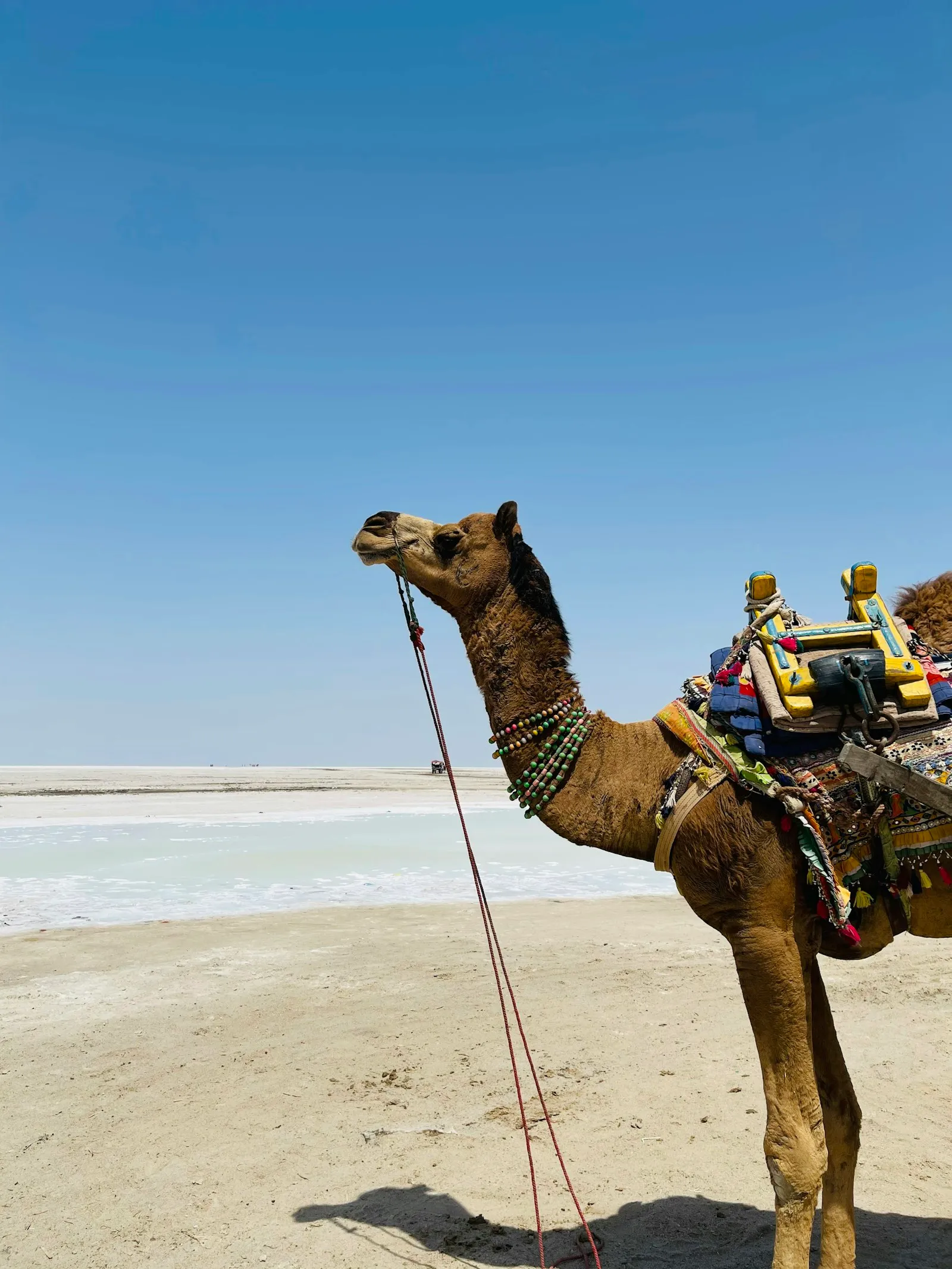
The white crust of the Great Rann stretches flat in every direction.
Is the Rann of Kutch safe, and what about the Pakistan border?
The Rann is a well-established and generally safe tourism region, and Gujarat as a whole is considered straightforward for visitors. The one real consideration is the international border. The UK Foreign, Commonwealth and Development Office advises against all travel within 10 kilometres of the India-Pakistan border, and notes that the border in Gujarat and Rajasthan is unmarked in places, so approaching it away from an official crossing could be dangerous. In practice the organised viewpoints at the White Rann and Kala Dungar sit within the permitted tourist zone, and the checkpost controls how far you can go, so stay within the marked areas and do not wander off alone across the flats. Read your own government's current travel advice before you go.
What should you pack, wear and know before you go?
Pack for a hot day and a cold night in the same twenty-four hours. The glare is intense, so sunglasses, a hat and strong sunscreen are not optional, and a warm evening layer is the thing most first-timers forget. Wear loose, modest clothing that covers shoulders and knees, both for the sun and out of respect in the villages, with closed shoes rather than sandals for the salt crust. Carry rupee cash, since card payments are patchy out here, and keep your passport with you for the permit. In the craft villages, ask before photographing anyone, use your right hand to give and receive, and buy something if you have watched an artisan work. Kutch is largely vegetarian and Gujarat is a dry state, so do not expect a drink with dinner.
What do first-time visitors get wrong about the Rann of Kutch?
The commonest mistakes are about timing and expectation. People come in the wrong season and find the Rann flooded or baking. They plan a single night and spend more time driving than standing in the desert. They fix on the full-moon weekend over Christmas and New Year and are surprised by the crowds. They assume the White Rann is open land, forget the permit, and lose time at the checkpost. And they treat Kutch as only the salt flats, missing the crafts and Dholavira, which for many travellers end up being the most memorable part.
Who is a trip to the Rann of Kutch best suited for?
It suits travellers drawn to landscape, craft and quiet rather than monuments and nightlife. Photographers, slow travellers, couples, and anyone who has already seen the headline India and wants somewhere stranger and emptier will find the Rann deeply rewarding. It is less suited to visitors on a tight first-time week who want the Taj Mahal and the classic north, since Kutch is a genuine detour in the far west, and families with very young children may find the long drives and late desert evenings hard work. If what you want from India is distance, silence and a horizon with nothing on it, there are few better places.
Frequently asked questions
Is the Rann of Kutch worth visiting?
For the right traveller, yes: if you are drawn to vast landscapes and living crafts, the white desert and the villages around Bhuj are genuinely memorable. If your priority is India's famous monuments on a short trip, it is a long detour better saved for a second visit.
How many days do you need at the Rann of Kutch?
Three to four nights is ideal, covering the White Rann at sunset and moonrise, the craft villages near Bhuj, Kala Dungar, and time for Dholavira. A single night is a long way to travel for one evening.
Do foreigners need a permit for the Rann of Kutch?
Yes. Every visitor needs a border-area permit to reach the White Rann, bought online at the official portal or at the Bhirandiyara checkpost, with photo identification. Fees are small but can change, so confirm them officially.
What is the best time to visit the Rann of Kutch?
November to February, when the Rann is dry and cool and Rann Utsav is running. The full-moon nights are the most spectacular and the most crowded, and the monsoon floods the flats from June.
How do you reach the Rann of Kutch?
Travel to Bhuj by air or train, then drive around 85 kilometres, roughly 53 miles, to the White Rann, about one and a half to two hours. Many visitors route through Ahmedabad, around 400 kilometres, roughly 250 miles, away.
Is the Rann of Kutch safe for tourists?
Generally yes. It is an established tourism region and Gujarat is considered straightforward for visitors. The only real caution is the nearby international border, which the permit and checkpost system manages, so stay within the marked tourist areas.
Planning a trip built around the Rann
The Rann of Kutch is not a sight you tick off in an afternoon. It is a landscape that only makes sense when you give it time: a sunset on the salt, a morning in a weaver's home, a night under a full moon with the horizon dissolved into the sky. We design private, personalised India journeys for visitors who want this kind of depth rather than a checklist, and Kutch is one of our favourite corners to build around. If you would like this shaped around your own dates, pace and interests, Plan my India trip.