Most first-time visitors arrive in Jaipur with a list of three buildings and a free afternoon they cannot fill. They photograph the Hawa Mahal from the street, climb to Amber Fort, walk the City Palace, and by the second morning they have run out of monuments. The city then feels like a stopover between Delhi and Udaipur rather than a place in its own right. That is a planning problem, not a Jaipur one.
This guide is for someone flying in from London, Frankfurt, New York, Toronto or Melbourne, probably on a first trip to India, who wants to know what Jaipur holds beyond the postcard. It answers how many days you need, how to reach the city, which forts earn your time, where the crafts and markets are, what it all costs in your own currency, and how to behave in a place that is still lived in rather than curated. Jaipur rewards the traveller who stays a day longer than the tour suggests.
Why is Jaipur called the Pink City?
Jaipur is called the Pink City because its old walled quarter was painted a terracotta pink in 1876 to welcome the Prince of Wales, pink being the colour of hospitality, and the colour has been kept by law ever since. The buildings inside the old wall are still repainted in that rose, so the historic core reads as one warm facade in the late-afternoon light.
The city itself is older and more deliberate than the colour. Jaipur was founded in 1727 by Sawai Jai Singh II, a king and astronomer, and laid out on a grid of nine sectors with wide streets meeting at right angles. In 2019, UNESCO inscribed the walled city as a World Heritage Site, partly for that planning and partly for the craft workshops that have run inside it for three centuries. It is not a museum of a city but a working one that happens to be beautiful.
How many days do you need in Jaipur?
Two full days is the honest minimum, and three is better. One day forces you to rush the forts and skip everything that makes the city distinctive. With two days you give the morning to the big monuments and the afternoons to crafts, markets and food. A third day adds a leopard safari or simply a slower pace.
The common mistake is to treat Jaipur as a single sightseeing day inside a Golden Triangle rush of Delhi, Agra and Jaipur in four nights. You can do it, but you will see three forts and none of the living city. If your trip is tight, shorten Agra, not Jaipur.
How do you get to Jaipur from Delhi or from abroad?
The simplest route is to fly into Delhi, then come to Jaipur by fast train or by road. There are no direct long-haul flights to Jaipur, so nearly everyone connects through Delhi or Mumbai.
By train, Delhi to Jaipur covers about 309 kilometres, roughly 192 miles, and the fastest services make it in good time: the Vande Bharat Express takes around three and a half hours and the Ajmer Shatabdi around four and a half, both air-conditioned, as of October 2026. By road it is about 280 kilometres, roughly 174 miles, and five to six hours on the national highway. The train is usually the calmer choice, booked well ahead through the official Indian Railways system (irctc.co.in), as the good trains sell out weeks in advance. Jaipur has its own airport (code JAI) too, with domestic links to Delhi and Mumbai.
We plan private Rajasthan trips that give Jaipur time beyond the forts: old-city bazaars, craft workshops and a guide who knows the lanes. Heritage stays and a dedicated driver are built around your pace, and our team stays on hand while you travel. Plan a private Rajasthan trip.
Which forts and palaces are actually worth your time?
Of Jaipur's headline sites, Amber Fort and the City Palace reward a proper visit, Jantar Mantar rewards a guide, and the Hawa Mahal is best enjoyed from the street. Trying to do all of them plus two hilltop forts in a day leaves you exhausted and underwhelmed.
Amber Fort, properly Amer, sits about 11 kilometres, roughly 7 miles, north of the centre, and it is the one to see first and early: a hillside palace of courtyards, mirror-work halls and ramparts that deserves two unhurried hours. The City Palace in the old city is still partly the royal family's home and holds a good textiles and arms collection. Jantar Mantar, next door, is the astronomer-king's open-air observatory of giant stone instruments, a UNESCO site that looks like abstract sculpture until a guide explains that each shape measures the sky. The Hawa Mahal, the honeycomb of pink windows, is really a facade, best seen from the street or a rooftop cafe opposite, not from inside.
Entry fees for foreign visitors run from a few hundred rupees to about ₹1,000, around USD 10, for Amber Fort, with composite tickets covering several monuments, as of October 2026. Fees change often, so confirm current prices and timings on the official Rajasthan tourism channels (tourism.rajasthan.gov.in).
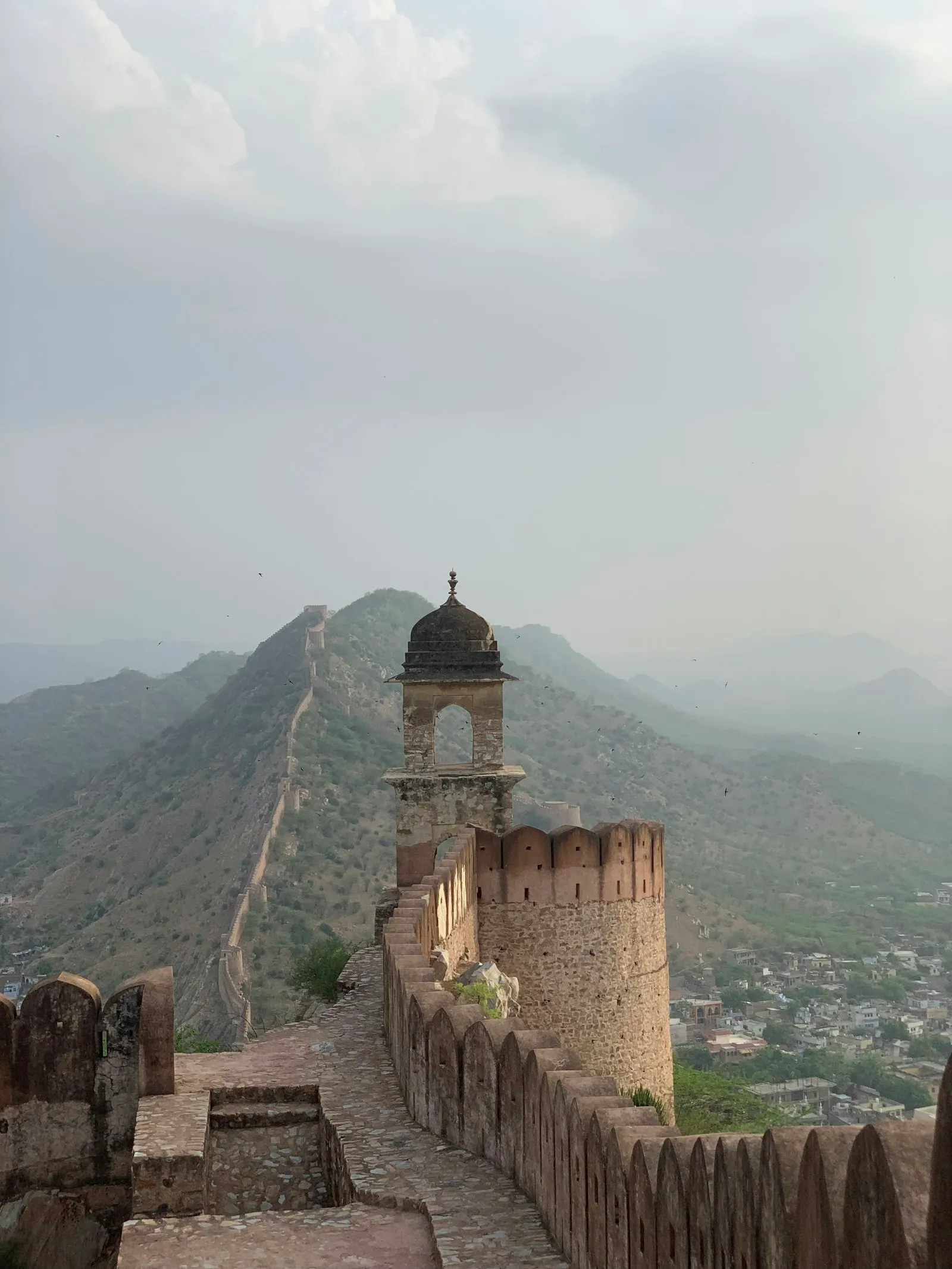
Amber Fort, 11 kilometres north of Jaipur, is best seen early before the coaches arrive.
Should you ride the elephants at Amber Fort?
No, and this is worth saying plainly. The elephant rides up to Amber Fort are a well-known animal-welfare concern, and the kinder, more interesting way up is to walk the ramp or take a jeep. The elephants carry passengers up a steep slope in the heat for hours, and campaigners have raised consistent welfare concerns. Skipping the ride costs you nothing, and the fort is no less magnificent for arriving on foot.
Where do you go in Jaipur to escape the crowds?
The best antidotes to the fort queues are the stepwell at Panna Meena ka Kund, the ramparts of Nahargarh at sunset, and the old-city lanes on foot. These are where Jaipur stops performing.
Panna Meena ka Kund is a sixteenth-century stepwell near Amber, a perfect geometry of criss-crossing staircases descending to the water, and free to enter; go early, before the coaches reach Amber, and you may have it to yourself. Nahargarh Fort, on the ridge above the city, is worth the drive up for the late-afternoon view across the whole pink grid. And the most underrated thing to do in Jaipur is to walk a slice of the old city early, through the flower sellers, metalworkers and sweet shops, before the traffic takes over. The dawn walks I send travellers on start around the markets, so they see the city working rather than waiting.
What crafts is Jaipur known for, and can you try them?
Jaipur is one of India's great craft cities, best known for hand block-printed textiles, blue pottery and gemstone work, and the most memorable way to meet these crafts is to make something yourself. Block printing is the technique of stamping cloth by hand with carved wooden blocks dipped in dye.
The craft experiences worth your afternoon are the hands-on ones in a working printer's courtyard, not the shop demonstrations. In the printing villages on the city's edge, you sit at a long padded table, choose your blocks, and print your own length of cotton with natural dyes, mistakes and all, keeping the cloth at the end. Blue pottery, Jaipur's distinctive turquoise-and-white ceramic made without any clay, is also worth trying by hand. These are the experiences we build Jaipur days around, not a showroom with a card machine. Our guide to India's living crafts goes deeper into both across the country.
How do you shop Jaipur's bazaars without being overcharged?
Shop the old-city bazaars by neighbourhood, go slowly, and expect to negotiate everywhere except fixed-price government and cooperative shops. Jaipur's markets are organised by trade: Johari Bazaar for jewellery, Bapu Bazaar for textiles and leather, Tripolia Bazaar for lac bangles and brassware, and Kishanpol for block-printed fabric.
A few habits help. Decide what something is worth to you before you ask the price, because the first number is an opening move, and walk away cheerfully if the gap is too wide. For gemstones, which Jaipur sells in volume, buy only from certified dealers unless you genuinely know stones, because the city is also where tourists are most often sold glass as sapphire. The government emporium and craft cooperatives are a useful baseline: their prices are fixed, so an hour there teaches you what the open market should cost.
What should you eat in Jaipur?
Jaipur's food is rich, vegetarian-leaning Rajasthani cooking built for a desert climate, and the three things to try are dal baati churma, a Rajasthani thali, and the city's famous sweets. A thali is a platter of many small dishes with rice and bread, the easiest way to taste a region's range at once.
Dal baati churma, the signature dish, is baked wheat dough balls, called baati, broken into lentils and ghee, with a sweet churma crumble alongside. Look also for laal maas if you eat meat, a fiery mutton curry, and the pyaaz kachori, a flaky pastry stuffed with spiced onion. As anywhere in India, drink bottled or filtered water, and eat where there is turnover and a crowd.
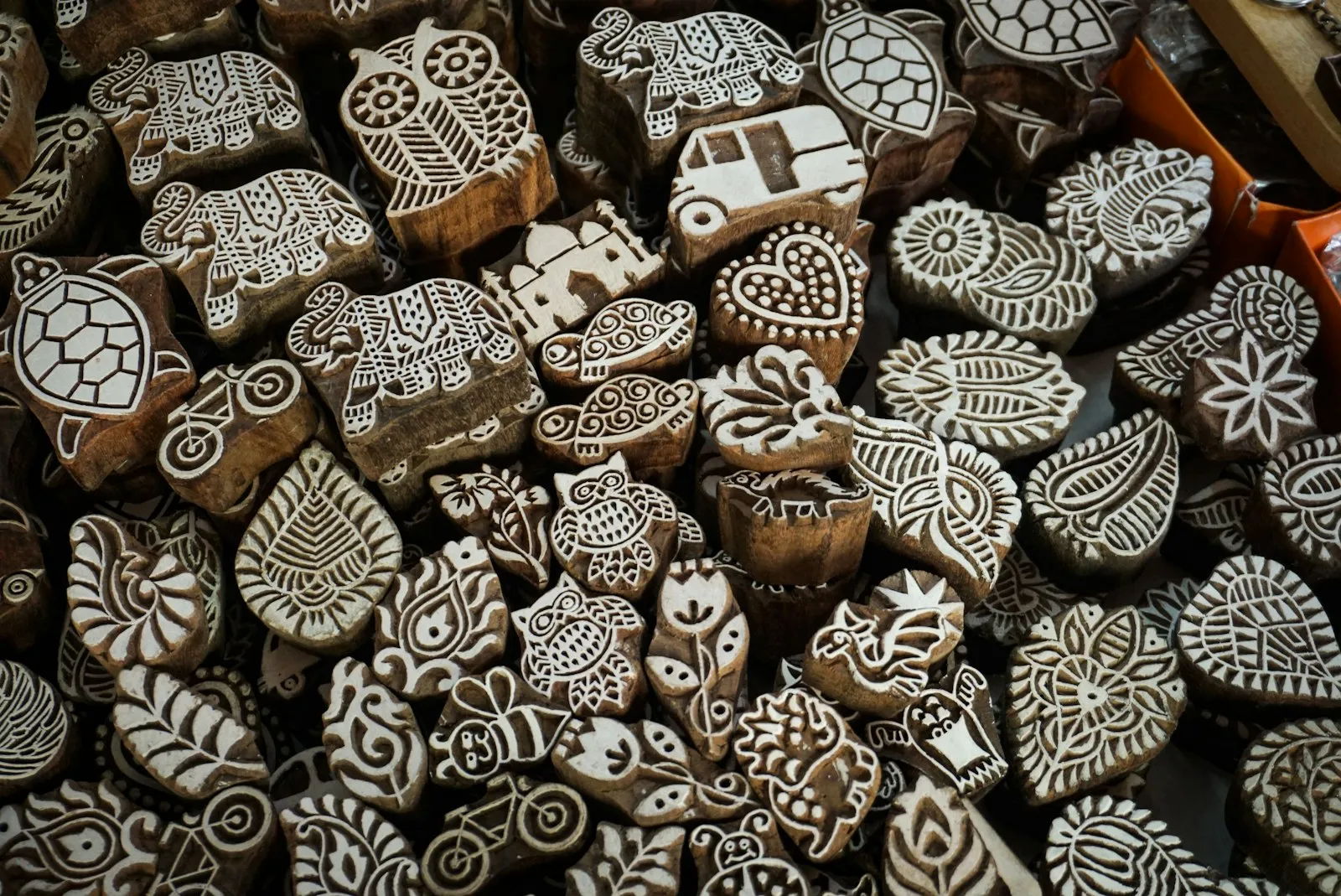
Carved wooden blocks for hand block-printing, one of Jaipur's living crafts.
Can you really see leopards inside the city?
Yes. The Jhalana Leopard Reserve, on the city's southeastern edge, is one of the few places in the world where you can reliably see wild leopards on a short safari near a city. Open-top jeep safaris run in morning and afternoon slots, and sightings, while never guaranteed, are common.
A safari takes a couple of hours, uses a limited number of permitted vehicles, and must be booked ahead, so it suits a third day well. If you have come to India for its wildlife but are not routing through a national park, Jhalana is a genuine, low-effort chance to see a big cat.
What does a trip to Jaipur cost?
Jaipur can be done comfortably on a mid-range budget, and the biggest variable is your choice of hotel. A couple travelling well, with a private car and guided experiences, might spend around ₹10,000 to ₹30,000 a day for two, about USD 104 to 313, GBP 79 to 237, or EUR 92 to 276. Treat every figure here as a planning range, as prices move with season and demand. Conversions use rates of about ₹96 to the US dollar, ₹127 to the pound and ₹109 to the euro, as of October 2026.
The main components, as of October 2026:
- A boutique or heritage double room: roughly ₹4,000 to ₹20,000 per night, about USD 42 to 208, GBP 32 to 158, or EUR 37 to 184, depending on how grand you go.
- A private car with a driver for the day: roughly ₹4,000 to ₹8,000, about USD 42 to 83, GBP 32 to 63, or EUR 37 to 74.
- Monument entry for foreign visitors: a few hundred rupees each, up to about ₹1,000 for Amber Fort, so around USD 5 to 18 for a full day.
- A good meal: ₹300 in a simple local restaurant to ₹2,500 in a hotel dining room, about USD 3 to 26.
- A hands-on craft workshop: a few thousand rupees per person for a half-day, roughly ₹3,000 to ₹5,000, about USD 31 to 52, though this varies, so confirm directly.
A homestay-based trip costs a fraction of this, and a palace-hotel version several times more, yet the sights are the same whichever you choose. For a wider view of trip budgets, see how much a trip to India costs.
When is the best time to visit Jaipur?
October to March is the best time to visit Jaipur, when the days are warm and dry and the evenings cool. This is desert Rajasthan, so the season you choose changes the trip entirely.
- October to March: the comfortable window. Daytime temperatures sit around 22 to 27 degrees Celsius, roughly 72 to 81 Fahrenheit, and winter nights can drop to 8 to 12 degrees, the mid-forties to low-fifties Fahrenheit, so pack a warm layer.
- April to June: very hot, frequently 40 to 45 degrees Celsius, around 104 to 113 Fahrenheit. Sightseeing becomes an early-morning and late-evening affair, though hotels are cheaper.
- July to September: the monsoon brings some rain, a green break in the heat, and the city's liveliest festivals.
Two festivals are worth planning around. The Jaipur Literature Festival, usually held in late January or early February, draws writers from around the world; check the official programme for the year's dates. Gangaur, in March or April, and Teej, in the monsoon, fill the old city with processions. For a country-wide view of timing, see our month-by-month guide to the best time to visit India.
What should you wear, and how do you visit respectfully?
Dress modestly, cover your shoulders and knees at temples, and ask before photographing people. Jaipur is relaxed by Indian standards, but it is a traditional city, and a little care goes a long way.
Loose cotton or linen is respectful and sensible in the heat, and slip-on shoes help where you remove them at the door. When photographing craftspeople, shopkeepers or people at prayer, ask first; most will happily agree. Eat and pass objects with your right hand. Getting around is easy: app-based cabs are the simplest default, auto-rickshaws (three-wheeled open taxis known locally as autos) suit short hops, and a private car with a driver is best for a full day of spread-out forts. Carry rupee cash for autos, markets and temples, though cards work in hotels and larger shops.
For visas, vaccinations and insurance, rely on official sources rather than any travel article, including this one. Apply for a tourist visa only through the Indian government portal (indianvisaonline.gov.in), speak to a travel clinic well before you fly, and check your own government's current travel guidance, such as the UK's (gov.uk/foreign-travel-advice/india), which at the time of writing considers Rajasthan straightforward for ordinary tourism.
What do first-time visitors get wrong in Jaipur?
The commonest errors are rushing the city in a day, seeing only the forts, and treating every quoted price as fixed.
- Giving Jaipur a single day. Two is the minimum for the city to make sense.
- Stopping at the three famous buildings. The crafts, markets, stepwell and leopard reserve are where the city opens up.
- Sightseeing at midday. The forts are hot and crowded then; go early and keep the afternoon for shaded lanes.
- Taking the elephant ride without thinking about it. Walk or take a jeep instead.
- Buying expensive gemstones from a tout or a driver's "friend's shop". Use certified dealers only.
- Negotiating aggressively, or not at all. Decide your price, ask once, stay friendly.
Who is Jaipur best suited for?
Jaipur suits almost everyone, and it is especially rewarding for first-time visitors to India, for couples, and for anyone drawn to crafts, design and architecture. It is a gentler introduction to urban India than Delhi, with the same richness and less of the overwhelm.
It is especially rewarding for travellers interested in textiles, jewellery and interiors, for whom the workshops and bazaars are a destination in themselves, and comfortable for older visitors and families. It fits naturally into a first North India trip with Delhi and Agra, and pairs well with a longer Rajasthan loop through Udaipur and Jodhpur. If you want deep wilderness, Jaipur is a city stop, though Jhalana gives it an unexpected wild edge. For how it fits a longer route, see our classic North India itinerary and the ways to go beyond the Golden Triangle.
Frequently asked questions
Is one day enough for Jaipur?
One day lets you see Amber Fort, the City Palace and the Hawa Mahal facade, and little else. Two full days is the realistic minimum, and three allows crafts, markets and a leopard safari at a comfortable pace.
Is Jaipur safe for tourists, including solo women?
Jaipur is generally considered safe and straightforward for visitors, including solo women, with the usual precautions: dress modestly, use app-based cabs at night, avoid unlit areas late, and keep valuables discreet. Check your own government's current travel advice before you go.
Why is Jaipur painted pink?
The old walled city was painted terracotta pink in 1876 to welcome the visiting Prince of Wales, pink being the colour of hospitality. The buildings in the historic core are still repainted in the same shade by law.
What is Jaipur famous for shopping?
Hand block-printed textiles, blue pottery, lac bangles, leather juttis and gemstone jewellery. The old-city bazaars are organised by trade, with Johari Bazaar known for jewellery and Bapu Bazaar for textiles.
How far is Jaipur from Delhi and Agra?
Jaipur is about 280 kilometres, roughly 174 miles, from Delhi, five to six hours by road or three and a half to four and a half by fast train. Agra is about 240 kilometres, roughly 150 miles, away, which is why the three cities form the classic Golden Triangle.
Do you need to book the leopard safari in advance?
The Jhalana leopard safari uses a limited number of jeeps per slot and does sell out, so book ahead, especially in the busy winter months. Monument tickets can usually be bought on the day, though booking online avoids queues.
Planning your own Jaipur
The difference between a good day in Jaipur and a forgettable one is rarely the monuments, which are the same for everyone. It is the hours around them: a stepwell before the crowds, an afternoon with your hands in dye, a market walked slowly with someone who knows which shop is honest.
We design private, personalised India journeys for visitors who want that depth rather than a checklist. If you would like Jaipur shaped around your own dates, pace and interests, Plan my India trip