Most visitors meet their first Indian thali and assume it is a tasting menu, a tray of little bowls to graze across. It is not. A thali is a full, considered meal, the everyday lunch of millions, and the small bowls are parts of one plate, arranged so that sweet, sour, salt and spice land in the right order.
This guide is for someone flying in from London, Frankfurt, New York, Toronto or Melbourne who wants to understand Indian food before the first meal. It covers what a thali is, how it changes across the country, how to eat one, what it costs in your own currency, and where to find the version worth travelling for.
What is an Indian thali, exactly?
A thali is a complete Indian meal served on one plate: many small dishes eaten together, not in sequence. The centre holds a staple, usually rice or flatbread. Around it sit lentils, two or three vegetable dishes, yoghurt, a pickle, a crisp wafer and something sweet.
The point is balance: a starch to build on, protein from the lentils, cooked and raw vegetables, something sour to cut richness, something sweet to close, and heat held in check by yoghurt. You eat a little of everything in rotation, so no single flavour dominates. For the cuisines it draws on, see our guide to India's regional cuisines.
What does the word "thali" actually mean?
Thali is simply the Hindi word for "plate". The meal took the name of the dish it is served on, and underneath it sits an old idea about balance. Ayurvedic tradition, India's system of medicine and diet, holds that a complete meal should carry all six tastes, known as shadrasa: sweet, sour, salty, pungent (the heat of chilli and pepper), bitter and astringent (the dry pucker of certain greens and lentils). A well-built thali is that theory made edible, and a plate hitting all six does feel more satisfying than one that does not.
How do you eat a thali without getting it wrong?
You eat with your right hand, mixing a little of one dish into the rice at a time, and let the staff refill the bowls as they empty. That is the whole method, and nobody expects a visitor to do it flawlessly.
A few things help. Use the right hand for eating and passing food, as the left is traditionally considered unclean at the table. Do not flood the plate: take rice or bread, combine it with one dish, eat that, then move on. Leaving a little at the end is fine, but a loaded, wasted plate reads as careless. Cutlery is always available, and asking for a spoon is normal. Much as in temples, covered in our guide to Indian temples, the rule is simple: watch, follow, and ask if unsure.
We build food into private India trips with care: home kitchens, regional thalis at places we trust, and market walks with local guides who explain what is on the plate. Every route starts with your dates, pace and dietary needs, and our team stays on hand while you travel. See how our private India trips work.
What is the difference between a thali and "meals"?
They are the same thing under two names. "Thali" is the northern and pan-Indian word; "meals" is what the same plate is called across South India, served on a banana leaf rather than a steel tray.
A South Indian "meals" board at lunchtime almost always means rice, sambar (a tangy lentil and vegetable broth), rasam (a thin peppery soup drunk towards the end), two or three vegetable sides, a pappadam (a thin crisp wafer), yoghurt and a small sweet, refilled until you wave it away. It is among the best value lunches in the country.
What is in a Gujarati or Rajasthani thali?
These are the two great thalis of western India, both built around the climate they come from. A Gujarati thali is almost entirely vegetarian and leans gently sweet, balancing sugar against salt and chilli. A Rajasthani thali is heartier and drier, made for a desert state where fresh produce was historically scarce.
A Gujarati thali typically brings several vegetable dishes, lentils, kadhi (a yoghurt and gram-flour curry), soft rotli flatbreads, rice, fried snacks called farsan, pickles and a sweet, all refilled generously. The Rajasthani version centres on dal baati churma: baati are hard roasted balls of wheat, cracked open and doused in ghee (clarified butter) and lentils, with churma, a sweet crumbled wheat dish, alongside. Both are usually unlimited feasts.
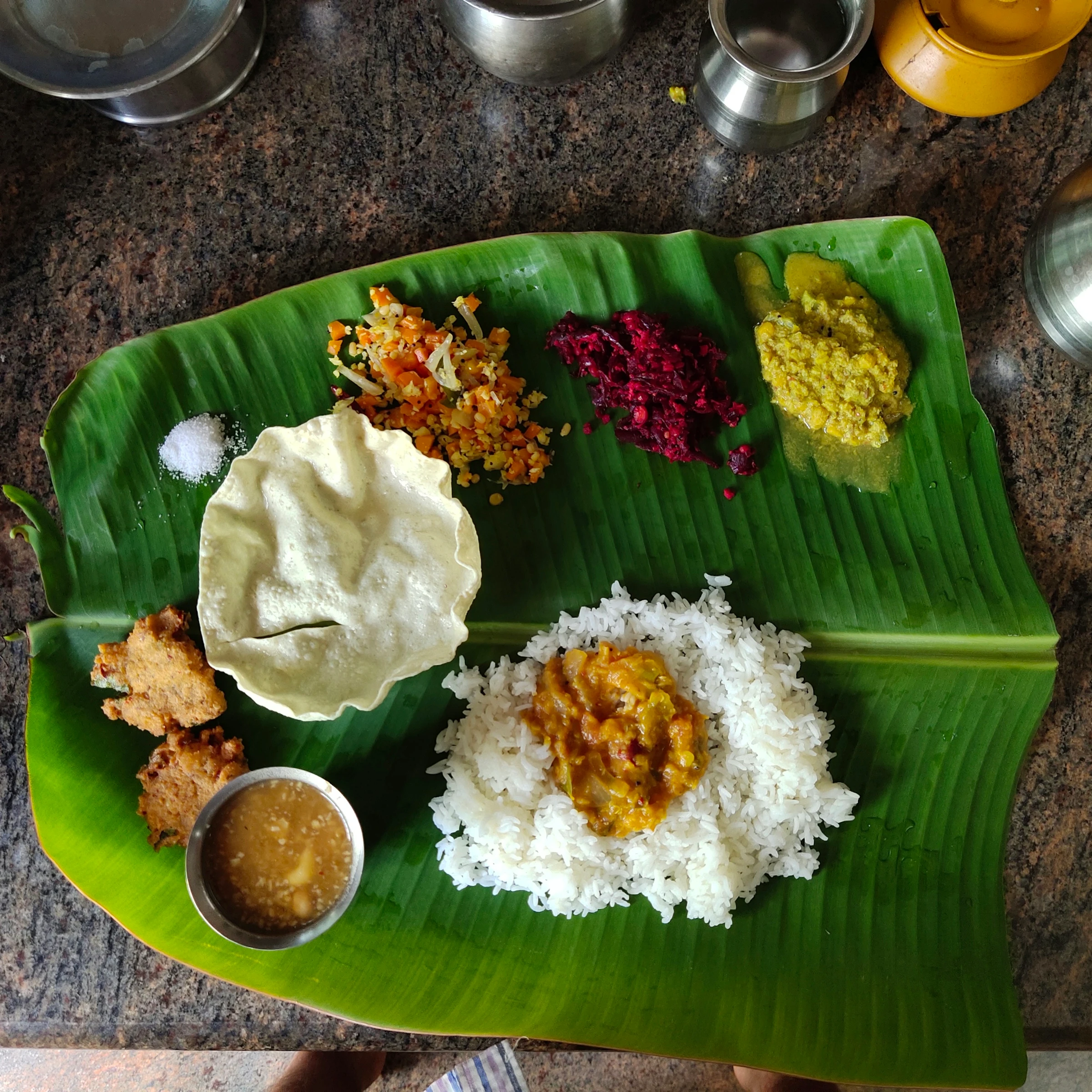
In South India the same plate is called 'meals', often served on a banana leaf and refilled until you wave it away.
What is a sadya, and why is it served on a banana leaf?
A sadya is the grand vegetarian banana-leaf feast of Kerala, served at weddings, temple events and above all at Onam, the state's harvest festival. It is a thali scaled up to ceremony: anywhere from nine dishes at home to more than thirty at a full celebration, all vegetarian, all on one leaf, which is itself the single-use plate.
There is a grammar to it. The leaf is laid with its tapered tip pointing to your left. Pickles, a banana, salt, banana chips and a sweet go along the top; the lower half is kept clear for rice. You work through it in order: parippu, a soft dal with ghee, then sambar, then yoghurt-based dishes, then payasam, a sweet milk or jaggery pudding, and finally rasam and buttermilk.
I once took a group through an Onam sadya in Kochi with someone who could name every item on the leaf and say why it sat where it did, and it changed the meal. Left alone, you eat twenty-six good things in a slight panic. Guided, you are reading a map of a whole cuisine. Onam falls in August or September; a banana-leaf meals plate is available in Kerala year-round.
What about Bengali, Maharashtrian and Himalayan thalis?
Nearly every region has its own plate. A Bengali thali comes closer to in courses, from bitter greens through fish and rice to a sweet; coastal Maharashtra's Malvani plate leans on coconut and kokum, a sour fruit, with sol kadhi, a pink drink that cools the heat.
Go north into the hills and it changes again. In the tea country of Himachal Pradesh, the festive meal is the dham, a Pahari feast of rice, lentils, yoghurt-based curries and a sweet. I ate a version at a working tea estate in the Kangra valley, after walking the gardens: a reminder that a thali is really whatever a place considers a complete meal.
Are thali refills really unlimited?
At a traditional thali or "meals" restaurant, yes: rice, dal, vegetables and bread are topped up until you signal that you are done, though the sweet and pickle are sometimes served once. Not every thali works this way. One on an airline, in a smart hotel or on a set menu is usually a fixed plate, so it is worth asking before you order.
How much does an Indian thali cost?
Very little, by most visitors' standards. Prices vary by city and venue, so treat these as planning ranges as of 2026, at roughly 96 rupees to the US dollar, 127 to the pound and 108 to the euro.
A simple local "meals" or everyday vegetarian thali typically runs about 120 to 300 rupees, roughly USD 1.25 to 3.10, GBP 1 to 2.35, or EUR 1.10 to 2.80. A generous unlimited Gujarati or Rajasthani thali at a dedicated thali restaurant is more like 350 to 700 rupees, about USD 3.65 to 7.30, GBP 2.75 to 5.50, or EUR 3.25 to 6.50. A festive sadya or a thali in a smarter restaurant commonly sits between 500 and 1,200 rupees, about USD 5.20 to 12.50, GBP 3.95 to 9.45, or EUR 4.65 to 11.10. Rates and local prices move, so check the current rate before you travel.
Where do you find a thali worth travelling for?
The best thali is rarely the fanciest. For an everyday plate, follow the lunchtime crowd into a busy "meals" restaurant where turnover is high. For a regional showpiece, seek out a dedicated thali house in Ahmedabad for Gujarati, or Jaipur or Jodhpur for Rajasthani. For the home-style version, the village kitchens and farm tables of rural India serve a thali closer to how families eat.
For the plate you remember for years, time a trip to a festival. A sadya during Onam, eaten off a banana leaf with someone to explain it, is one of the most generous meals in India. Travelling with people who know the calendar and the kitchens earns its place here.
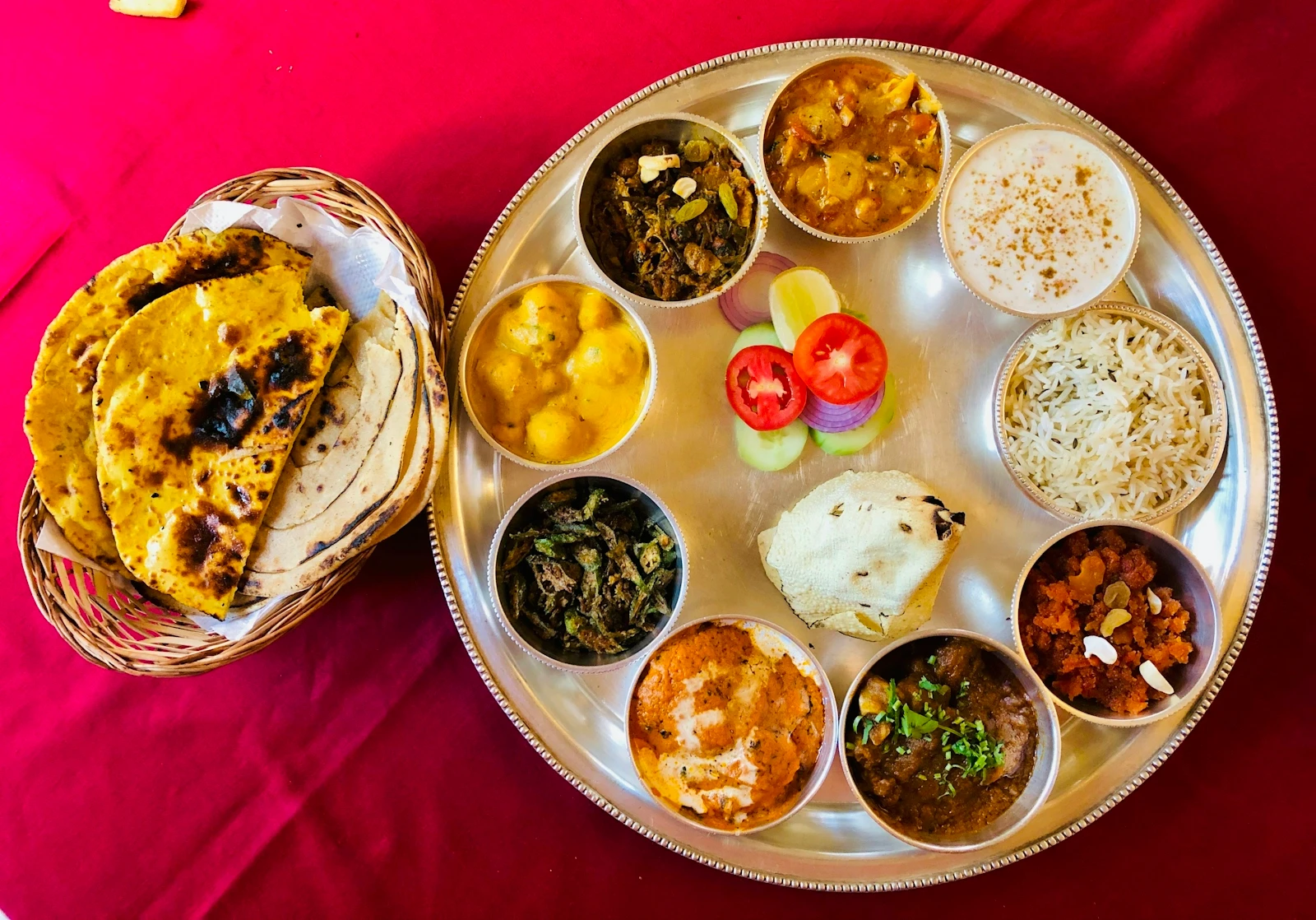
A thali is one balanced meal, not a sampler: rice at the centre, with lentils, vegetables, yoghurt, pickle and a sweet around it.
Can you learn to cook a thali yourself?
Yes, and it is one of the better half-days a food-minded traveller can spend. The cooking classes worth your time are the small ones run out of a family kitchen, five or six people round the counter with their hands in the dough, learning the two or three dishes of a regional plate and leaving with recipe cards.
Avoid the demonstration format, where you watch a chef cook from a chair and eat the result. The value is in doing it: grinding the spice, tempering mustard seeds in hot oil, building a small thali of your own. In Fort Kochi and across Kerala and Tamil Nadu these home kitchens are easy to find, and a good one sends you home able to recreate at least a corner of the meal.
Is it safe to eat a thali, including on the street?
A freshly made thali from a busy kitchen is one of the safer things you can eat in India, because high turnover means food is cooked and served quickly rather than held warm. The usual habits apply: eat where there is a crowd, favour food that is hot and fresh, and drink only bottled or filtered water.
Give your stomach a couple of days to adjust, and carry rehydration salts. For anything medical, from vaccinations to anti-malarial advice, speak to a travel clinic or your own doctor before you fly, and verify current guidance through an official source such as the CDC's India travel health page rather than any article.
What do first-time visitors get wrong about the thali?
- Treating it as a sampler to graze across, rather than a balanced meal eaten in rotation.
- Filling up on the first dish. Pace yourself: the sweet and rasam close the meal.
- Eating only with cutlery. Using the right hand is not compulsory, but it is worth trying once.
- Assuming every thali is unlimited. The dedicated thali house refills; the hotel set plate does not.
- Skipping the regional versions. Gujarati, Rajasthani and Kerala sadya are three different meals.
Who is the thali experience best suited for?
The thali suits almost everyone, which makes it a fine entry point to Indian food. It is ideal for vegetarians and vegans, for cautious eaters who want to try many things in small amounts, and for anyone who wants to understand a region through its everyday lunch rather than its restaurant showpieces.
It works less well only for travellers who want a single large main course; even then, order one thali plus a dish alongside. For families it is a quiet blessing: fussy eaters find rice, bread, yoghurt and something mild on the same plate.
Frequently asked questions
What is the difference between a thali and a curry?
A curry is a single dish. A thali is a whole meal: a staple plus several dishes, usually including one or more curries, served together on one plate and designed to balance each other.
Is an Indian thali vegetarian?
Many are, and some, such as the Gujarati thali and the Kerala sadya, are strictly vegetarian, which makes India very easy for vegetarians. Others, including Rajasthani, Bengali and coastal thalis, include meat or fish, and restaurants state whether a thali is "veg" or "non-veg". Vegans should ask about ghee, paneer, yoghurt and milk-based sweets, but kitchens adapt readily.
How do you eat a thali correctly?
Eat with your right hand, mixing a little of one dish into your rice or bread and working through the plate in rotation. Let the bowls be refilled, and use the rasam and sweet to finish. Cutlery is available if you prefer it.
What is a sadya?
A sadya is Kerala's grand vegetarian feast, served on a banana leaf with nine to more than thirty dishes eaten in a set order. It is the centrepiece of Onam, the harvest festival in August or September.
How much does a thali cost in India?
As of 2026, a simple local thali costs roughly 120 to 300 rupees, about USD 1.25 to 3.10 or GBP 1 to 2.35. A regional or festive thali runs higher, commonly 500 to 1,200 rupees, about USD 5.20 to 12.50, and prices vary by city and venue.
Is street food thali safe to eat?
A thali cooked fresh in a busy kitchen is generally safe, because high turnover keeps food from sitting out. Eat where there is a crowd, choose food that is hot and freshly made, and drink bottled or filtered water.
Reading India one plate at a time
Learn to read a thali and you can read the country. The sweetness of a Gujarati plate, the ghee-soaked baati of the desert, the twenty-six dishes of a Kerala sadya on a leaf: each is a region explaining itself in the plainest language it has.
We design private, personalised India journeys built around this kind of understanding, from a festival sadya eaten with context to a morning in a family kitchen learning to cook the plate yourself. If you would like a trip shaped around the food as much as the sights, Plan my India trip