The usual advice on taking children to India is to wait until they are older. I hear it at the start of almost every family enquiry, and I understand the worry behind it, but it is mostly wrong. India is loud, colourful and immediate in exactly the way small children are, and a seven-year-old watching a temple elephant or eating with their hands off a banana leaf is often having a better time than their parents.
If you are flying in from London, Frankfurt, New York, Toronto or Melbourne with children in tow, your questions are practical ones: how far apart things are, whether the food will work, how a tired child copes with a long drive, and what the whole trip costs. This guide answers those. It is about how to travel in India with your family without turning the holiday into an endurance test, and it assumes you have never done this before.
Is India a good place for a family holiday?
Yes. India is one of the most rewarding places in the world to travel with family, as long as you slow the pace down and build the trip around your children rather than around a list of sights. Indian culture is openly, unselfconsciously fond of children. Your kids will be talked to, fed, included and occasionally photographed, and most families find this warmth is the thing they remember.
What India asks in return is flexibility. Plans move, trains run late, a child melts down in the heat. The families who struggle are the ones trying to run an adult sightseeing itinerary with children attached. The families who thrive treat the children as the point.
What is the best age to bring children to India?
There is no single right age, but the easiest years are roughly four to twelve. Children in that band are out of nappies, walk reasonable distances, sleep through most nights, and are curious rather than self-conscious. Under-fours travel fine too, though you plan around naps and carry more.
Teenagers are a different and often excellent proposition. Give them a camera, a reason to care, and the odd day of beach or pool, and India can genuinely move them. The one combination I steer people away from is a packed, monument-heavy route with a baby. It is not unsafe, it is just joyless for everyone.
How long should a first family trip to India be?
Two weeks is the sensible length for a first family trip, and ten days works if your flights allow little else. Anything shorter and the long-haul recovery eats most of it. Plan on roughly twelve usable days once you allow a day to arrive and a day to fly home.
Resist the urge to fill those days. A good rule with children is one main thing a day, with the morning for the activity and the afternoon for a pool, a park or nothing at all. Three nights in each place beats two, and two beats a blur of one-night stops. This is the single biggest planning decision you will make, and it matters more than which cities you pick.
We plan private family trips around the ages and energy of everyone travelling: shorter drive days, kid-friendly stays, a dedicated driver and guides who know how to hold a child's attention. Food, hygiene and safety checks are built into each decision, and our team stays on hand while you travel. See how our private India trips work.
Where should families go in India for a first trip?
For a first family trip, choose one region and go deep rather than crossing the country. The three that work best with children are Kerala in the south, Rajasthan in the northwest, and the classic Golden Triangle of Delhi, Agra and Jaipur, each for different reasons.
Kerala is the gentlest. Distances are short, the backwaters and beaches build in natural downtime, and the green, watery landscape is easy on everyone. Rajasthan is the storybook India of forts, camels and palaces, which lands beautifully with children who like knights and kings, though summers are fierce. The Golden Triangle delivers the Taj Mahal and tigers within short hops, but it is busier and better in winter. If you want the whole argument for the south laid out, our ten-day Kerala itinerary is a good companion to this guide.
A gentle two-week family route, at a glance
As a worked example, here is a Kerala-based fortnight that I have shaped many times for families. Nights are listed, because nights are what you book.
- Kochi: 2 nights. Arrival, jet lag, a gentle harbour city.
- Munnar: 2 nights. Tea hills, cool air, space to run.
- Thekkady, Periyar: 2 nights. A boat safari and spice gardens.
- Backwaters: 1 night on a houseboat, 1 night on land.
- Marari or a beach: 3 nights. The reward at the end.
- Kochi: 1 night. Culture, last curries, fly home.
The shape matters more than the exact stops: a soft landing, one active middle stretch, and a stretch of beach at the end so the trip finishes with everyone rested rather than frayed. The same logic drops neatly onto Rajasthan or the north.
How do you get around India with children?
For families, a private car with a driver is the most practical way to cover ground on most days, with the occasional train for the fun of it. This is not a luxury chauffeur. It is the ordinary way visitors travel in India: an air-conditioned sedan or small SUV with a professional driver who knows the roads, waits while you stop, and finds a clean lunch. Reckon on roughly ₹4,000 to ₹8,000 per day including fuel, about USD 42 to 83, GBP 31 to 63, or EUR 37 to 74, at rates in early October 2026.
A car lets you stop when a child needs the loo or a nap, which a train or a group tour will not. One warning that catches foreign parents off guard: child car seats are not standard in India and taxis rarely have them, so if your child needs one, bring your own lightweight travel seat from home.
Are Indian trains a good idea with children?
A train is worth doing once or twice for the experience, but it is not how you will cover most of the trip with young children. Indian trains are an adventure in themselves: chai sellers, the countryside sliding past, strangers who adopt your children within minutes. Pick a daytime run of three to five hours in an air-conditioned class rather than an overnight sleeper the first time.
The fare rules are worth knowing. Children under five travel free with no separate berth, and children aged five to eleven can travel at half fare without their own berth or full fare with one. Book well ahead through the official reservation system, because good trains sell out weeks before. The toy trains, the narrow-gauge mountain railways around Darjeeling, Shimla and Ooty that are collectively a UNESCO World Heritage listing called the Mountain Railways of India, are a pure delight if your route passes one.
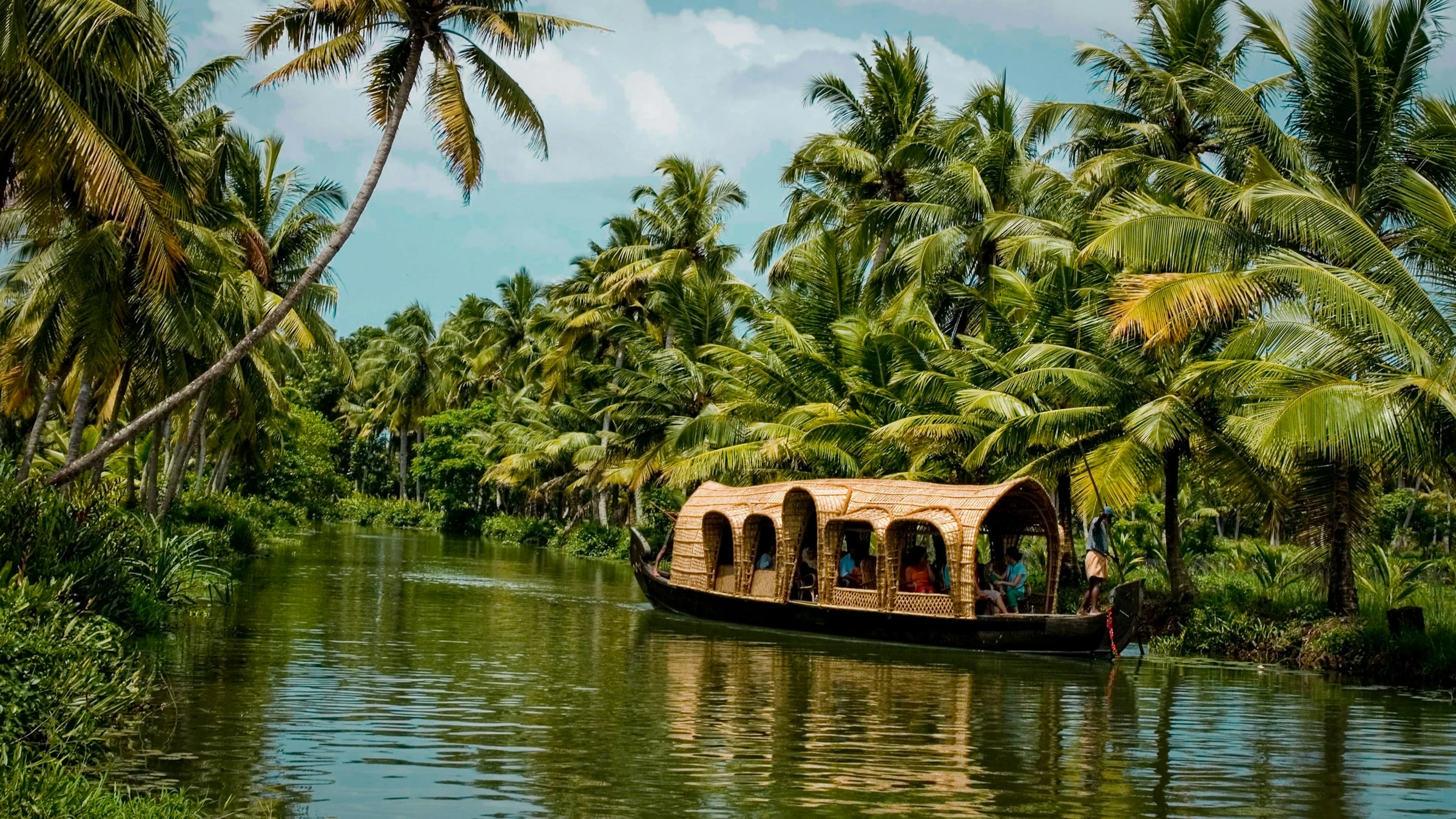
The Kerala backwaters, where a slow boat does more for a tired family than any monument.
What will children actually enjoy in India?
The things children remember are rarely the famous monuments. They are the small, hands-on encounters, which is where a well-planned trip earns its keep.
In the Kerala backwaters, the houseboat is the headline, but it is the small punted village canoe that children love, slipping down canals too narrow for the big boat, past people washing clothes and ducks being herded by a boy with a stick. A village morning near the coast, pulling in a Chinese fishing net, watching crabs farmed in the shallows and eating what the family cooks, holds a nine-year-old far longer than any palace. A coracle ride in the old Hampi landscape, spinning in a round basket boat on a green river, is ten minutes of pure joy.
Food becomes an activity, not just fuel. The cooking sessions worth your evening are the ones run out of a family kitchen, five or six of you round the counter with your hands in the dough and recipe cards to take home, not the ones where you watch a demonstration from a chair. And a classical dance performance means little to a child until they have sat with the dancer beforehand and watched the green and red face paint go on inch by inch, at which point they are transfixed. Arranging these properly, in the right order and at a child's pace, is most of what we do when we plan a family trip.
How do you handle food and fussy eaters?
Indian food is easier for children than parents fear, because the staples are plain. Rice, flatbreads, mild dal, which is a lentil stew, yoghurt, bananas, omelettes and simple grilled chicken are everywhere, and most kitchens will happily cook a child's portion with the chilli left out if you ask. Say "no spice, for a child" and it lands.
Carry a few familiar snacks from home for the first disorientated days and for long drives. Give stomachs two or three days to settle before anything adventurous, and keep to the simple water and hygiene habits in the next section.
Is the food and water safe for children?
With a few simple habits, yes. The upset stomach that families worry about is usually avoidable rather than inevitable. Drink only sealed bottled or properly filtered water, and use it for brushing teeth too. Skip ice unless you know it is made from filtered water, and skip pre-cut fruit from stalls.
Eat where there is turnover. A busy place cooking fresh in front of you is safer than a quiet buffet holding food warm. Carry oral rehydration salts and a children's dose of the usual remedies, and build in an easy day or two at the start while everyone adjusts. None of this is unique to children, it just matters a little more.
What about health, vaccinations and mosquitoes?
Treat the medical side as the one part of planning you do not improvise. Vaccination recommendations and anti-malarial advice depend on your nationality, your route, the season and your children's ages, and they change over time, so speak to a travel clinic or your family doctor well before you fly rather than relying on any article, including this one.
Pack a simple kit: rehydration salts, child paracetamol, plasters, high-factor sunscreen, insect repellent suitable for children, and any regular medicines in their original packaging with a copy of the prescription. Cover arms and legs at dusk and use repellent, which handles both mosquitoes and the general business of outdoor evenings. Good hotels can call a doctor quickly, and private clinics in the cities are excellent.
How much does a family trip to India cost?
As a working figure, a well-organised two-week family trip in comfortable, family-friendly hotels lands at roughly ₹120,000 to ₹220,000 per adult excluding international flights, about USD 1,250 to 2,290, GBP 945 to 1,730, or EUR 1,110 to 2,040 at rates in early October 2026. Children usually cost noticeably less, because they share your room and travel free or at half fare.
Indicative components, all of which move with season and demand:
- Comfortable family room or adjoining rooms: roughly ₹7,000 to ₹20,000 per night, about USD 73 to 208, GBP 55 to 157, or EUR 65 to 185.
- Private car with driver: ₹4,000 to ₹8,000 per day, about USD 42 to 83.
- Overnight houseboat for a family, all meals: commonly ₹18,000 to ₹40,000, about USD 187 to 416.
- A family meal: ₹250 in a local restaurant to ₹2,500 in a hotel dining room, about USD 3 to 26.
- Monument entry, where it applies: the Taj Mahal, for instance, charges foreign adults ₹1,100, about USD 11, with under-fifteens free.
Exchange rates and prices move, so treat every figure as a planning range rather than a quotation. The largest variable is your choice of hotel, not the country. For a fuller breakdown by travel style, see our guide to what a trip to India costs.
Where should families stay in India?
Look for space, a pool and a kitchen that will flex, in that order. A family suite, two adjoining rooms or a small homestay with a garden beats a single cramped double every time, and a pool is not a luxury with children in a hot country, it is the thing that rescues the afternoon.
Homestays are the quiet secret of family travel in India. A family-run house with a few rooms gives your children other children to play with, a cook who will make something plain, and parents on hand who understand exactly what a tired child needs. Heritage properties, the old havelis and palace hotels, delight children who imagine themselves royalty, though check that grand does not mean fragile and formal.
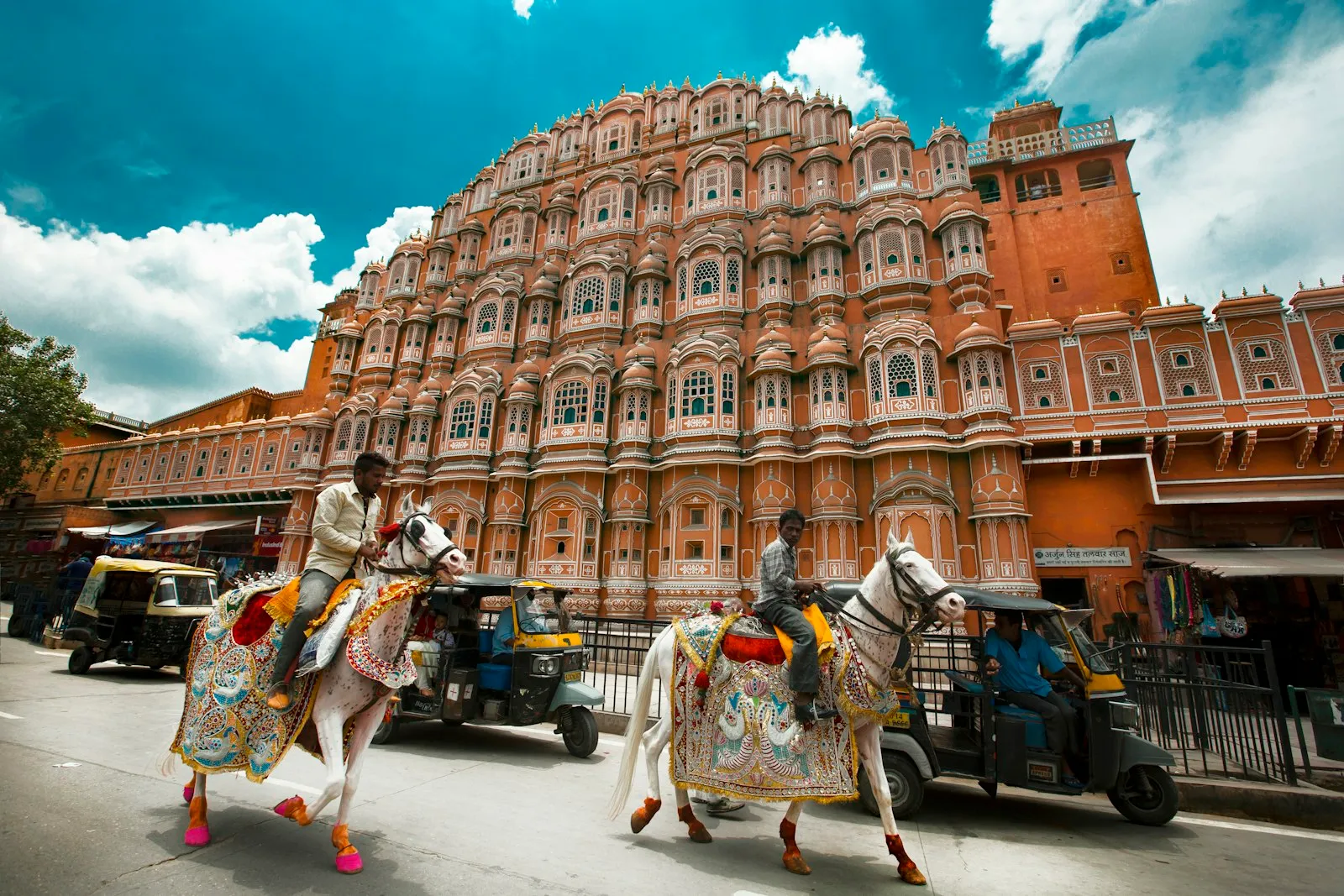
Rajasthan's forts and palaces land beautifully with children who like knights and kings.
What should you pack for children?
Pack light, cool, covering clothes and far less than you think. Loose cotton that covers shoulders and knees keeps children comfortable and works in temples. Bring sun hats, closed sandals they can slip off at temple gates, and one warm layer for the hills, where Munnar and the like sit at around 1,600 metres, roughly 5,200 feet, and mornings are cool.
Beyond that: a travel car seat if you need one, a small daypack each so children carry their own water and toy, wet wipes and hand gel, any medicines in original packaging, and a universal plug adapter. Nappies, formula and common medicines are all available in Indian cities if you run short.
How do temples and cultural sites work with children?
Temples welcome families, with a few rules worth teaching children in advance so nothing feels like a telling-off. You remove shoes at the gate, cover shoulders and knees, and keep voices low in the inner areas. Some temples do not admit non-Hindu visitors to the innermost sanctum, which is worth explaining beforehand so it does not feel like a snub, and some ask men to remove their shirts in certain shrines.
Go early, when the stone is cool underfoot and the heat has not built. A good local guide transforms a temple for a child, turning a confusing stone hall into a story about a god who did something interesting. If you want the etiquette set out properly before you go, our guide to Indian temples is the place to start.
Is India safe for families?
For the regions in this guide, India is broadly safe for families with ordinary precautions, and millions of children travel there happily every year. The real risks are mundane: traffic, the sun, an upset stomach, rather than anything dramatic. Hold hands near roads, insist on booked transport rather than flagging down unmarked cars, and keep to the sun-and-water habits above.
A few areas carry formal government warnings and are nowhere near a normal family route. As of October 2026 the UK Foreign Office advises against all travel to Jammu and Kashmir and to within ten kilometres of the India-Pakistan border, and against all but essential travel to Manipur in the northeast. The US State Department issues similar area-specific warnings for Jammu and Kashmir, the border, Manipur and parts of central and eastern India. None of this touches Kerala, Rajasthan, Agra, Jaipur or the other places families actually go, but check your own government's current advice before you book, and read our honest take on whether India is safe.
What do first-time families get wrong on an India trip?
The mistakes are nearly always about pace and expectation rather than anything exotic.
- Cramming the itinerary. Six cities in two weeks with children is a punishment, not a holiday. Three bases is plenty.
- Sightseeing in the midday heat. Mornings and late afternoons are for activity, the middle of the day for shade and water.
- Underestimating drive times. Assume 40 to 50 kilometres an hour, about 25 to 30 miles an hour, on most non-highway roads, and far less in cities.
- Treating the famous monuments as the trip. Children remember the canoe and the cooking, not the queue.
- Booking the wrong season. Rajasthan in May tops 40 degrees Celsius, about 104 Fahrenheit, which is miserable with children. Our best time to visit India guide maps this by region.
Who is a family trip to India best suited for?
India rewards families who are curious and relaxed more than families who want everything smooth and predictable. If your children are the sort who like talking to strangers, trying new food and getting slightly grubby, and if you can hold your plans loosely when a train runs late, you will have the trip of your lives.
It suits families with children from around four upwards especially well, and teenagers who are ready to be genuinely interested. It suits parents who would rather their children met people than were sheltered behind five-star walls. It is less suited to families who need every day identical and controlled, or who are travelling with a very young baby on a monument-heavy route. If that is you, a gentle week of Kerala beach and backwater is a better first taste than a grand tour.
Frequently asked questions
What is the best part of India to take children to?
Kerala is the usual first choice: short distances, backwaters, beaches and an easy, green landscape that builds in rest. Rajasthan suits slightly older children who love forts and camels, and the Golden Triangle delivers the Taj Mahal and tigers in short hops. Pick one region rather than trying to combine them on a first trip.
How many days do you need in India with kids?
Two weeks is ideal and ten days is the workable minimum once long-haul recovery is counted. Plan one main activity a day and three nights in most places. A shorter, slower trip beats a longer, rushed one every time with children.
Do children need their own visa for India?
Yes. Every traveller, including a baby, needs their own visa and a passport valid for at least six months. An electronic tourist visa is available to many nationalities. Rules, fees and eligible entry points change, so apply only through the official Indian government portal and check current requirements before booking flights.
Is Indian food too spicy for children?
Usually not, once you ask. The staples of rice, flatbread, mild dal, yoghurt and fruit are gentle, and almost any kitchen will cook a child's portion without chilli if you request it. Give stomachs a couple of days to adjust and carry familiar snacks for the first days and long drives.
Is it safe to drink the water in India with children?
No, stick to sealed bottled or properly filtered water, and use it for brushing teeth as well. Avoid ice of unknown origin and pre-cut fruit from stalls, eat where food is cooked fresh in front of you, and carry rehydration salts. These simple habits prevent most upset stomachs.
What is the best time of year to take a family to India?
Broadly, November to March, when most of the country is dry and comfortable. Rajasthan and the north are best in winter, Kerala is pleasant for much of the year, and the hot pre-monsoon months of April and May are hard work with children. Check the season for your chosen region before booking.
Planning your own family trip to India
A good family trip to India is not a shorter version of an adult one. It is a different trip, built at a child's pace, around encounters rather than monuments, with room to breathe.
We design private, personalised India journeys for families who want their children to meet the country rather than be sheltered from it. If you would like a route shaped around your own dates, your children's ages and your own pace, Plan my India trip