Most people give Agra half a day. They arrive at dawn, stand before the Taj Mahal, take the photograph, and are back in the car by mid-morning, driving on to Jaipur or Delhi with the feeling that the city is ticked off. It is an understandable plan that misses almost everything. The Taj is the reason you come to Agra, not the reason to leave.
If you are flying in from London, Frankfurt, New York, Toronto or Melbourne, you have come a long way to be here, and the city that built the Taj has far more to show you within a few kilometres of it: a working fort grander inside than the Taj, a smaller marble tomb that came first and taught the Taj how to look, a garden across the river with the finest view in India, and the quiet workshops where the same inlay craft is still cut by hand. This guide tells you what is worth the rest of your day in Agra, what each thing costs in your own currency, and how to fit it around the one sight you already came for.
Why look beyond the Taj Mahal when you are in Agra?
Because Agra was an imperial capital for over a century, and the Taj is one building from one reign. The city holds two more UNESCO World Heritage Sites, several Mughal tombs and gardens, and a living craft tradition, most within a fifteen-minute drive of the main gate.
There is also a practical case. The Taj is busiest and hottest in late morning, exactly when the half-day visitor is still inside it. Spend the first cool hours at the Taj, then move to the fort and quieter tombs while the coaches are still queuing behind you. You see more, in better light.
How much time do you need in Agra?
A full day and a night is the honest answer, and two nights turns a rushed stop into a proper visit. One night lets you see the Taj at sunrise without a punishing pre-dawn drive, with an unhurried afternoon for the fort and a tomb.
The common mistake is treating Agra as a drive-through between Delhi and Jaipur, which leaves you arriving tired and leaving before you have understood where you are. Sleep in Agra at least one night, ideally in one of the city's heritage hotels. The city at dusk, once the day-trippers have gone and the light turns the sandstone the colour of embers, is a different and better place.
What is there to see in Agra besides the Taj Mahal?
More than a half-day allows, which is the point of this guide. Here is the short list of what earns your time, roughly in the order a sensible day would take them.
- Agra Fort: the red sandstone and marble citadel the emperors lived in, a UNESCO site fifteen minutes from the Taj.
- Itimad-ud-Daulah, the "Baby Taj": a jewel-box marble tomb across the river, the design the Taj grew out of.
- Mehtab Bagh: the Mughal garden across the Yamuna, the best place to watch the Taj at sunset.
- Fatehpur Sikri: Akbar's perfectly preserved abandoned capital, a day trip forty kilometres west.
- The marble inlay workshops: where the craft you admire on the Taj is still practised by hand.
You will not fit all of these into one day. Choose three or four, keep the fort and one tomb as the core, and leave Fatehpur Sikri for a half-day of its own. For the monument itself at dawn, see our companion guide, The Taj Mahal, Reimagined.
We plan private Golden Triangle trips that give Agra a full day, not a dawn photo stop: the Taj at the right hour, the fort and Baby Taj with a specialist guide, and sunset at Mehtab Bagh. Stays, driver and timings are built around your pace, and our team stays on hand while you travel. Plan a private Golden Triangle trip.
What makes Agra Fort worth a morning?
Agra Fort is the most underrated major monument in North India. Emperor Akbar rebuilt it in red sandstone from 1565, and his grandson Shah Jahan, who built the Taj, later added marble palaces and pavilions inside the same walls. It is a UNESCO World Heritage Site, open every day from around sunrise to sunset, and the foreign-visitor ticket is about 650 rupees, roughly USD 7 or GBP 5, as of October 2026.
Inside, it is really two forts: Akbar's muscular sandstone and Shah Jahan's delicate marble court. You walk up a long ramp through gates built to break a war elephant's charge, then emerge into courtyards, audience halls and a carved marble mosque. The detail that stays with most visitors is the Musamman Burj, the octagonal marble tower where Shah Jahan is said to have spent his final years under his son's confinement, with a clear view downriver to the Taj he built for his wife. Seeing the Taj frame itself in that arch is the moment Agra stops being a checklist. Go in the cooler part of the day and give it at least ninety minutes.
What is the "Baby Taj", and why see it?
The Tomb of Itimad-ud-Daulah, which everyone calls the Baby Taj, is a small marble tomb on the east bank of the Yamuna, built between about 1622 and 1628 for Mirza Ghiyas Beg, a Persian nobleman who rose to be the empire's treasurer. His daughter, the empress Nur Jahan, raised it.
It matters because it came first. This was the earliest Mughal building faced entirely in white marble and the earliest to use pietra dura on this scale, the technique of inlaying cut semi-precious stone into marble to make flowers and patterns. Everything the Taj later did in grand form was rehearsed here in miniature a decade earlier. Because it is small and far less visited, you can stand close to the walls and study the inlay, impossible in the crush at the Taj. The foreign ticket is about 310 rupees, roughly USD 3 or GBP 2.40, and half an hour is enough. See it before the Taj, and the Taj will mean more.
Where can you see the Taj Mahal from across the river?
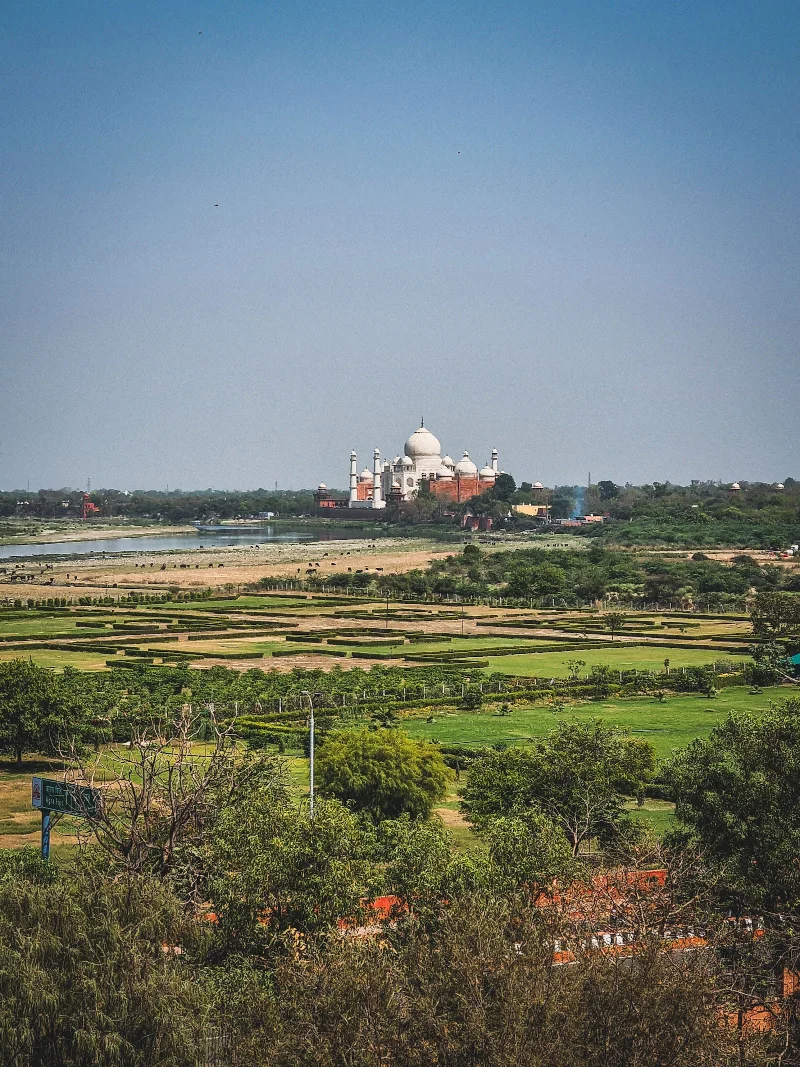
Mehtab Bagh, the Moonlight Garden, is a Mughal garden on the far bank of the Yamuna, laid out to line up exactly with the Taj opposite. It is the classic place to watch the Taj at sunset, when the marble warms from white to pink to amber and you see the whole building, gardens and river at once rather than standing inside the grounds.
The foreign-visitor ticket is about 300 rupees, roughly USD 3 or GBP 2.30, and the garden is best in the last ninety minutes of daylight. Bring a long lens if you carry one, because the river is wide. One quiet pleasure we build into an Agra day is a short rowing boat on the Yamuna towards this bank at the end of the afternoon. From the water, low and slow, with birds coming in to roost and the marble changing colour above the reeds, you see the Taj the way the court once approached it, by river, and it is the view most first-time visitors remember longest.
Is Fatehpur Sikri worth the day trip from Agra?
Yes, if you have a second morning. Fatehpur Sikri is about forty kilometres west of Agra, roughly twenty-five miles, around an hour to an hour and a half by road, so it is a half-day out rather than a quick detour. Akbar built it as his capital in the 1570s, a complete city of red sandstone palaces and a great mosque, then abandoned it within about fifteen years, most likely because the water supply failed. What remains is a UNESCO World Heritage Site and unusually complete, so you walk through intact royal apartments rather than ruins. The Buland Darwaza, the gateway to the mosque, is one of the tallest in the world. The palace-complex ticket for foreign visitors is about 610 rupees, roughly USD 6 or GBP 5, and the mosque courtyard has no entry charge.
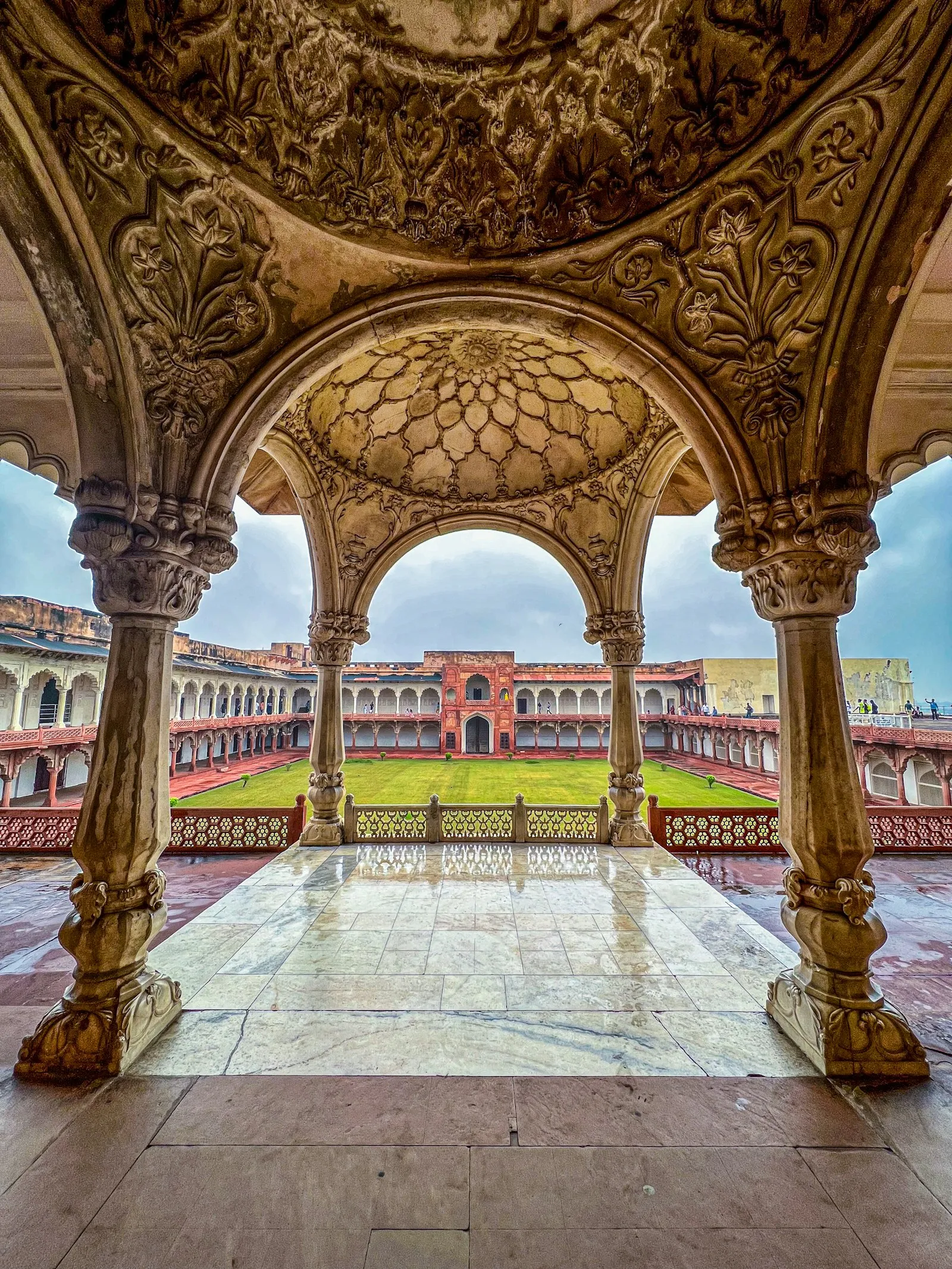
Inside Agra Fort, Akbar's red sandstone gives way to Shah Jahan's marble courts.
Where does the Taj Mahal's marble inlay actually come from?
From workshops a few streets away, where the craft has been handed down through families since the Mughal courts. The flowers set into the marble of the Taj and the Baby Taj are pietra dura, meaning hard stone: craftsmen cut tiny pieces of carnelian, lapis, malachite and mother-of-pearl, grind them to shape by hand, and set them into channels chiselled into white marble so the surface is perfectly smooth.
This is the part of Agra the half-day visitor never sees, and it is the part I send people to first. In my experience, the Taj means something different once you have watched how long a single flower takes, how many fragments of stone a petal is, how the polish is brought up by hand. We arrange a morning in the artisan homes with the makers, rather than at a showroom counter, before the Taj visit, so you arrive able to read what you are looking at. If you want to buy, you can, from a few hundred rupees for a small coaster to several lakh, meaning hundreds of thousands of rupees, for an inlaid tabletop. Be wary of the roadside "marble factories" that drivers are paid to deliver you to; the real workshops do not need to find you.
What else can you add to a day in Agra?
The monuments are the frame. These are the experiences we add most often when we plan Agra for travellers, each one a way into the city through its people rather than its queues.
Crafts of Agra: the artisan studio trail
A morning with the marble inlay, embroidery and miniature artists who keep Mughal crafts alive, in working studios rather than showrooms. It is the experience described above, and the one we place first in the day so the Taj makes more sense when you reach it.
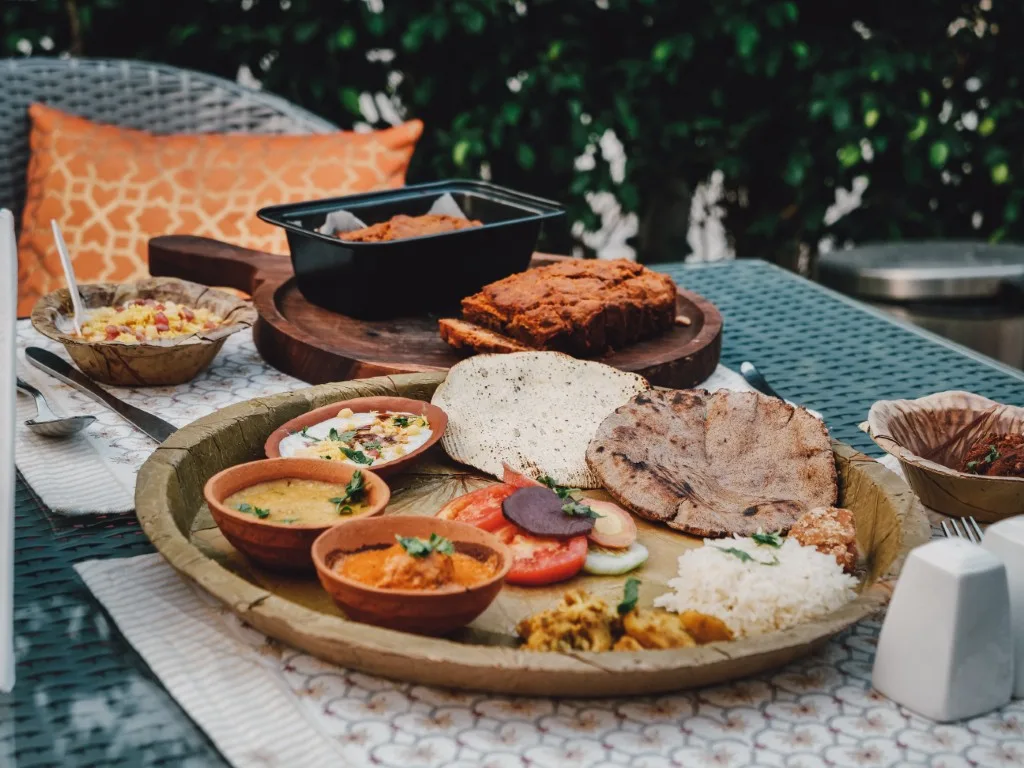
Pattal Ki Dawat: a Mughal feast on leaf plates
Pattal is a plate made from stitched leaves, and dawat means a feast. This is a traditional meal of old Agra's dishes, served the way they once were, and an easy way to taste the city's Mughal food history without guessing at restaurant menus.
Rural Agra: the Taj and the villages around it
Pair the monument with village lanes, local homes and the farming life that carries on a short drive from the Taj. For many travellers it is the part of the day they talk about most, because it shows how people actually live around one of the most visited buildings on earth.
An ittar perfume workshop
Ittar, or attar, is traditional Indian perfume distilled from flowers, spices and woods. In a small workshop you learn how the scents were made and used in markets and rituals, then blend one of your own to take home.
Yoga by the Taj Mahal
For travellers who want a slower start, a sunrise session of breathwork and yoga with the Taj in view, before the day's crowds arrive.
Cooking in a local home
Step into a family kitchen and cook recipes handed down through generations, then sit down to eat what you made. It suits anyone who would rather learn a cuisine than sample it.
You would not do all six in one day. Two of them, set around the Taj and the fort, are usually enough to turn a stop into a stay.
What do Agra's monuments cost to enter?
Agra's main sights carry separate foreign-national tickets, and children under fifteen enter free. The figures below are the published Archaeological Survey of India rates as of October 2026, converted at roughly 97 rupees to the US dollar, 128 to the pound and 108 to the euro. Check the official Taj Mahal ticketing site for the current rate before you travel, as these are revised periodically.
- Taj Mahal: about 1,100 rupees for foreign visitors, roughly USD 11, GBP 9 or EUR 10, plus an extra 200 rupees, about USD 2, if you want to go inside the main mausoleum. Closed every Friday.
- Agra Fort: about 650 rupees, roughly USD 7 or GBP 5. Open daily.
- Itimad-ud-Daulah, the Baby Taj: about 310 rupees, roughly USD 3 or GBP 2.40.
- Mehtab Bagh: about 300 rupees, roughly USD 3 or GBP 2.30.
- Fatehpur Sikri: about 610 rupees, roughly USD 6 or GBP 5.
- Akbar's Tomb, Sikandra: about 310 rupees, roughly USD 3 or GBP 2.40.
On top of entries, budget for a car and a good guide. A private car with driver for a full day around Agra runs roughly 4,000 to 8,000 rupees, about USD 41 to 83, or GBP 31 to 63, and a half-day with a licensed guide who can actually explain what you are seeing is around 2,500 to 6,000 rupees, about USD 26 to 62, or GBP 20 to 47. The guide is the line item that changes the day most.
How do you get to Agra from Delhi or Jaipur?
Most visitors reach Agra by road or by the fast train from Delhi, and both are straightforward. The choice is mainly about whether you want to stop along the way.
From Delhi, the Yamuna Expressway covers about 230 kilometres, roughly 143 miles, in around three to four hours by car. The faster option is the train: the Gatimaan Express runs from Hazrat Nizamuddin station to Agra Cantt in about one hour and forty minutes, every day except Friday, with air-conditioned Chair Car and Executive Class seating. Book it on the official Indian Railways system a few weeks ahead, as it sells out. From Jaipur it is road only, about 240 kilometres, roughly 150 miles, and four to five hours, and many itineraries break the drive at Fatehpur Sikri. Agra is the hinge of the classic circuit, so if you are joining the dots, our two-week North India itinerary shows how it fits with Delhi, Jaipur and Varanasi.
A word on the common one-day coach trip from Delhi: it can be done, but it is a very long drive for a couple of rushed hours at the Taj, and it is why so many people feel they only glimpsed Agra. If you can, sleep a night.
How do you get around Agra once you are there?
Within Agra you will mostly use an auto-rickshaw, the small three-wheeled open taxi known locally as an auto, or a pre-booked car for the day; app-based cabs work here too.
Distances between the main sights are short, so a car with a driver who waits while you are inside each monument is the least stressful way to string a day together, especially in the heat. If you prefer autos, agree the fare before you get in, and know that a short hop across town should cost well under a couple of pounds. Electric and battery vehicles are used for the final approach to the Taj, because fuel traffic is kept away to protect the marble, so expect a short shuttle or walk at that end.
When is the best time of year to visit Agra?
October to March is the window. The weather is dry and the days are warm rather than punishing, which matters when you are walking on stone and standing in open courtyards.
- October to March: the comfortable season, with cool mornings ideal for a sunrise Taj visit. December and January can be cold at dawn and prone to morning fog, which occasionally delays the sunrise view, so build in a little flexibility.
- April to June: very hot on the plains, frequently 40 degrees Celsius and above, roughly 104 Fahrenheit, which makes a full day of monuments hard work. Start at first light and rest at midday if you travel then.
- July to September: the monsoon brings rain and humidity but also fewer crowds and a greener setting, and the Yamuna runs high behind the Taj.
Whenever you come, the monuments are at their best early and late. The middle of the day is for lunch and shade.
Can you see the Taj Mahal at night?
Yes, on a limited basis, and it is special if your dates line up. The Archaeological Survey of India opens the Taj for night viewing on five nights each month, the full moon and the two nights either side, closed on Fridays and during the month of Ramzan.
Viewing runs between eight and midnight in timed half-hour batches, watched from a platform rather than from up at the mausoleum. The foreign-visitor ticket is about 750 rupees, roughly USD 8 or GBP 6, bought in advance through the official ASI night-viewing page, and you report to the Shilpgram complex near the eastern gate with your passport before your slot. It is not the close-up daytime experience, but on the right night of the lunar month it is worth staying up for.
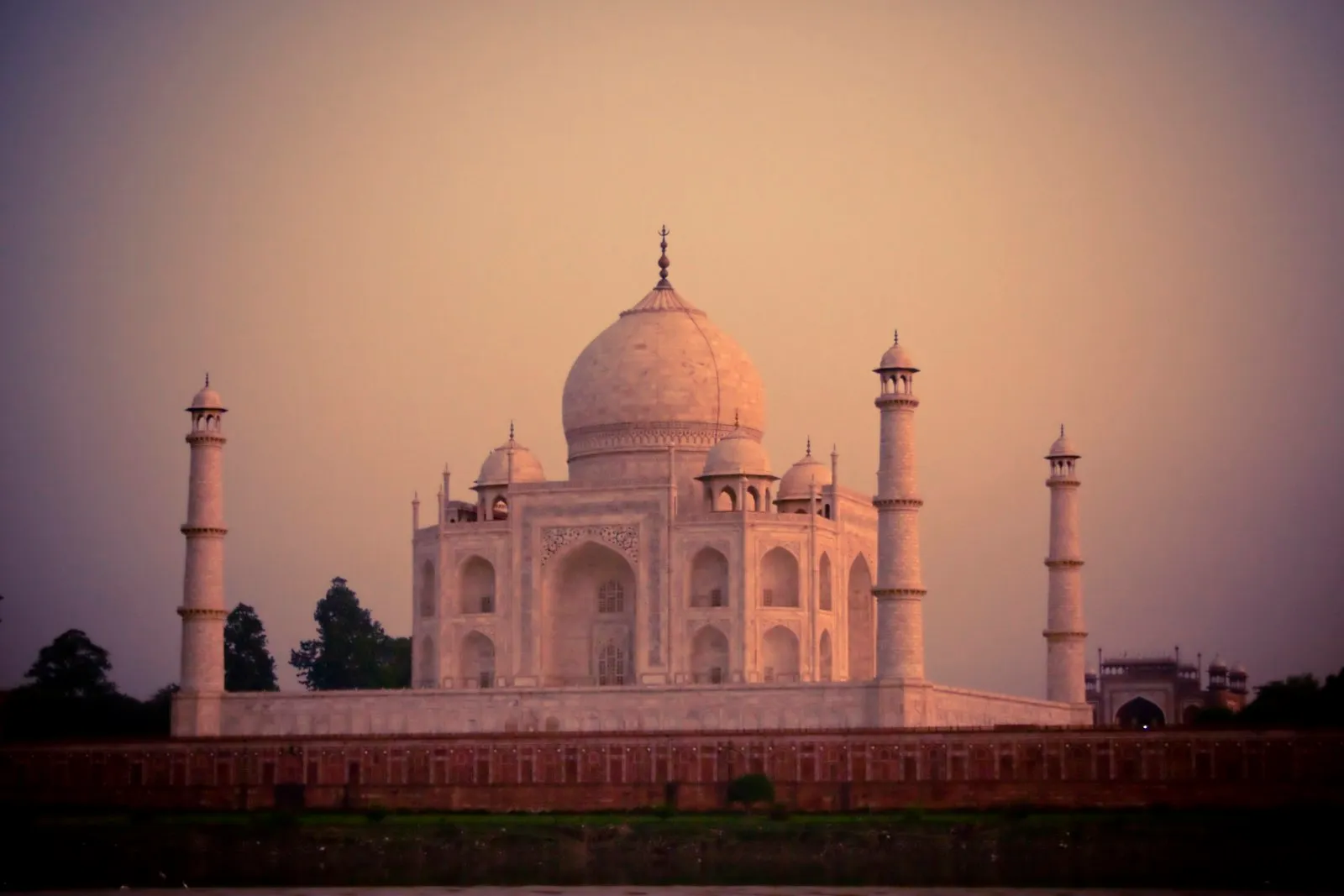
The Taj from the river side, the view Mehtab Bagh was laid out to frame.
How should you dress and behave at Agra's monuments?
Dress modestly and practically: shoulders and knees covered, loose cotton or linen in the heat, and shoes you can slip on and off easily, because you will remove them before entering the main mausoleum of the Taj and before any mosque. Socks are worth carrying for hot marble.
A few points save friction. Photography is restricted or forbidden inside the main mausoleum and some sanctums, so watch for the signs, and always ask before photographing a person, especially someone at prayer. Tripods and large bags are generally not allowed in, and there is airport-style security at the gates, so travel light. The same respect applies at Agra's living temples and mosques as anywhere in India, and our guide to visiting Indian temples covers the detail. At Fatehpur Sikri's mosque, cover your head if asked and give a donation only if you choose to.
Is Agra safe, and how do you handle the touts?
Agra is a mainstream, well-policed tourist city and is not covered by any "do not travel" advisory. As of 2026, the US State Department and the UK Foreign Office reserve their strongest warnings for Jammu and Kashmir, the India-Pakistan border, Manipur and certain Maoist-affected districts of central and eastern India. Uttar Pradesh, the state Agra sits in, is not on those lists. Both advise increased caution across India, so read your own country's current advice before you travel.
The real nuisance in Agra is commercial, not criminal: persistent touts, drivers steering you to commission shops, "guides" who attach themselves at the gates, and the overcharging any famous monument attracts. Use a pre-booked driver and a licensed guide so you are never dependent on whoever approaches you, buy tickets only from official counters or the official website, and decline uninvited help politely. Solo women travellers find Agra manageable with the usual sensible precautions, and a trusted driver and guide make a real difference to how relaxed the day feels.
Is there a kinder half-day near Agra?
If the monuments start to blur, or you are travelling with children, there is a gentler way to spend a morning near Agra: an elephant and sloth bear rescue centre out towards Mathura, about thirty kilometres from the city, roughly nineteen miles, around forty-five minutes to an hour by road.
It cares for elephants and bears rescued from street begging, circuses and the old "dancing bear" trade, and visitors see the animals looked after and fed rather than ridden or made to perform. For families, and for anyone uneasy about how animals are sometimes used in tourism, it is a quiet, hopeful counterweight to a run of forts and tombs. Visits are by arrangement in set time slots, so it has to be planned into the day.
What do first-time visitors get wrong in Agra?
The errors are nearly always about pace and planning, not the sights.
- Giving Agra only half a day. You arrive tired, see the Taj in the crowds and leave before the fort or a single tomb.
- Standing at the Taj at midday. It is hottest and busiest then. Go at opening, and keep the middle of the day for shade.
- Skipping Agra Fort. Many visitors never go in. It is a UNESCO site, grander inside than most expect, with the best Taj view in the city.
- Visiting on a Friday without checking. The Taj Mahal is closed every Friday, and so is its night viewing.
- Following a driver into a "marble factory". These are commission showrooms. The real workshops are found through a guide, not a tout.
- Treating the Taj as the whole of Agra. It is one astonishing building in a city full of them.
Who is a beyond-the-Taj day in Agra best for?
This fuller way of seeing Agra suits anyone whose interest runs to history, architecture and craft rather than a single photograph: couples, solo travellers, older visitors who would rather walk one fort well than tick off six things, and families, who do well with the fort, a boat and the animal rescue centre spread across a day.
It is less suited to a tight one-day loop from Delhi, where there is only time for the Taj itself, although even then the fort can be added if you start early. Come this far and Agra will reward every extra hour you give it.
Frequently asked questions
Is one day enough for Agra?
One full day lets you see the Taj at sunrise plus Agra Fort and one or two tombs at a sensible pace. It is a night in Agra that makes this possible, rather than a day-trip from Delhi. To add Fatehpur Sikri, allow a second morning.
What is there to do in Agra apart from the Taj Mahal?
Agra Fort, a UNESCO-listed citadel; Itimad-ud-Daulah, the marble "Baby Taj" that predates the Taj; Mehtab Bagh, the river garden opposite the Taj; Fatehpur Sikri, Akbar's abandoned capital nearby; Akbar's Tomb at Sikandra; and the pietra dura marble workshops where the inlay craft is still practised.
How much does it cost to visit the Taj Mahal and Agra Fort?
As of October 2026, the Taj Mahal is about 1,100 rupees for foreign visitors, roughly USD 11 or GBP 9, plus 200 rupees for the main mausoleum. Agra Fort is about 650 rupees, roughly USD 7 or GBP 5. Children under fifteen are free. Check the official ticketing site for current rates.
Which day is the Taj Mahal closed?
The Taj Mahal is closed to visitors every Friday, including for its night viewing. The other Agra monuments, including Agra Fort, stay open seven days a week, so a Friday in Agra is best spent on the fort, the Baby Taj and Fatehpur Sikri.
How do you get from Delhi to Agra?
By car in three to four hours on the Yamuna Expressway, around 230 kilometres or 143 miles, or by the Gatimaan Express from Delhi to Agra Cantt in about one hour and forty minutes, daily except Friday. Book the train ahead through the official Indian Railways system.
Can you see the Taj Mahal at night?
Yes, on the five nights around each full moon, excluding Fridays and the month of Ramzan. Tickets, about 750 rupees for foreign visitors, are bought in advance from the official Archaeological Survey of India site, and viewing is from a platform in timed evening batches.
Planning a fuller day in Agra
The Taj Mahal is worth every superlative. Agra is worth more than the hour most people give it. A fort at opening time, a boat on the Yamuna at dusk, a morning with the people who still cut the marble by hand: that is the Agra the half-day visitor drives straight past.
We design private, unhurried India journeys that give places like Agra the time they deserve, built around your own dates, pace and interests. If you would like a day in Agra shaped around the real city, Plan my India trip.